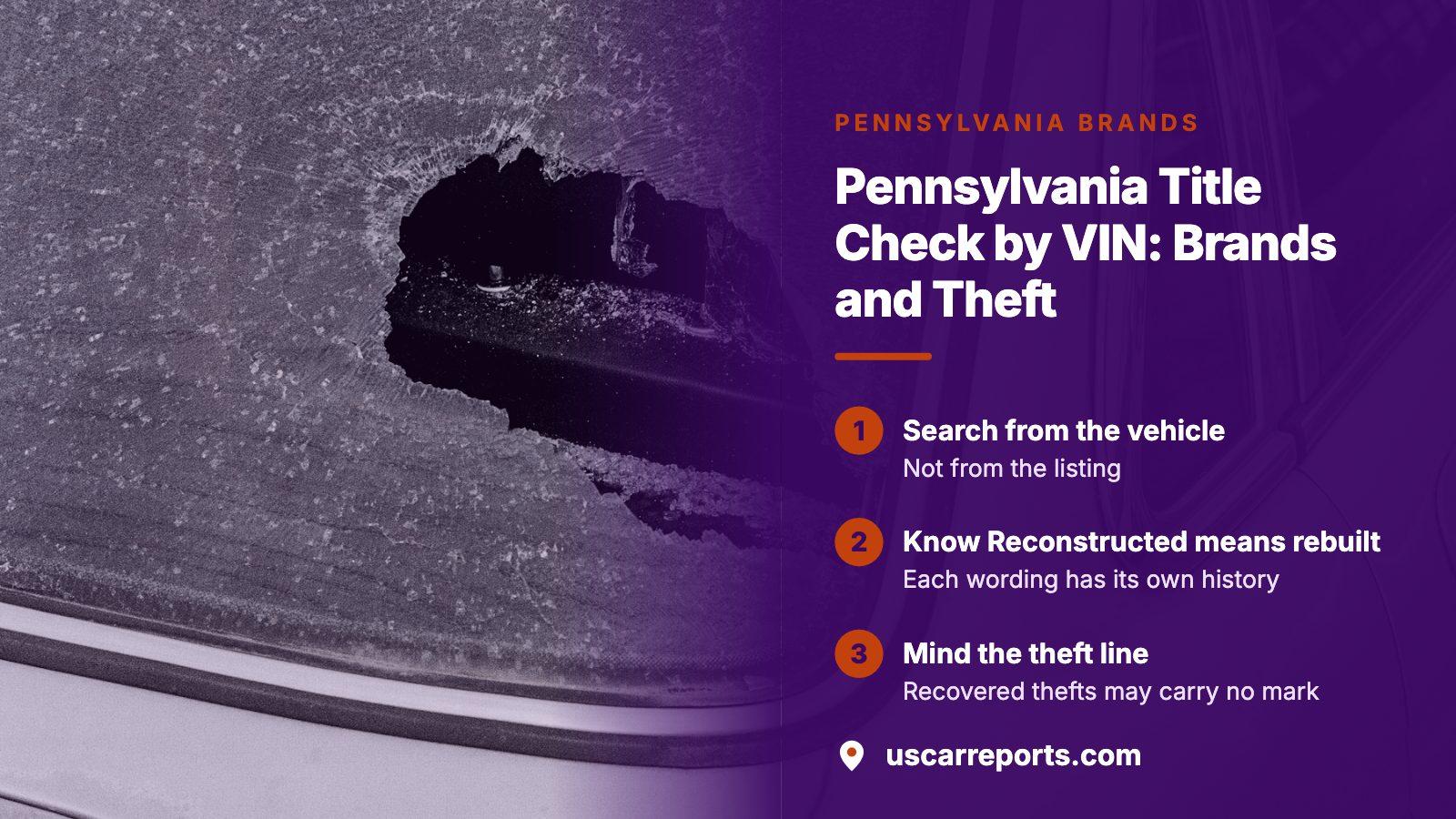
THE SHORT ANSWER
To run a Pennsylvania title search, type the 17-character VIN into USCarReports and read the free preview. When year, make and model match the listing, buy the report and look for brands, total-loss and salvage entries, theft records, mileage dates and liens, then hold it against the Pennsylvania title. A reconstructed or flood brand calls for repair and inspection papers, and a plain title can still sit on a recovered theft.
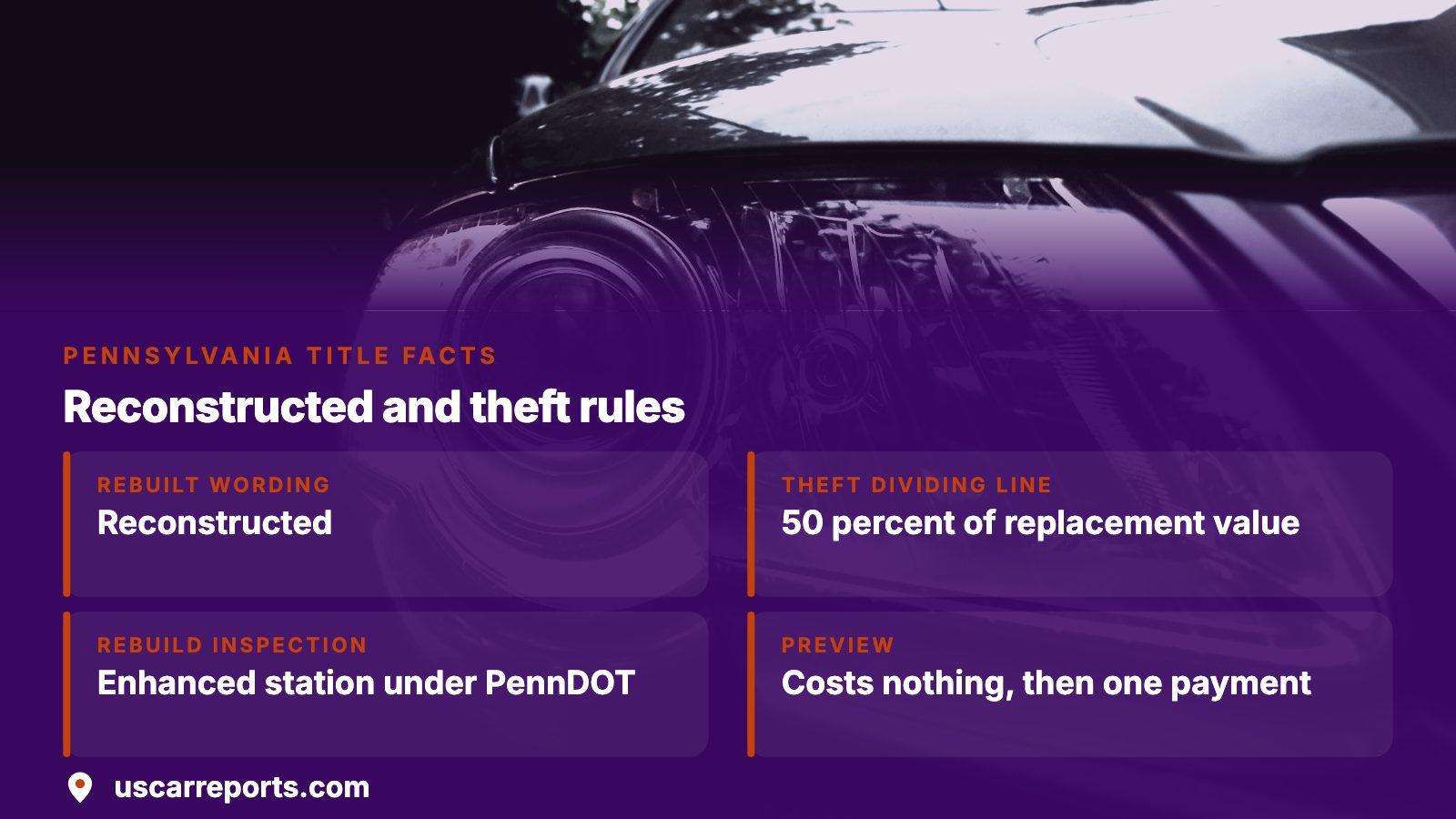
- Rebuilt wording
- Reconstructed
- Theft dividing line
- 50 percent of replacement value
- Rebuild inspection
- Enhanced station under PennDOT contract
- Preview
- Free, then one payment per report
What a title check adds to the Pennsylvania paper
A Pennsylvania title records what the state knew on the day it was printed. A VIN search reaches further, since brands and total-loss entries follow the number from state to state.
| Record in the report | What it settles on a Pennsylvania car |
|---|---|
| Brand entries from any state | Salvage or flood wording applied before Pennsylvania. |
| Salvage and auction entries with photos | The damage as it looked before repair. |
| Theft and insurance entries | A loss the Pennsylvania document never mentions. |
| Odometer readings by date | Mileage that climbs steadily, or stalls and then drops. |
| Liens and impounds | A lender or impound yard with a claim still on file. |
It is a records search. Rust, weld quality and worn parts stay invisible to it.
Running the search from the vehicle, not the listing
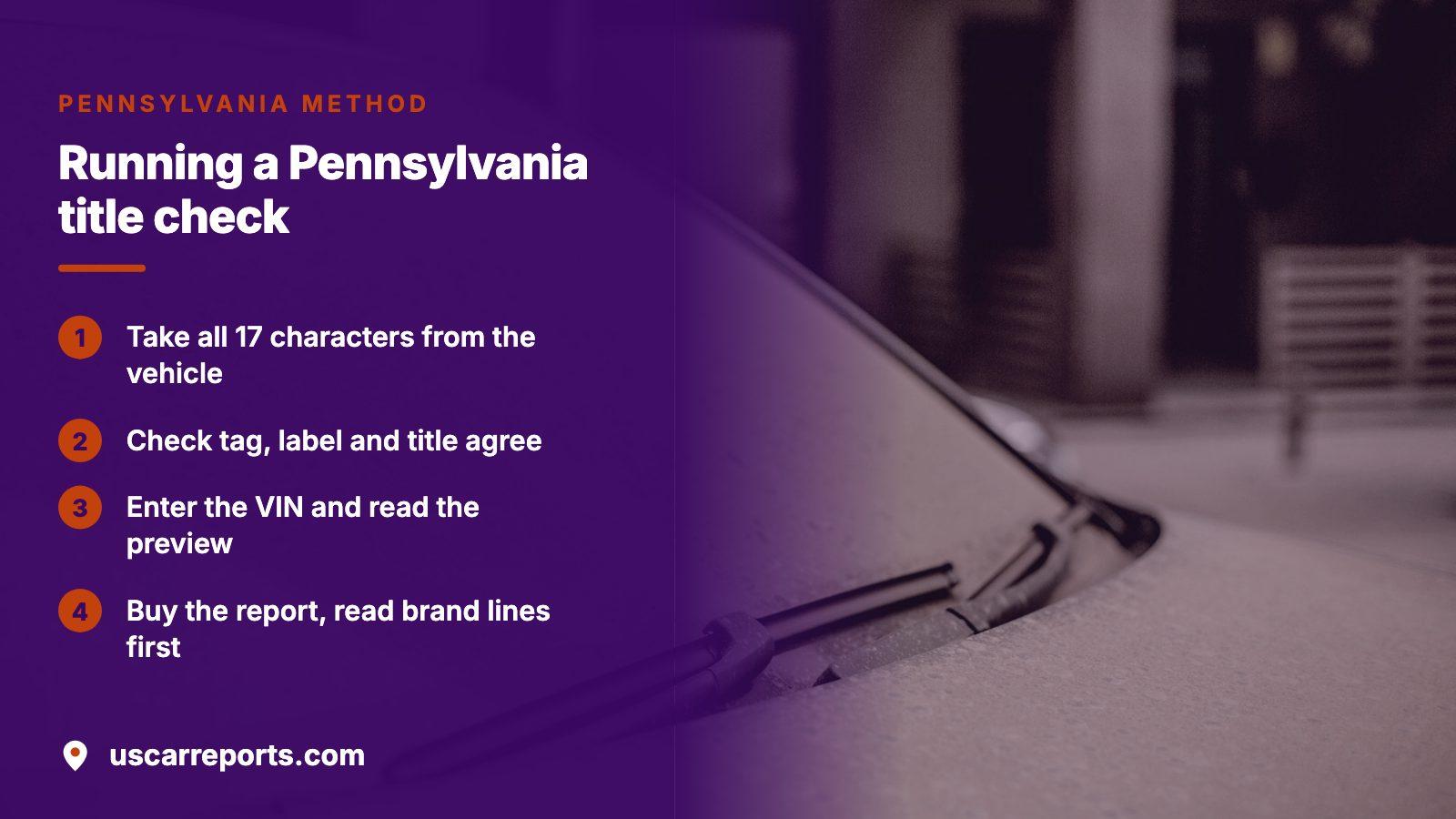
- Take all 17 characters from the vehicle: the metal tag on the dashboard near the driver, readable from outside the windshield, and the label on the door pillar. A number lifted from a listing proves nothing.
- Check that the tag, the label and the title agree. A difference ends the deal.
- Enter the VIN on USCarReports. The preview's year, make and model should fit the car in front of you.
- Buy the report when they fit, and read the brand lines first.
- Set the report beside the seller's title. Brand wording, owner and lender should tell one story.
A used car from a non-resident, or one titled elsewhere before, also needs its VIN traced from the plate, or verified by a certified inspection mechanic, when the title application is filed.
Pennsylvania's brand wordings and the history behind each
Pennsylvania prints the history in words, not one catch-all label.
| Wording | What happened | How to read it |
|---|---|---|
| Certificate of salvage | A salvage-level loss; the certificate went to its holder. | Not a title. No retitling or registration until the rebuild application is filed. |
| Reconstructed | A salvage car was restored and passed the enhanced inspection. | Ask for repair bills, photos and the station's name. |
| Nonrepairable | A salvage dealer marked the car as never to be rebuilt. | No title or certificate will follow. A running car on this paper is a contradiction. |
| Recovered theft vehicle | Stolen, found, repairs above 50 percent of replacement value, owner kept it. | The theft stays on the paper. Ask what was replaced. |
| Reconstructed recovered theft vehicle | Stolen, found, repairs above replacement value, then rebuilt and inspected. | Theft plus a rebuild. Ask for the full file. |
| Flood vehicle, or reconstructed and flood vehicle | A water loss; the longer wording applies when repairs would pass replacement value. | Water damage is on record. Have the electrics and underbody inspected. |
Recovered theft: four outcomes, one of them unmarked
Once an insurer pays on a stolen car, a theft-branded salvage certificate is requested. If the car is found, an insurer or licensed physical damage appraiser assesses it, naming the replacement value and the damage in dollars. An insurer that insures itself must use an appraiser who does not work for it. Repair cost then sorts the outcome:
- Repairs above replacement value: the certificate serves as the ownership paper, and a rebuilt, inspected car is titled reconstructed recovered theft vehicle.
- Repairs above 50 percent, owner keeps the car: titled recovered theft vehicle.
- Repairs at or below 50 percent, insurer already paid: the owner can request an unbranded title after an appraiser inspects the car.
- A private owner the insurer never paid, with no salvage certificate issued, keeps using the original title.
A stolen car can carry a plain title
The third outcome means a car that was stolen and then repaired for half its replacement value or less can be retitled with no mark at all. If the theft was reported, a history report is where it shows.
Flood cars carry their own brands too
After a water-loss payout, a flood-branded salvage certificate is requested. Where repairs would exceed replacement value, the salvage certificate stands as proof of ownership until the car passes the rebuild inspection, and the title then reads reconstructed and flood vehicle. Where they would not, the owner requests a title branded flood vehicle, backed by an appraisal report. Either way the word flood stays on the paper, and flood vehicles also go through an enhanced station before titling. A listing that never mentions water needs an explanation before any deposit.
What the rebuild inspection checks, and what it leaves to you
A reconstructed car must be restored to the maker's design, airbags, belts and emissions parts included, then pass at a PennDOT-contracted enhanced station. Since January 1, 2007 only those stations may do this work. The inspector then photographs the car and checks the owner's papers. On a recovered theft car, the owner cannot act as the inspecting mechanic.
The Vehicle Code's findings give the purpose: a title is how a stolen car becomes marketable. A federal committee urged a two-part inspection, first matching the VIN and replacement parts to titles, bills of sale and the owner's statement, then a uniform safety test. Identity matters as much as welds. Once titled, the car takes later periodic inspections at any station.
Ask for the file
A seller who rebuilt a theft recovery should hold the appraisal report, photos and parts receipts, with donor-car VINs written on them. Ask which enhanced station inspected it.
Where the Pennsylvania record ends and the national one begins
A branded title or salvage certificate from another state, or a replacement VIN, sends the application to PennDOT itself, and State Police review can slow it. PennDOT says it can check titles electronically against national data covering about 81 percent of US vehicles, and holds back any whose results raise questions.
That national database keeps five indicators: where the car was last titled, plus brand, odometer, total-loss and salvage history. Repairs, recalls and maintenance fall outside it. States, insurers and salvage operations report to it, so another state's brand can still reach you.
Red flags in a Pennsylvania result
| The record shows | Why it matters here | What to do |
|---|---|---|
| A reconstructed or flood brand with no repair file | The inspection happened, but the seller cannot show the work. | Ask for bills, photos and the station's name. |
| A theft entry above a plain Pennsylvania title | The unbranded path exists, so the title settles nothing. | Request the appraiser's report and have a shop check the structure. |
| A nonrepairable entry on a car that runs | That designation rules out any title. | Walk away. |
| A salvage certificate with a blank buyer line | Assigning one in blank is barred, so the ownership chain is broken. | Hold payment until corrected. |
| Mileage that drops between dates | A lower reading after a higher one needs an explanation. | Ask for service records. |
Paying for the report, then finishing the purchase
The preview costs nothing and shows whether the record fits the car. A report is bought once, and bundles of 3, 5 or 10 serve a wider search. Nothing renews, and the pricing page lists amounts.
- Open the preview with the VIN from the car.
- Buy the report when it fits the listing, and read brands first.
- If reconstructed, theft or flood wording appears, get the station name, repair bills and appraisal report before discussing price.
- Pay a mechanic to examine structure and underbody; the Justice Department's NMVTIS page strongly encourages an independent inspection.
- Close before an authorized PennDOT agent: the title counts as transferred once both parties' sections are signed and notarized.
Where this information comes from
- Pennsylvania General Assembly: Vehicle Code, Title 75, Chapter 11 — Salvage certificates, nonrepairable cars, the theft and flood outcomes, the 50 percent line and the reason for the rebuild inspection.
- PennDOT: reconstructed vehicle titling procedure — Restoration standard, the enhanced inspection, accepted ownership papers and which applications go to PennDOT.
- PennDOT: recovered theft vehicle procedure — Who assesses the damage, the four outcomes, and the photos and parts receipts a theft title needs.
- PennDOT: enhanced vehicle safety inspections — Which vehicle types need the special inspection and that only contracted stations may perform it.
- PennDOT: NMVTIS — How PennDOT screens titles against the national database and its advice to check before buying.
- US Department of Justice: understanding an NMVTIS vehicle history report — The five indicators the national database holds, who reports to it and what it leaves out.
- PennDOT: buying or selling your vehicle in Pennsylvania — Agent-witnessed transfers, notarized sections and the VIN tracing rule for out-of-state cars.
Sources and photos: Facts checked against the sources above in November 2026. Photos by Kenan Reed, JavyGo and Alexandru Goman on Unsplash; diagrams by USCarReports.
Keep reading
- Pennsylvania VIN check: history report first, notary visit secondSticker months, notary closings and what a Pennsylvania VIN search finds on a used car.
- Title status check: what the state lookup tells a car buyerWhat a state title lookup returns, and what it leaves out.
- Registering a car in another state: deadlines, title and checksWhat a new state checks before it titles a car that arrives with a brand.
- New Jersey Title Check by VIN: Salvage Rules and the Rebuild InspectionA neighbor that folds theft into its salvage rules, for comparison.
Frequently asked questions
How do I run a Pennsylvania title check by VIN?
Enter the VIN on USCarReports, confirm the preview matches the car, then buy the report and compare its brands with the wording on the seller's Pennsylvania title. Read the number off the vehicle, not the advert.
Is there a free Pennsylvania title search?
Partly. The USCarReports preview costs nothing, but a full title history is a paid report. PennDOT's NMVTIS page urges buyers to check first and points to vehiclehistory.gov.
What does reconstructed mean on a Pennsylvania title?
A car that held a certificate of salvage, was restored to operating condition and passed an enhanced inspection before being titled again. The term does not apply to antiques and classics.
Can a stolen Pennsylvania car have a clean title?
Yes, in one case. If the insurer paid, the car was recovered and repairs were 50 percent of replacement value or less, the owner can request an unbranded title. A theft or insurance record may be the only trace.
Do I need an enhanced station inspection after buying a reconstructed car?
Not once it is titled as reconstructed. PennDOT requires the enhanced station only for the first titling. After that, ordinary periodic inspections, plus emissions checks where an area requires them, can be done anywhere.
Now check the car itself
The guide explains what to look for. The report shows what this VIN has on record.