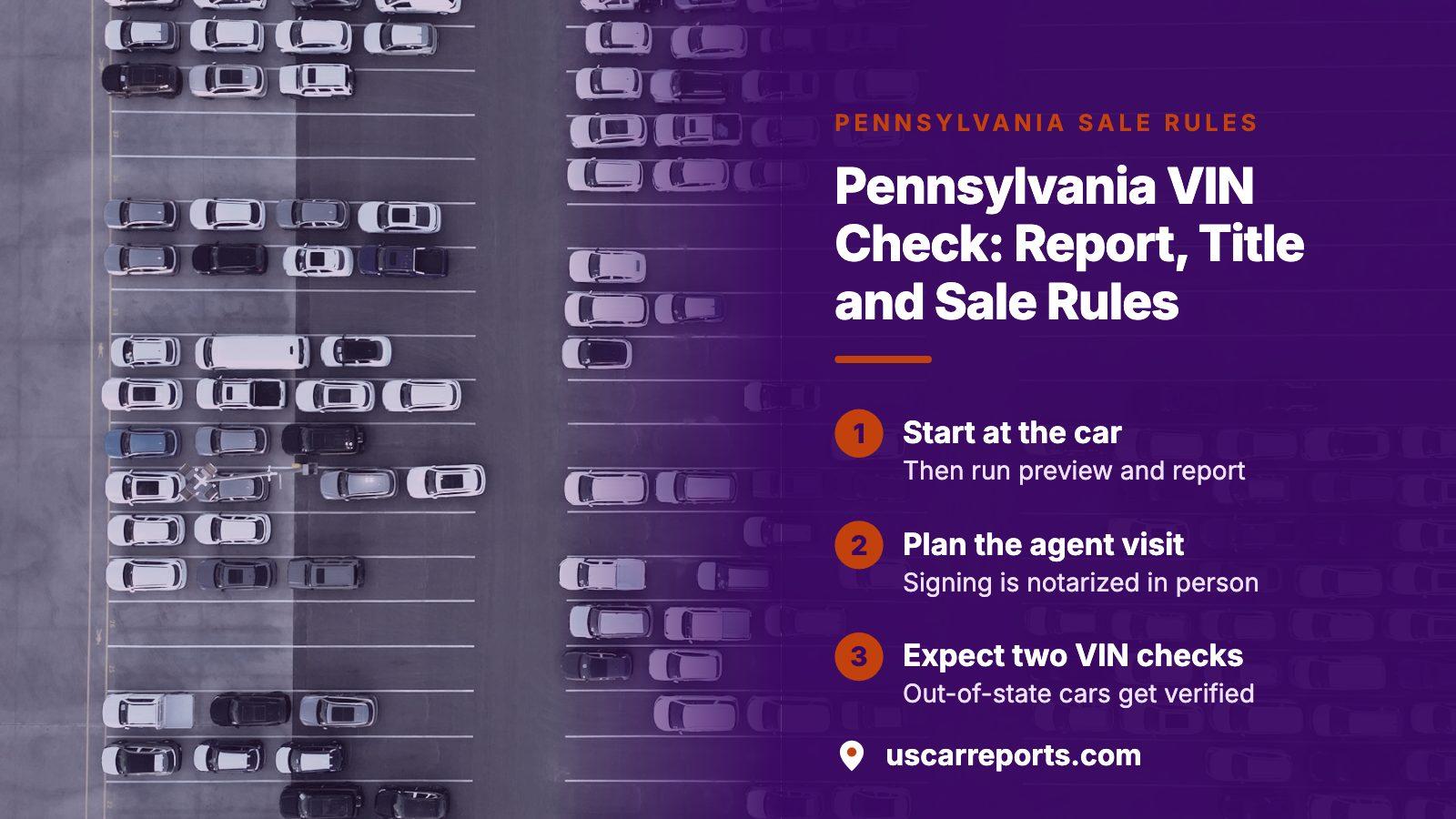
THE SHORT ANSWER
Type the VIN to see a free preview. If the car passes the preview, buy the full report: title brands from any state, accident and salvage records, odometer readings, liens and theft flags. Read it beside the paper title and the sticker month. In Pennsylvania the sale itself should close at an authorized agent, where the seller signs before a notary.
- Title transfer
- Signed and notarized at an authorized PennDOT agent
- Filing
- Title paperwork due within 20 days of the notarization
- Out-of-state cars
- The VIN gets verified, usually by a pencil tracing
- Plates
- The seller removes them; they never go to the buyer
What a Pennsylvania VIN lookup finds on a used car
A Pennsylvania VIN search reads the records tied to those 17 characters, and the records do not stop at the state line. Cars move between states, so the search pulls title data from every reporting state. The report covers:
- Title brands and the state that applied them, such as salvage, flood or junk.
- Accident records and damage reports, along with salvage and auction listings whose sale photos you can hold against the panels in person.
- Odometer readings from different dates, which show whether the mileage climbs in a straight line.
- Liens, impounds, theft records and insurance claims, any of which can mean the seller cannot hand over clean ownership.
- Open safety recalls and the factory specifications for that exact VIN.
It is a records search. It does not look up a license plate or see rust, and a worn brake pedal is invisible to it. Those jobs stay with you and your mechanic.
Start the search from the car itself
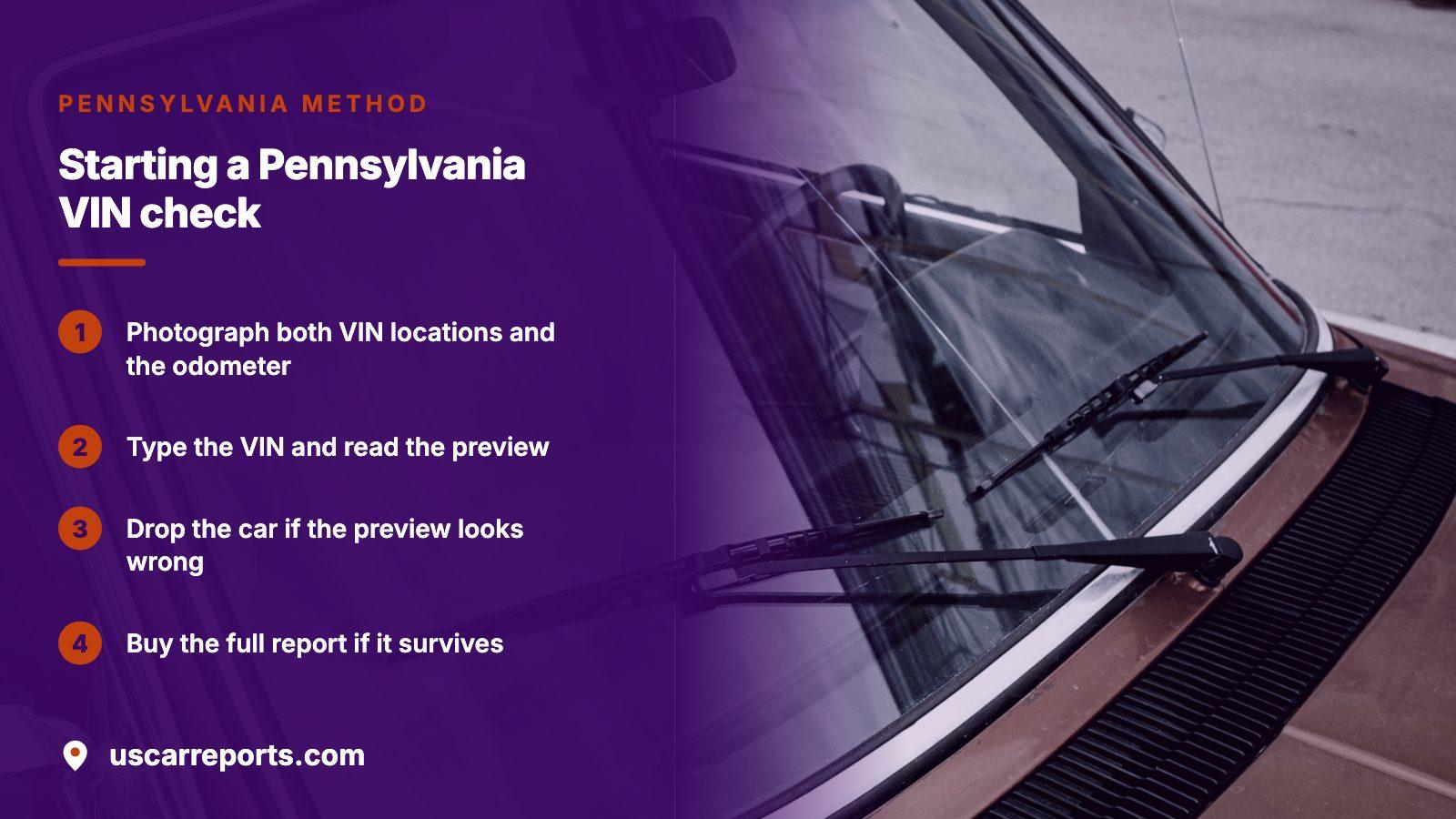
The VIN sits in two places on the car: a small plate at the far-left corner of the dashboard, and a label along the edge of the driver door. Either one should match the title character for character. Position ten encodes the model year, so it should fit the year in the ad. A mismatch on the car itself ends the deal before you spend anything.
- Photograph both VIN locations and the odometer.
- Type the VIN into the box on this page and read the free preview.
- Drop the car if the preview already looks wrong. If it survives, buy the full report before you arrange a meeting.
How a Pennsylvania private sale closes: the agent visit
PennDOT's advice is that both parties go together to a notary, a tag service or a dealer that PennDOT has authorized as an agent. The title application forms come only from those agents, so a handshake in a parking lot cannot finish the job.
| Step | What Pennsylvania expects |
|---|---|
| The seller's part | On a car already titled here, the seller fills in the buyer's details, signs, prints a name and states the mileage while the agent watches. The buyer then signs and prints too. |
| When it counts | The title is transferred once the seller's section and the buyer's section are both signed and notarized. |
| What the buyer brings | A Pennsylvania license or photo ID and a current insurance card. Call the insurer within 14 days to cover the new car. |
| The deadline | PennDOT's FAQ puts the filing at 20 days from the notarization. The agent sends the application straight to PennDOT. |
| Plates | The seller takes the plate off after the transfer and may keep it for another car. It should never go to the buyer. With no plate to move, an agent can issue a temporary registration. |
A car from another state gets its VIN checked twice
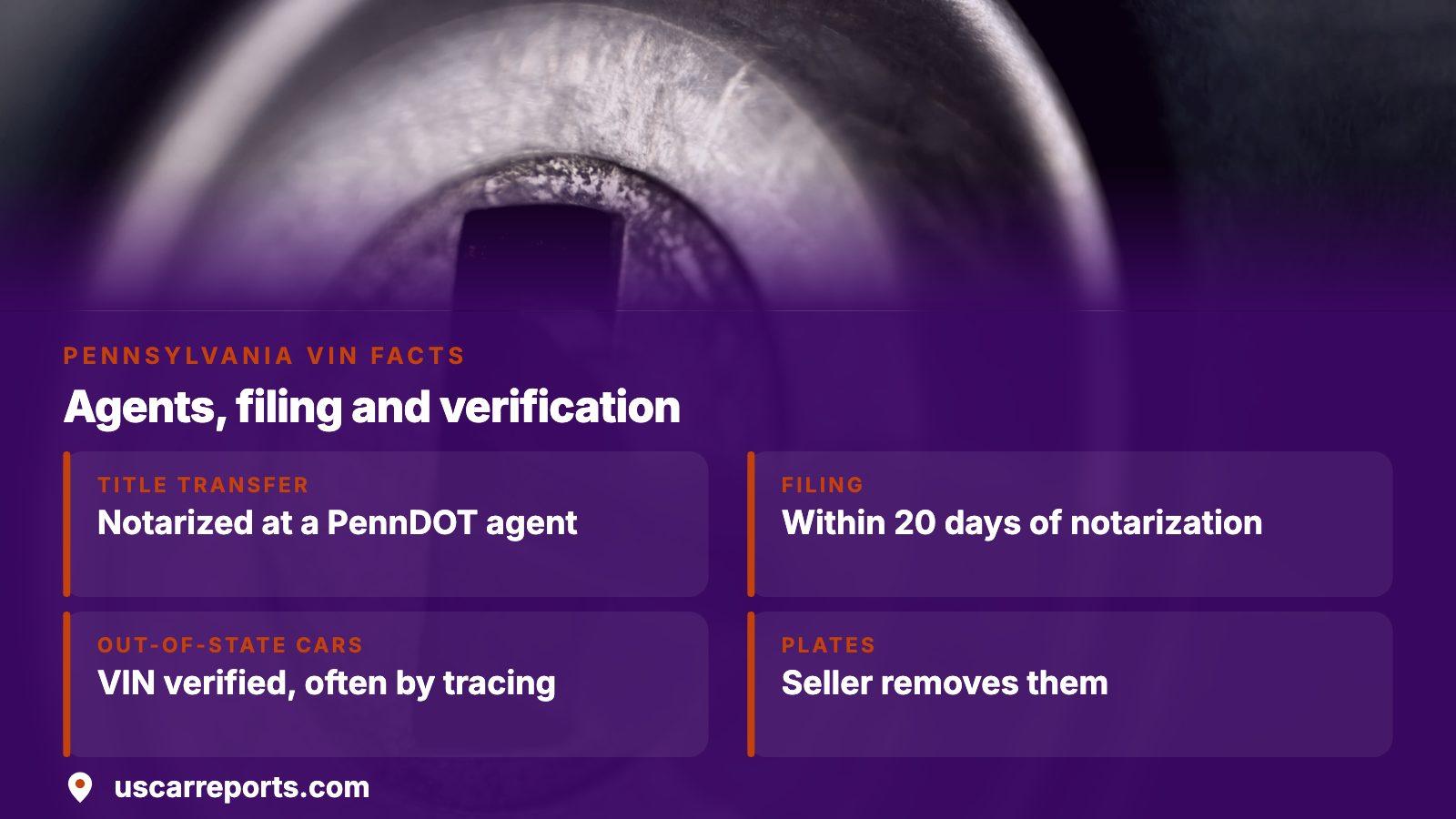
A Pennsylvania resident who buys a used car from a non-resident, out-of-state dealers included, or who brings in a car previously titled in another state, must include a verified VIN with the application. Most buyers do this with a pencil tracing of the embossed VIN plate. When a clean tracing is out of reach, a certified inspection mechanic may inspect the plate instead, and so may a notary who works for a dealer, a manufacturer or a full agent. A photo counts only if the mechanic compares it with the real plate, then signs and dates it.
Two checks, two jobs
The tracing ties the paperwork to the metal on the car. The report ties that VIN to everything before you met the seller. Run it first, since a brand from a distant state is cheaper to find before a deposit.
Read both sides of an out-of-state title. It should have a space for the seller's signature and one for the odometer reading, and some states require a notarized signature.
Reading the report beside the paper title
Lay the report next to the title; they should tell one story. These findings call for action:
| The report shows | What it can mean | What to do |
|---|---|---|
| A salvage brand | Under Pennsylvania's definition, the repair bill would top the vehicle's value once fixed. | Price it as a damaged car, or walk away. |
| A reconstructed brand | A salvaged car was restored and passed an enhanced inspection before it could be titled again. | Ask for repair records and get a mechanic's second opinion. |
| A flood brand | Water reached the car, and electrical trouble can appear late. | Check carpet, trunk and seat tracks for silt or mildew, or pass. |
| Mileage that falls or stalls | A rollback or a swapped instrument cluster. | Compare the report with the figure the seller writes on the title. |
| A lien with no release | If a lender holds the title electronically, a paper title is needed before the seller can transfer it. | Wait for the paper title and a written release. |
| A theft or impound record | The car may be reported stolen. | Stop and call the police or the insurer. |
PennDOT lists junk, salvage and flood among the brands the national title database carries. Brands travel with the VIN, so a Pennsylvania plate on the car proves nothing.
What the windshield sticker adds, and what it leaves out
Safety inspections happen at official PennDOT inspection stations, usually repair garages. Most passenger cars get a sticker valid for one year from the month of inspection. The check covers suspension, steering, brakes, tires and wheels, lights, glass, mirrors, fuel system, exhaust and body. Emissions testing is organized by region, so ask what applies in the county where you will register the car.
Compare the sticker month with the listing date
A car that needs work to pass again can be worth more sold than repaired. If the sticker runs out within weeks of the ad, ask what the next inspection will need, and have a garage look at brake lines, joints, exhaust and tires.
A sticker is a snapshot of one day on one checklist. It says nothing about title, liens or earlier damage, and a reconstructed car gets the same periodic inspections once it is titled.
What Pennsylvania winters do to the underbody
Roads here are salted, and freeze and thaw cycles keep moisture working into seams. Rust starts where you cannot see it: frame rails, brake and fuel lines, subframes and rocker panels. Put the car on a lift, and treat fresh undercoating as a question. Ask for the last inspection results too, since a garage that flagged the brake lines last year has priced this year's repair. A report cannot show any of this, which is why the lift matters more than the screen.
Cost, and the order to work in
The preview costs nothing and shows what the record holds. A single payment buys one full report, and packs of 3, 5 and 10 reports exist for longer shortlists. No subscription renews. For current prices, open the pricing page.
- Start with the VIN on the car and open the preview.
- Check open recalls with NHTSA and theft and salvage records with NICB's VINCheck. Both cost nothing.
- Buy the report for brands, mileage history and liens.
- Have a garage inspect the brakes and underbody, and ask for the last inspection results.
- Meet the seller at a notary, tag service or dealer agent. Sign nothing beforehand.
- Bring ID and insurance, then file the title paperwork within 20 days.
Where this information comes from
- PennDOT fact sheet: Buying or selling your vehicle — Covers the agent visit, signatures, VIN tracing, plate removal, insurance proof and liens held electronically.
- PennDOT: Motor vehicle miscellaneous FAQs — Source for the buyer's 20-day filing window after notarization.
- PennDOT fact sheet: Reconstructed vehicle titling — Defines salvage and reconstructed vehicles and the enhanced inspection.
- PennDOT: Safety inspection FAQs for consumers — Sticker validity and the list of items inspected.
- PennDOT: NMVTIS — Explains the national title database and the junk, salvage and flood brands.
- NICB VINCheck — A no-cost theft and salvage search fed by participating insurers.
- NHTSA: Recalls — A no-cost lookup of open safety recalls by VIN.
Sources and photos: Facts checked against the sources above in November 2026. Photos by Iain, Max Tokarev and Derek Nelson on Unsplash; diagrams by USCarReports.
Keep reading
- Pennsylvania Title Check by VIN: Brands, Theft and Flood RulesSalvage, reconstructed and recovered-theft titles in Pennsylvania, in more depth.
- Ohio VIN check: records to pull, title brands and Ohio buying rulesThe western neighbor, with its own title and salvage rules for cars crossing the line.
- New Jersey VIN check: flood history, title brands and the buying rulesHow inspection and transfer rules change across the Delaware River.
- Sample reportSee what a finished report looks like before you buy.
Frequently asked questions
How do I run a Pennsylvania VIN check?
Read the VIN off the car, type it into the box on this page for the preview, and buy the full report if the car survives. Then compare it with the paper title, look up recalls and theft records with NHTSA and NICB, and meet the seller at an authorized agent.
Is there a free Pennsylvania VIN lookup?
Partly. The preview on this page is free, and NHTSA's recall tool and NICB's VINCheck cost nothing. The full report is one payment. None of these replaces the paper title or a mechanic.
Does a Pennsylvania title have to be notarized?
On a car titled in Pennsylvania, the seller signs in front of an authorized agent, and the title counts as transferred once the seller's and buyer's sections are signed and notarized. Some out-of-state titles need it too.
Does a car from another state need VIN verification?
Yes, when a Pennsylvania resident buys it from a non-resident or brings in a car titled elsewhere. The VIN plate is traced with pencil and paper, or a certified inspection mechanic or dealership notary verifies it.
Can I look up a Pennsylvania license plate to find the owner?
No. Federal law, the Driver's Privacy Protection Act, restricts who can obtain owner information from motor vehicle records, and comparing used cars is not a permitted use. Get the VIN from the seller and search with that.
Now check the car itself
The guide explains what to look for. The report shows what this VIN has on record.