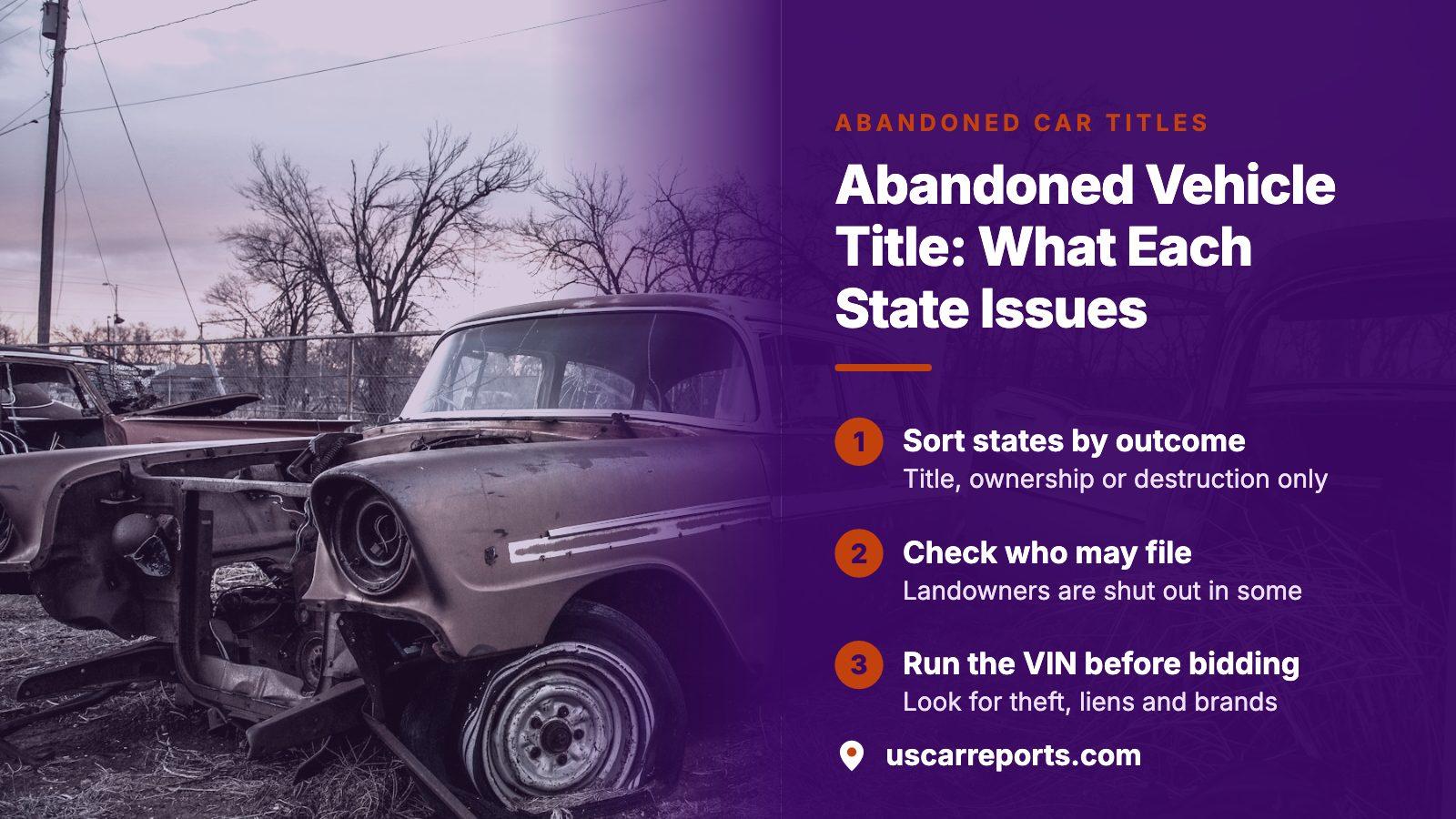
THE SHORT ANSWER
In most states an abandoned vehicle procedure does not put a title in your name. Virginia and Pennsylvania are the two that can. Arizona and Missouri pass ownership to whoever holds the car after a tow, and a sale state issues the title to the winning bidder, who may be you. Texas issues only permission to destroy. Before filing or bidding, run the VIN to look for a theft record, a lender or a brand.
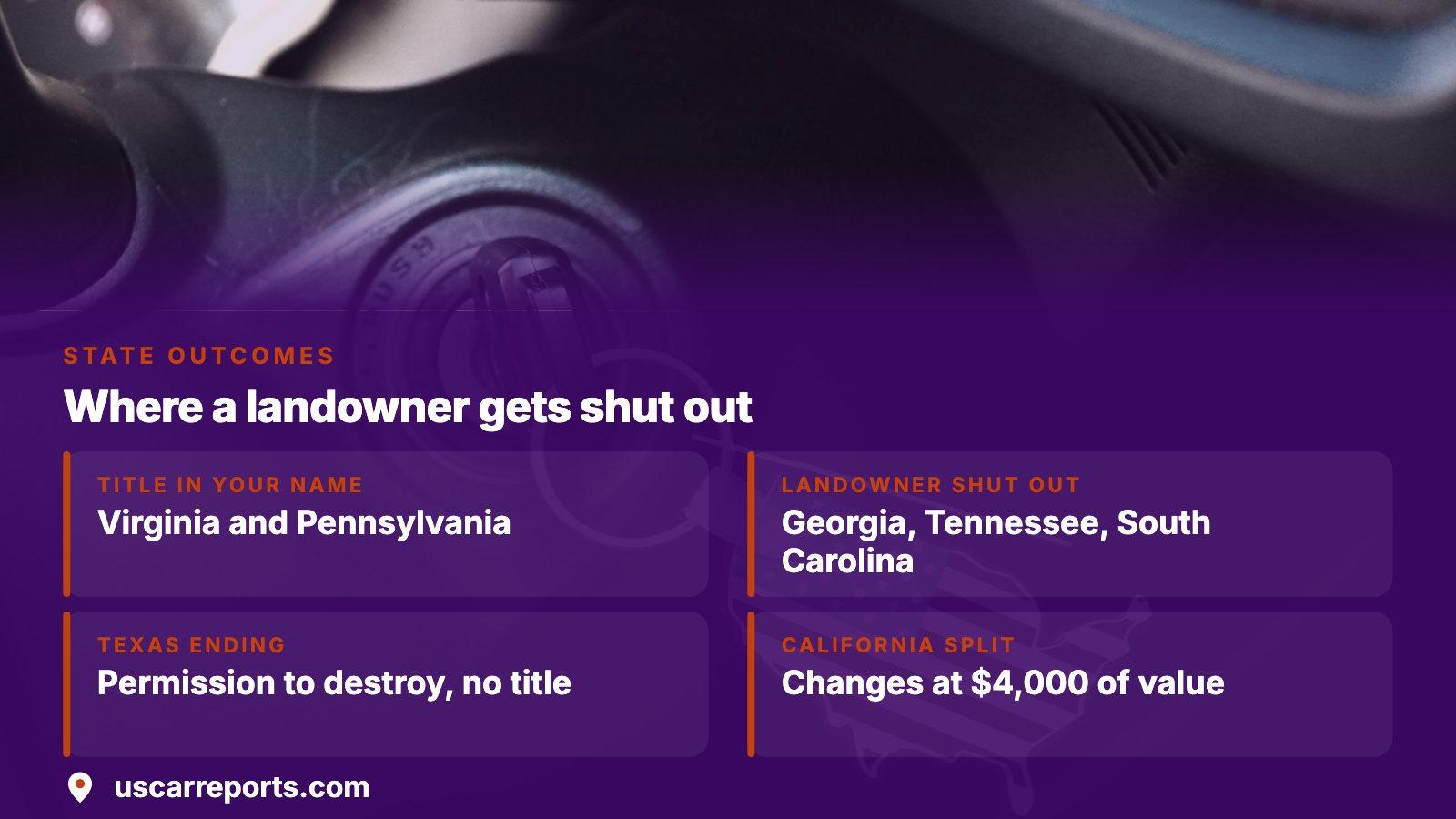
- Title in your name
- Virginia and Pennsylvania, of fourteen states read
- Landowner shut out
- Georgia, Tennessee, South Carolina and Mississippi
- Texas ending
- Permission to destroy, never a title
- California split
- The track changes at $4,000 of value
Title for whom? The question behind the search
People type this phrase for two reasons. Some have a car sitting on their land and want it gone or theirs. Others are looking at a car someone is selling and have heard it came out of an abandoned-vehicle sale. USCarReports reads both sides, because the rules for the person who finds the car decide what the next buyer inherits.
The useful question is what the procedure hands over and who receives it. Across fourteen states the answer runs from a title in the applicant's name to a scrap authorization. Find your state below and read the last column first.
What the process ends with, grouped by outcome
| Ending | States | Who ends up holding the paper |
|---|---|---|
| A title issued to the applicant | Virginia, Pennsylvania | The person who started it, through a DMV election form in Virginia or a court order in Pennsylvania |
| Ownership to whoever has custody | Arizona, Missouri | The tow or storage business that took the car |
| A sale, with the title to the buyer | California, Florida, Georgia, Mississippi, Tennessee, and both Carolinas | Whoever wins the sale, which can be the applicant bidding |
| Permission to destroy | Texas | Nobody: the car is not meant to be registered again |
| A bill of sale, then a second filing | Alabama | The buyer, once a separate title application is made |
| Ownership to the local authority | New York | The town or other local government |
Seven of the fourteen end in a sale. A car with this history is usually something a buyer purchases, not something a finder inherits, so the buyer's side comes next.
If you are bidding at the sale, or buying from someone who did
The purchaser is the person these statutes protect. South Carolina says the buyer at a magistrate's sale takes the car clear of liens and ownership claims and may register it. Mississippi's public auction removes the claims against the vehicle, and Georgia runs the sale under a court order.
Two cautions follow. The record of a sale reads as a sale, not a transfer, so the next buyer's history report will show it. California documents the case where no one bids and the lienholder signs as seller and buyer both. Alabama differs: the process closes with a bill of sale for the abandoned car, a separate title application comes after, and for sales from 1 January 2020 the purchaser posts a surety bond if the seller is not bonded.
Bonds do not carry over between states. Georgia will not issue a title on an abandoned car against a surety bond, and North Carolina refuses bonds on these cars too.
Four states where a landowner cannot file at all
Georgia, Tennessee, South Carolina and Mississippi write their procedures for licensed tow, storage and repair businesses. Tennessee's page states that private individuals may not use the process. Georgia lets only authorized tow and storage firms take a car off private land, so a homeowner there never gets as far as filing.
The realistic move there is a tow by a licensed operator, who may run the sale. The driveway comes back; the car does not.
Pennsylvania is the exception, and PennDOT's fact sheet is written for landowners. One can ask police to declare the car abandoned so a salvor removes it, move it to storage and bring a District Justice case for the costs, or ask the Court of Common Pleas to award the car outright. The state takes that court order in place of a certificate of title.
The clocks, and what each one counts from
Every waiting period exists so the registered owner can turn up. The trap is the starting point, which is rarely the day the car appeared.
| State | What the clock measures |
|---|---|
| Missouri | 96 hours counted from telling police, then 30 days after the notice is mailed |
| Virginia | 15 days to reclaim after the DMV letter, then 21 days of online posting |
| Texas | Listed for 20 days, with permission to destroy released the day after |
| Florida | 35 days after the tow for a car over three years old, 57 days for a newer one |
| Pennsylvania | 24 hours on private land, then a lawsuit with no set end date |
| New York | 96 hours on another person's land; ownership vests 10 days after notice |
| The Carolinas | A week parked on private land, then a further 30 days before the next step |
Rules keep moving
Florida replaced newspaper advertising with a website posting from 1 July 2024. Mississippi has required an approved third-party vendor for owner notices since 1 July 2026. Alabama's bond rule dates from 2020. Read your state agency's page on the day you file.
Cars that belong in a different chapter
- A tenant's leftover car: often landlord or storage law, with its own notices.
- A car left at a shop and never collected: a repairer's or storage lien, which is its own route. Virginia carves these out of its abandoned program.
- A car you paid for where the seller never signed: a transaction with a gap in it, so the bonded title route applies.
- A car whose titled owner has died: an estate transfer, on a different form in each state.
- A true shell past use: junk or dismantler routes, ending in a non-repairable document.
Filing under the wrong heading costs the entire waiting period, because the mistake only shows at the end.
Liens decide whether the outcome holds
Unclaimed cars often have a lender somewhere in the record, and a lender is the one party certain to arrive with paperwork. Arizona and Missouri clear prior liens, but the clean ownership goes to the party holding the car, typically the tow operator. South Carolina clears them for the purchaser at the sale. Elsewhere a lienholder is owed notice, and one who responds usually wins, since a recorded lien outranks possession.
Who hunts for the owner varies too. Tennessee, Texas, Arizona, Virginia, Missouri and New York run the record search. Applicants do it in Alabama, Pennsylvania, Georgia and both Carolinas, and Florida and Mississippi use an approved vendor. California decides by value: past $4,000 the notice duties grow, and a car worth $500 or less goes to a dismantler.
Run the VIN before you file or bid
Look for three things first: a theft entry, a recorded lender, and any title brand already on the car, since a brand caps what a later title can say. Each changes whether the procedure is worth starting or the lot is worth bidding on, and each costs more to learn later.
Start with the free preview on USCarReports; a full report is bought once, and the options sit on the pricing page. It can show title brands, liens and impounds, theft records and auction history. Alabama expects applicants to query a national title history, which the federal NMVTIS record supplies.
If the VIN shows a theft record or a lender
Sort that out first. A sale or a scrap permit does not erase a recorded claim, and a lender who answers the notice usually beats the person holding the car.

Where this information comes from
- TxDMV: Abandoned vehicles — Supports the 20-day listing and the permission to destroy that follows it.
- Virginia DMV: Abandoned Vehicle Program questions — Supports the reclaim period, the online posting and the lack of a newspaper duty.
- PennDOT: Disposition of abandoned vehicles, landowner fact sheet — Supports the three landowner routes and the court order accepted in place of a title.
- Georgia DOR: Abandoned vehicles — Supports the bar on bonded titles and the tow-and-storage-only rule.
- FLHSMV: Procedure TL-26, sale of abandoned or derelict vehicles — Supports the age-based waiting periods and the move to website posting.
- NCDMV: Special title cases — Supports the two-stage clock and the exclusion of bonds on abandoned vehicles.
- NMVTIS: National Motor Vehicle Title Information System — The federal title record that approved history providers draw on.
Sources and photos: Facts checked against the sources above in November 2026. Photos by Leo_Visions, Anastasiia Nelen and Jake Kling on Unsplash; diagrams by USCarReports.
Keep reading
- Bonded title: what it means for a buyer, state by stateThe route for a car you paid for where the seller never signed.
- Certificate of destruction by state: what the paper allowsWhere a permission-to-destroy ending actually leads.
- Title status check: what the state lookup tells a car buyerHow to read a title's status before money changes hands.
- Release of liability: what the notice does, state by stateHow a seller ends up holding a tow and storage bill.
Frequently asked questions
Can I end up with the title to a car left on my land?
Rarely. Of fourteen states read, only Virginia and Pennsylvania can issue the title to the applicant, by DMV election form or court order. Elsewhere the paper goes to a tow business, an auction buyer, the local authority or nobody. Read your state's ending first.
Does an abandoned vehicle process clear the loan on the car?
Only where the statute says so, and then it helps the person at the end of the chain. Arizona and Missouri clear liens for whoever holds the car, South Carolina for the buyer at the sale. Elsewhere a lender who responds to notice usually wins.
Can a surety bond replace the abandoned vehicle process?
Not uniformly. Georgia and North Carolina shut the bond route on abandoned cars. Alabama points the other way, asking the purchaser to post a bond on sales from 1 January 2020 when the seller is not a bonded agent. Check the state's own agency before relying on general advice.
How long before a parked car counts as abandoned?
No single clock applies. On private land the threshold ranges from 24 hours in Pennsylvania to 7 days in the Carolinas, with Missouri and New York at 96 hours. Florida disregards location and counts from the tow, 35 or 57 days by the car's age.
Is a car sold out of an abandoned vehicle sale safe to buy?
It can be, but verify it. The buyer usually receives a title, yet the record shows a sale, and a surviving lender or a theft entry can still cause trouble. Run the VIN and ask for the sale paperwork.
Now check the car itself
The guide explains what to look for. The report shows what this VIN has on record.