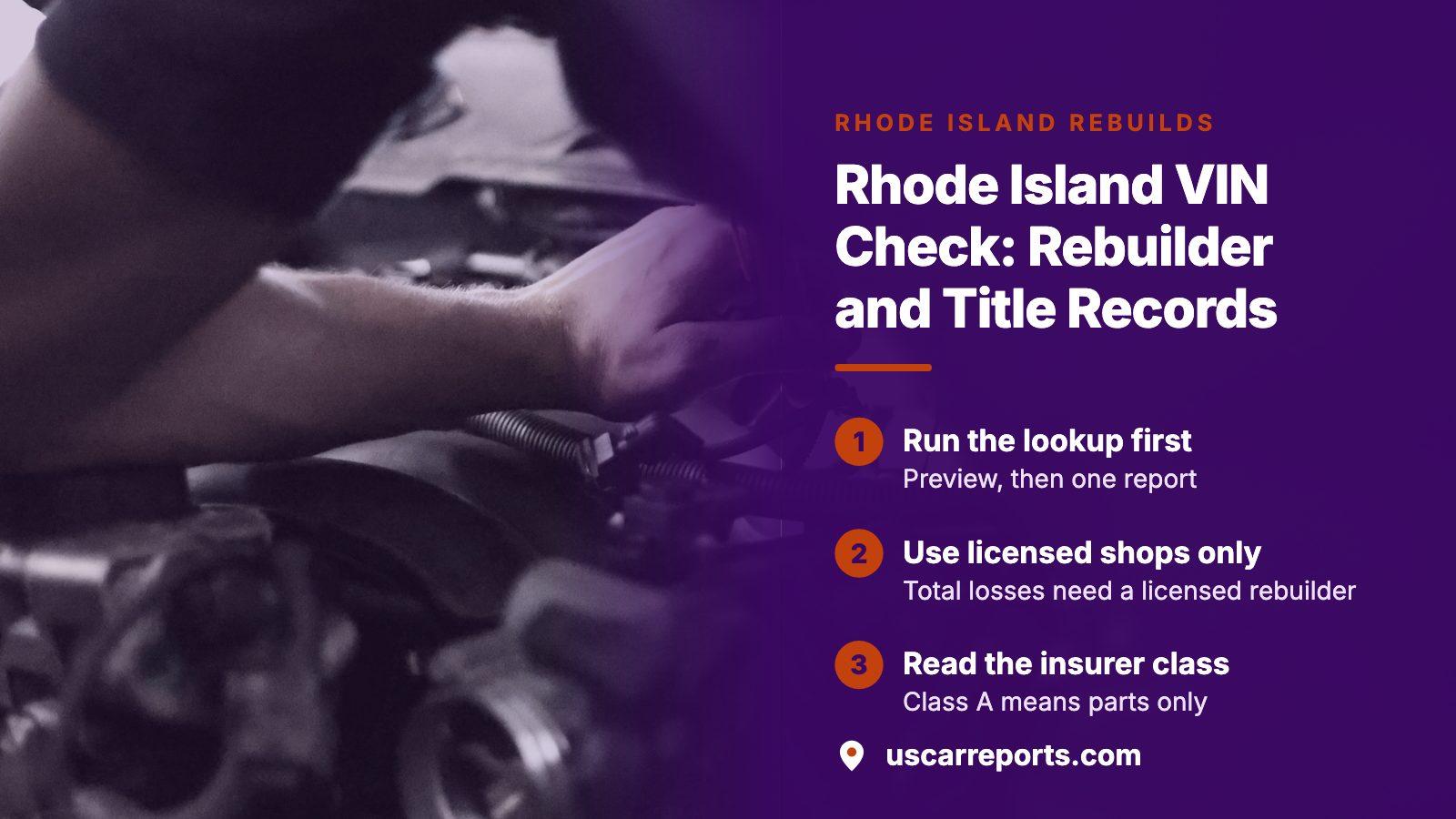
THE SHORT ANSWER
To run a Rhode Island VIN lookup, copy the VIN from the car, open the free preview, and buy the report if the record count fits the seller's story. For a rebuilt car, ask the seller to name the licensed rebuilder and to produce the insurer's classification letter. Then use the report to see whether the car was repaired, titled or wrecked in another state.
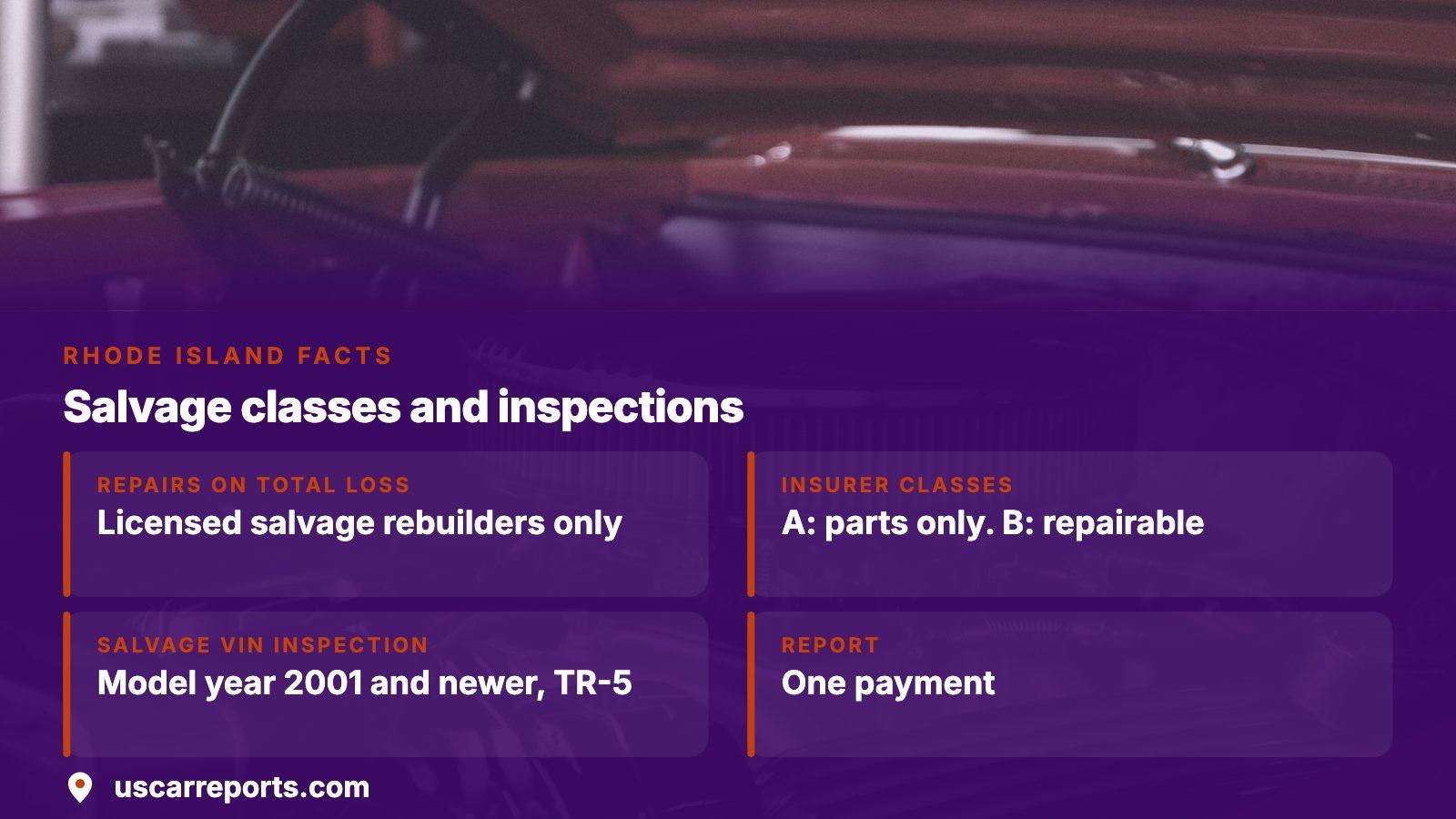
- Repairs on a total loss
- Licensed salvage rebuilders only
- Insurer classes
- Class A: parts only. Class B: repairable.
- Salvage VIN inspection
- Model year 2001 and newer, form TR-5
- Preview
- Free; the report is one payment
Rhode Island's buying rules at a glance
Each USCarReports state page opens with the rules that change what a buyer should check. In Rhode Island they hang on one idea: the state licenses the person who repairs a wrecked car, instead of only inspecting the car afterward.
| Question | Rhode Island's answer |
|---|---|
| Who may repair a total loss? | A Rhode Island licensed salvage rebuilder. There is no owner-rebuilt route. |
| How is a retained write-off labeled? | Class A or Class B, stated in the insurer's letter. |
| What travels with that letter? | The insurer's written appraisal of the damage. |
| Which cars need a salvage VIN inspection? | Salvage titles on model year 2001 and newer, logged on form TR-5. |
| Why license the shop? | Safer rebuilds, and no stolen parts or stolen cars in the trade. |
Running the Rhode Island lookup
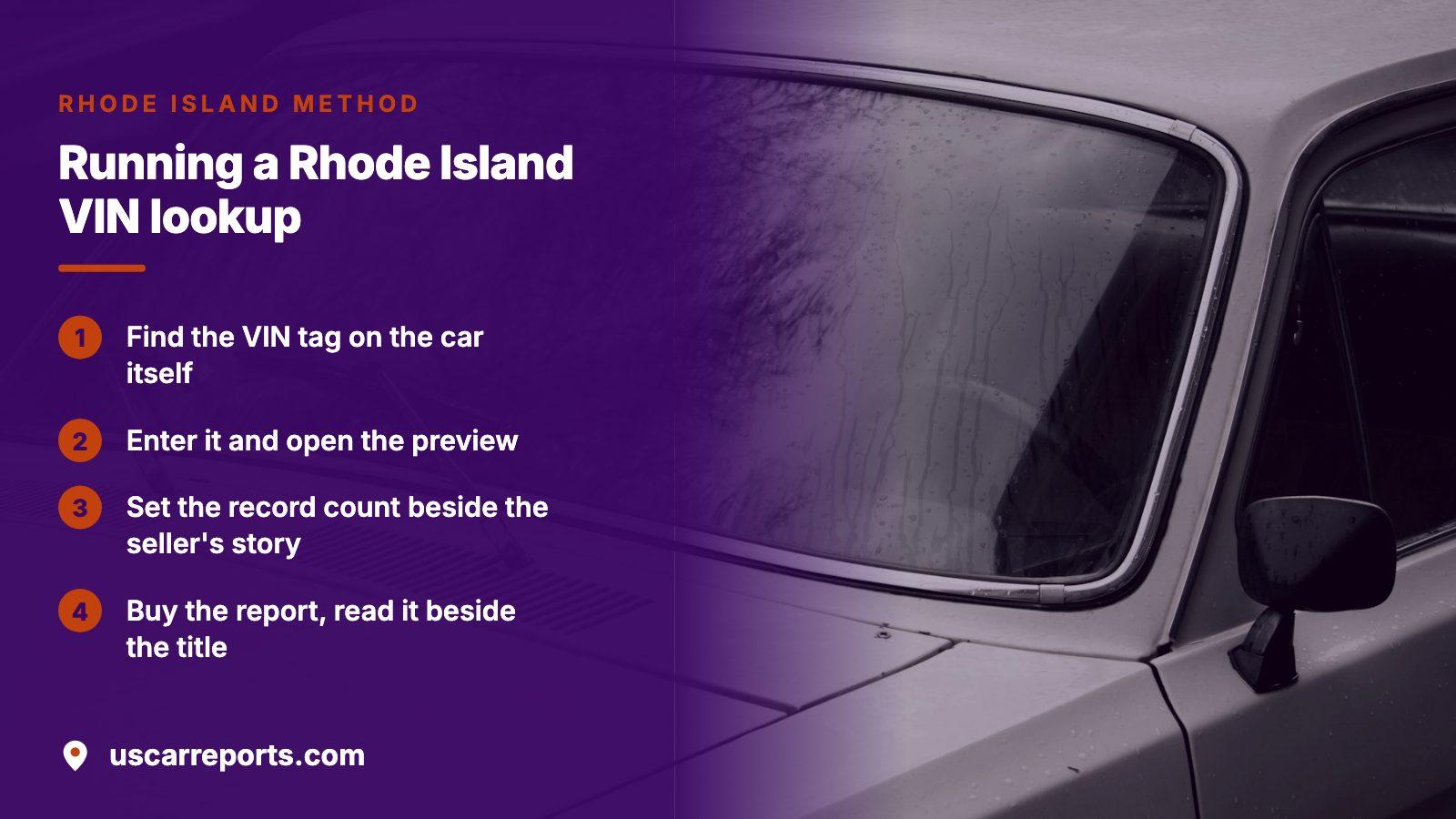
- Find the VIN on the car itself: the metal tag where the dashboard meets the glass on the driver's end, and the label inside the door frame. Both should match the title.
- Enter it on this site and open the preview. It lists the year, make and model, plus a count of the title, auction and damage records on file.
- Set that count beside the seller's description. A car sold as clean with several records on file needs an explanation before you talk price.
- Buy the report to read the records themselves, then read them next to the paper title while you stand at the car.
Mistype one digit and you will be reading about a different vehicle, so enter the VIN from the car and not from a listing photo.
The licensed-shop rule and what it rules out
In many states an owner can buy a wreck, repair it in a garage and present it for inspection. The state defines a salvage vehicle by its repair route: a total loss, declared by an insurer, that is now being fixed by one of the state's rebuilders. The rule follows from that definition, and every repair has to be done by a licensed one.
That shuts the owner-rebuilt project out of Rhode Island altogether. The license is held by the business, so a car rebuilt lawfully here has a repair history that ends at a company with a name.
The stated aims are two. Cars sold to retail buyers should be reconstructed safely, and stolen vehicles and parts should stay out of the rebuilding trade. An inspection judges one car on one day, while a license keeps the shop answerable on every job.
Ask for the rebuilder's name
A seller who calls a car rebuilt in Rhode Island should be able to name the business that did the work. Stalling on the name is itself information.
Reading a Class A or Class B letter
If an owner holds on to a car the insurer has written off, the insurer's letter must say three things: the car is a total loss, the owner is keeping it, and which class applies. Class A means the car is good for parts only. Class B means it can be repaired.
| Letter shows | What a buyer takes from it |
|---|---|
| Class A | The car was judged unfit to be rebuilt. A listing that treats it as a whole car deserves suspicion. |
| Class B | The car was judged worth repairing, and a licensed rebuilder should appear in its history. |
| No letter | A missing paper the state expects to exist. |
The insurer's estimate of the damage should sit alongside the letter. The class tells you what the insurer decided and the estimate tells you why, so ask for both and compare the estimate with the salvage photos in the report.
Where model year 2001 draws the line
Salvage titles on cars of model year 2001 or newer come with a salvage VIN inspection, and form TR-5 is where it gets recorded. Older cars fall outside that rule.
So read the model year first. Character ten of the VIN holds it, and the preview spells it out for you. A 1990s car with a branded past will have no TR-5 inspection behind it. That is no mark against the car, only a reason to lean harder on your own inspection and a mechanic's.
A small state with open borders
The state is less than fifty miles across, so its used cars drift into Massachusetts and Connecticut all the time. Many have been driven, insured or repaired there under rebuilding rules that are not Rhode Island's.
The licensing rule covers work done in Rhode Island and nowhere else. A car repaired across the line brings along whatever rules applied there, and a Rhode Island title will not mention it. The national title record that feeds the report's title entries gathers brands from the states that report, which is how an out-of-state brand shows up. Assume an out-of-state past until the record says otherwise.
Plates are a poor shortcut here too. In Rhode Island they go back to the DMV after a sale instead of staying with the car, so a plate in a listing identifies very little. The VIN stays with the car.
Red flags in a Rhode Island report
- A salvage or rebuilt brand, but no rebuilder the seller can name.
- A title entry from Massachusetts or Connecticut that never came up in conversation.
- Salvage or auction photos showing worse damage than the seller admitted.
- Mileage that drops, stalls or jumps between readings.
- A total-loss record on a car advertised as accident-free.
- A lien, an impound entry or a theft record.
Records have gaps
A report lists what someone recorded. Repairs paid for in cash may appear nowhere, which is why a mechanic should look the car over as well.
Paying for the report and finishing the purchase
Opening the preview is free of charge, and nothing recurs afterward. The report is bought once, either singly or as one of 3, 5 or 10 in a bundle, which suits anyone comparing several cars. Current prices are on the pricing page.
- Run the preview with the VIN from the car.
- Buy the report if the record count fits the seller's story.
- For a rebuilt car, collect the rebuilder's name, the insurer's letter and the damage estimate.
- Have a mechanic inspect it, and get an insurance quote before agreeing on a price.
- Hand over money only after the title shows the seller as its owner of record.
Where this information comes from
- Rhode Island DMV: salvage inspections — The state's salvage definition, the licensed rebuilder rule and the model year threshold for the TR-5 inspection.
- Rhode Island DBR: auto salvage rebuilder licensing — Why rebuilders are licensed, including the safety and stolen-parts aims.
- NHTSA: recalls — A no-cost open-recall lookup by VIN, independent of any state's rules.
- NMVTIS: National Motor Vehicle Title Information System — The national title record, which holds brands applied in other states.
Sources and photos: Facts checked against the sources above in November 2026. Photos by Mustafa Sheikhmouss, Tigran Shishmanyan and Victor Hughes on Unsplash; diagrams by USCarReports.
Keep reading
- Massachusetts VIN check: the plate record, the seven-day clock and buying rulesThe neighbor to the north and east, where many Rhode Island cars have lived.
- Connecticut VIN Check: Salvage Stamps and Parts-Only TitlesThe neighbor to the west, with its own salvage stamp rules.
- Title status check: what the state lookup tells a car buyerHow to read a title's status once the VIN record is open.
- Sample reportSee what a finished report looks like before you run one.
Frequently asked questions
How can I check a used car's VIN in Rhode Island?
Read the VIN off the dashboard plate or the door-pillar label, enter it, and open the free preview. If the record count fits the seller's story, buy the report and read it beside the paper title. NHTSA's recall lookup carries no charge and is quick to use.
Is it legal to repair my own totaled car in Rhode Island?
Not for a car that counts as a salvage vehicle under the state's definition. The work has to be done by a licensed Rhode Island salvage rebuilder, so a buyer should expect any rebuilt car to trace back to a named business holding that license.
How does Class A differ from Class B on a Rhode Island total loss?
Both are the insurer's call on a written-off car. Class A means parts only, so the car is not meant to be rebuilt. Class B means repairable, which routes the job through a licensed rebuilder. An owner who keeps the car gets a letter stating the total loss and the class.
Does a Rhode Island salvage title always need a VIN inspection?
Only for model year 2001 and newer, and form TR-5 records them. Older cars are outside the rule, so on a 1990s vehicle the missing inspection is not a warning sign. A hands-on check and a record search matter more instead.
Can I check a Rhode Island car by license plate?
This service works from the VIN. Plates go back to the DMV after a sale in Rhode Island, so the plate on a car says little about its past. Ask the seller to show you the VIN and run that.
Now check the car itself
The guide explains what to look for. The report shows what this VIN has on record.