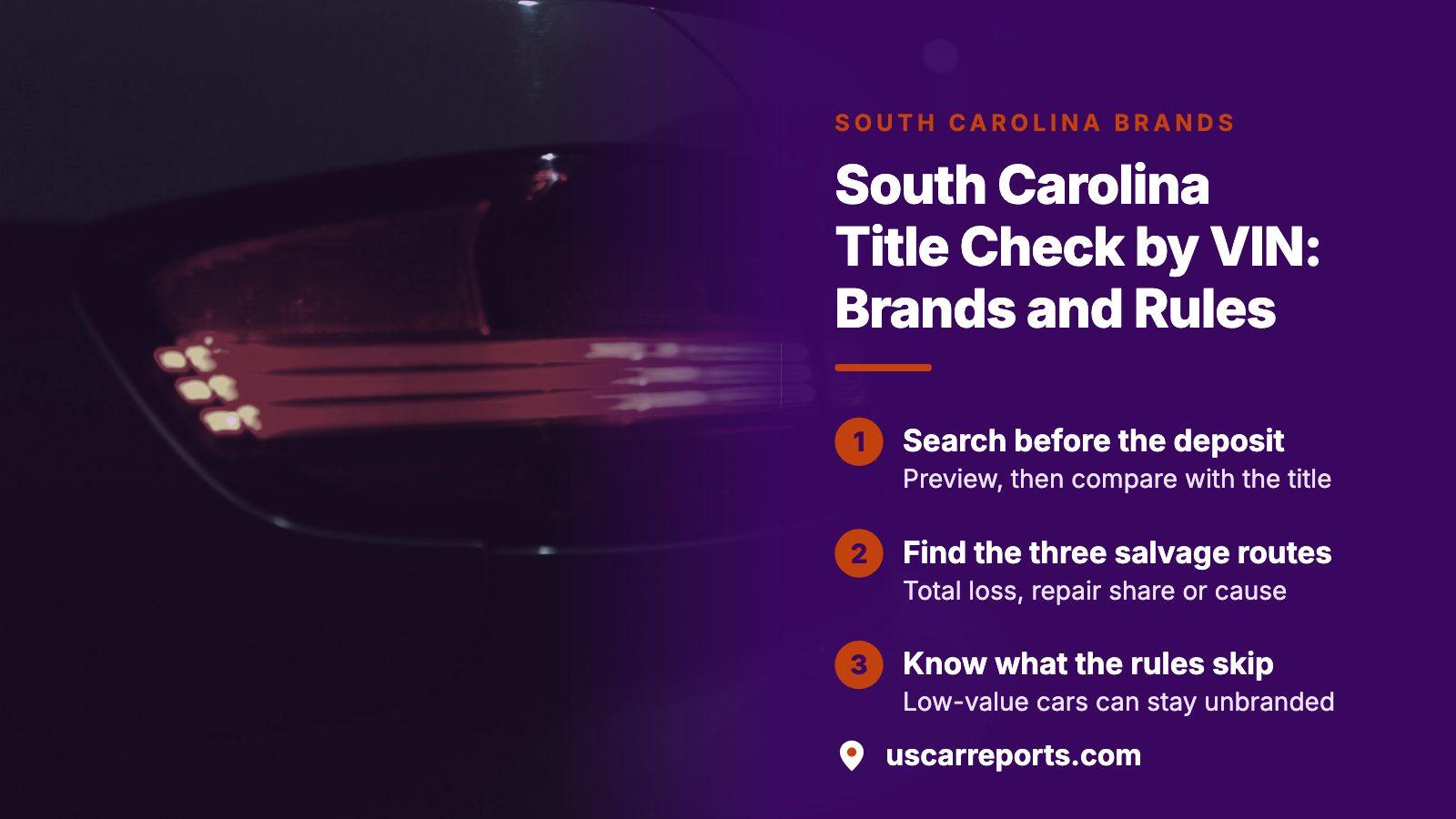
THE SHORT ANSWER
Copy the VIN from the car, open the preview here at no charge, and buy the report if the car still looks right. Then compare it with the title. South Carolina brands a car salvage after an insurer's total loss, when repairs reach 75 percent of its worth, or when the structure is unsafe. A later regular title has to read salvage rebuilt, flood rebuilt or fire rebuilt. Cars valued at $2,000 or less sit outside the rules.
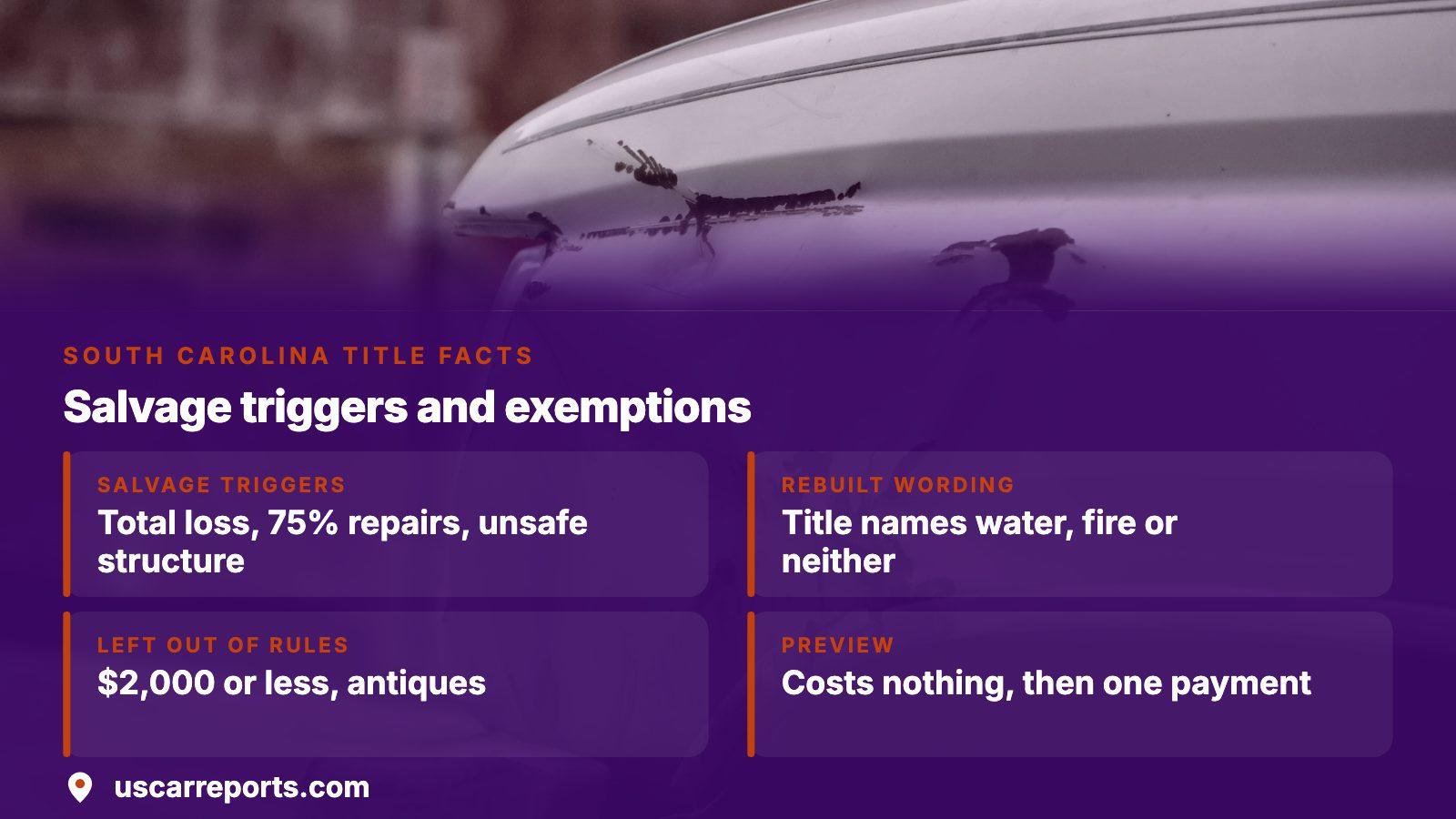
- Salvage triggers
- Insurer total loss, repairs at 75% of value, or an unsafe structure
- Rebuilt wording
- The title names the cause: water, fire or neither
- Left out of the rules
- Cars valued at $2,000 or less, and antiques
- Preview
- Free, then one payment per report
What a title search by VIN shows about a South Carolina car
A South Carolina title records one state's view, set down when one owner applied. A VIN search follows the car itself, backward before that application and forward after it. These entries matter most for a title question:
| Entry | Why it counts here |
|---|---|
| Title brands | Another state's brand can be missing from paper issued later |
| Insurance entries | A payout the seller never mentioned is one of the state's own routes to a brand |
| Salvage and auction photos | Before-repair pictures show damage that a rebuilt title only summarizes |
| Odometer readings | Dated mileage shows whether the climb is believable |
| Liens and theft | A lender's claim or theft entry must be settled before the title is worth owning |
Running the search before you hand over a deposit
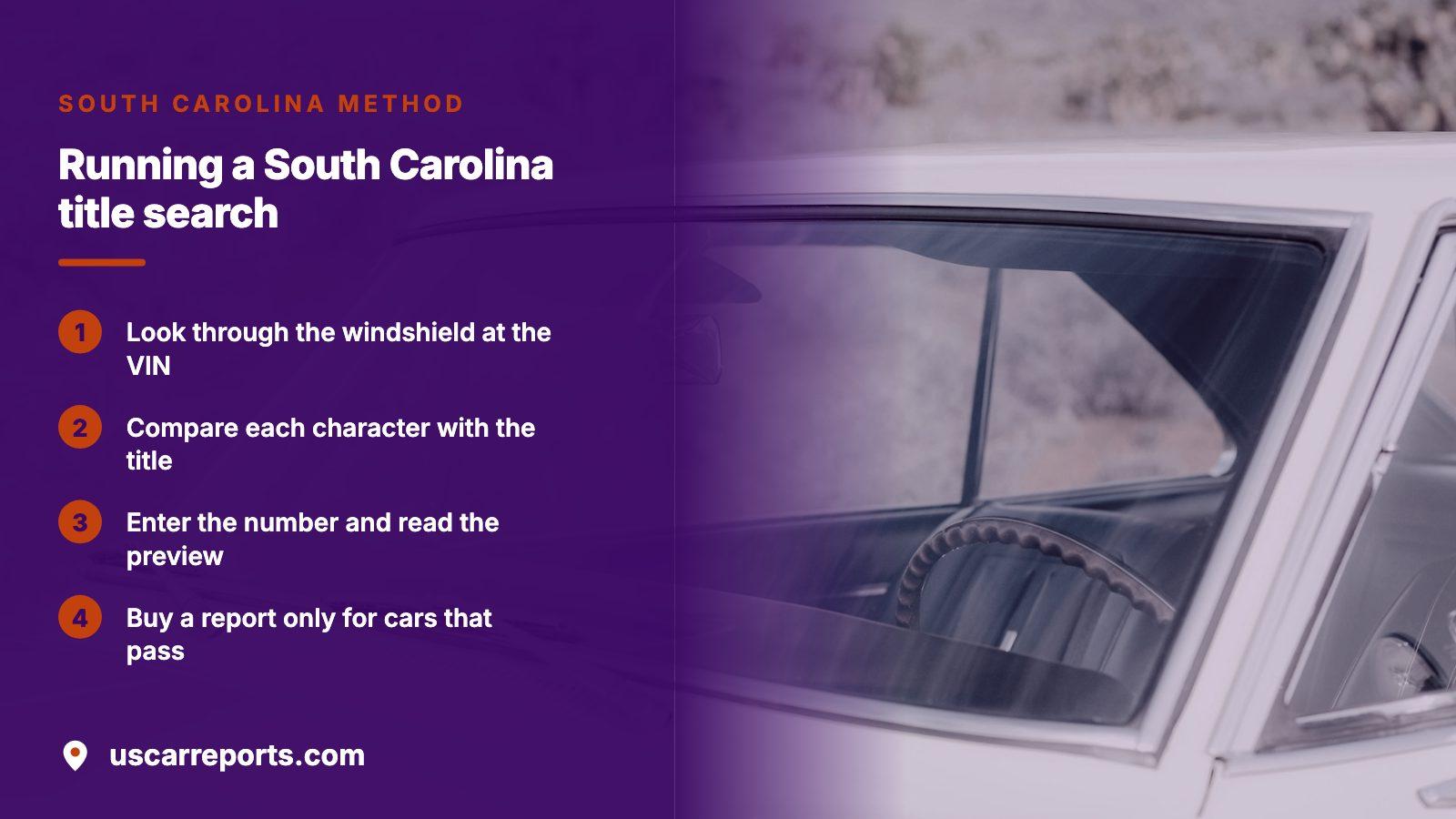
- Stand at the car with the paperwork put away and look through the windshield, at the driver's end of the dashboard, for the stamped VIN plate.
- Compare each character with the title. A single one that differs suggests the document and vehicle have different histories.
- Enter the number on this page and read the preview, checking that the decoded year, make and engine fit what you see.
- Buy a report only for cars that pass. For a shortlist, packs of 3, 5 or 10 exist; each payment is final and nothing renews.
- Read the report beside the title before any deposit.
Only the VIN opens the search. A listing or a plate cannot stand in for it.
Three ways a South Carolina car earns the salvage brand
The state does not rest on a single test. Any one of these will do:
- An insurer declares the car a total loss.
- Repair costs, parts and labor at fair local rates, reach 75 percent of the car's value in the moment before it was damaged.
- Structural harm to the body, unibody or frame is bad enough to make driving unsafe, whatever the estimate says.
The third route needs no percentage, so a modest estimate can still end in a brand. Labor priced at market rates also carries a bill toward the line faster than parts alone.
| State | Where salvage attaches |
|---|---|
| South Carolina | 75% of pre-damage worth, labor included |
| Missouri | 80%, and only for a car no more than six years past its model year |
| Texas | Repairs costing more than the car was worth before the damage |
So the same repair can brand a car in one state and leave it clean in the next, which is why the paper alone proves less than a record that follows the VIN.
The two kinds of vehicle the branding rules skip
Two kinds of vehicle fall outside the branding provisions: a car valued at $2,000 or less, and an antique as state law defines it. Ask the SCDMV how a car valued right at the line is treated, since the exact wording of the cutoff decides it.
A plain title on a cheap car
Down at the bottom of the market the brand may never have been available, so a clean title says little. Lean harder on insurance entries, mileage dates and a mechanic's verdict.
Antiques worry buyers less, because their buyers usually scrutinize the car itself. Either way, an exempt vehicle can be badly hurt and still carry an unbranded title, which is the case for running its VIN.
Salvage rebuilt, flood rebuilt, fire rebuilt: titles that name the cause
A previously salvaged vehicle that earns a regular title has to be annotated with that fact and the reason behind it. A bare rebuilt label leaves you guessing; this wording names the event.
| On the title | What it says about the earlier loss | Ask the seller for |
|---|---|---|
| Salvage rebuilt | Salvaged for some cause other than water or fire | Estimate, before photos, shop name |
| Salvage flood rebuilt | Water did the damage | How high it rose, what was replaced |
| Salvage fire rebuilt | Fire did the damage | What burned, whether wiring was renewed |
Flood wording deserves the most doubt. The FTC says water can slowly eat at mechanical and electrical systems, and that storm-hit cars are sometimes cleaned up and sold out of state. Check for:
- Silt under the seats and dash.
- Rust where the doors meet the body.
- Carpet that is loose, blotchy or the wrong color.
- A smell of mold, decay or strong cleaning products in the cabin or trunk.
The parts and repair record behind a regular title
A regular title does not return on the seller's word. The application must say the vehicle was rebuilt, carry the usual title details and identify the car. It also has to report each part's origin and cost and the extent of the repairs, and the state can ask for more.
- The estimate and the photos from before work started.
- Receipts showing where parts were bought.
- The shop that did the work, structural repairs especially.
A rebuilt car with none of this on file leaves the seller with a gap to explain. Since a damaged structure is one of the three routes to the brand, get an independent mechanic under it. The FTC is clear that a history report does not stand in for that.
When the report and the title disagree
Think of them as two witnesses, and doubt the paper first when they differ.
| What you find | What it can mean | What to do |
|---|---|---|
| Report shows a brand the title lacks | Another state branded the car before this title | Price as branded, or pass |
| Total-loss entry, plain title | The loss occurred elsewhere, or the value sat under the cutoff | Request repair records; inspect the underbody |
| Rebuilt wording, no parts or repair papers | The rebuild file is thin or gone | Wait for the seller to produce it, or cut the offer |
| A lien nobody mentioned | A lender still has a claim | Written release before payment |
| Mileage that falls or stalls | Gauge swap or altered miles | Service records; wear versus miles |
A theft entry is different: stop, and call the police or the insurer.
Cost, and a sequence that catches the most
Previewing a VIN here carries no charge. The report is a one-time purchase, sold singly or in a pack, and the pricing page lists current options.
- Read the preview and drop any car that already looks off.
- Run NHTSA's recall search for open recalls. It leaves out repaired recalls, some from small manufacturers, and anything past 15 years unless the maker adds coverage.
- Then NICB VINCheck. It covers insurer-reported theft, salvage and flood entries from participating companies, caps you at five lookups per 24 hours from an address, and only sees cars insured at the time of damage. A clean result guarantees nothing.
- Buy the report for brands, insurance entries, auction photos and mileage across states.
- Pay a mechanic to inspect, with the estimate in writing.
- Confirm the title wording with the SCDMV before paying.
NMVTIS, the federal system, is fed by state titling agencies and by insurers, junk and salvage yards and recyclers. It tracks title state, brands, odometer readings, total losses and salvage, so it can reveal a brand South Carolina never applied.
Where this information comes from
- South Carolina Code of Laws: Title 56, Chapter 19 — Section 56-19-480, the home of the 75 percent test, the value and antique exemptions and the rebuilt annotations.
- SCDMV: Title brands — How the department describes each brand, including the structural damage route.
- NMVTIS: Understanding a vehicle history report — What the federal title record covers and who is required to report to it.
- NICB VINCheck — A no-cost insurer lookup, with its search limit and its stated blind spots.
- NHTSA: Check for recalls — A no-cost open-recall search by VIN, and the recalls it leaves out.
- FTC: Buying a used car from a dealer — Why a history report does not replace an independent inspection.
- FTC: How to steer clear of a flood-damaged car — Signs of water damage and the limits of insurer flood records.
Sources and photos: Facts checked against the sources above in November 2026. Photos by Johnathan Kaufman, Wesley Tingey and Everett Pachmann on Unsplash; diagrams by USCarReports.
Keep reading
- South Carolina VIN Check: Brands, the $2,000 Floor and Flood CarsThe same state from the VIN side, with the value floor and the flood coast.
- North Carolina title check by VIN: brands, the 75% line and the damage formThe neighboring state's title rules, its damage form and its own 75 percent line.
- Title status check: what the state lookup tells a car buyerHow to read a title's status wherever the car was last registered.
- Sample reportA finished report, so you know what a purchase returns.
Frequently asked questions
How do I run a South Carolina title search?
Take the VIN from the car, check it against the title, and enter it on this page for the preview. Buy the report for any car that still fits, before the seller gets a deposit, then compare what it says with the title.
Is there a free South Carolina title check?
Partly. The preview here costs nothing, as do NHTSA's recall search and NICB VINCheck. Each covers a narrow slice. The paid report reaches brands, auction photos and mileage dates beyond one state or one group of insurers.
Does a clean South Carolina title mean the car was never wrecked?
No. Cars valued at $2,000 or less sit outside the branding rules, repairs under the 75 percent line draw no brand, and another state's brand can be absent from later paper. Pair the report with an inspection.
What does salvage flood rebuilt mean on a South Carolina title?
The car was salvaged after water damage, then repaired and retitled. South Carolina puts that cause on the title. Ask how deep the water got and which electrical parts were replaced, then have it inspected.
Can I see a South Carolina car's lien before buying it?
Liens appear in the report, so read it before any deposit. If one shows, wait for the lender's written release before paying. A seller saying the loan is paid off is not evidence.
Now check the car itself
The guide explains what to look for. The report shows what this VIN has on record.