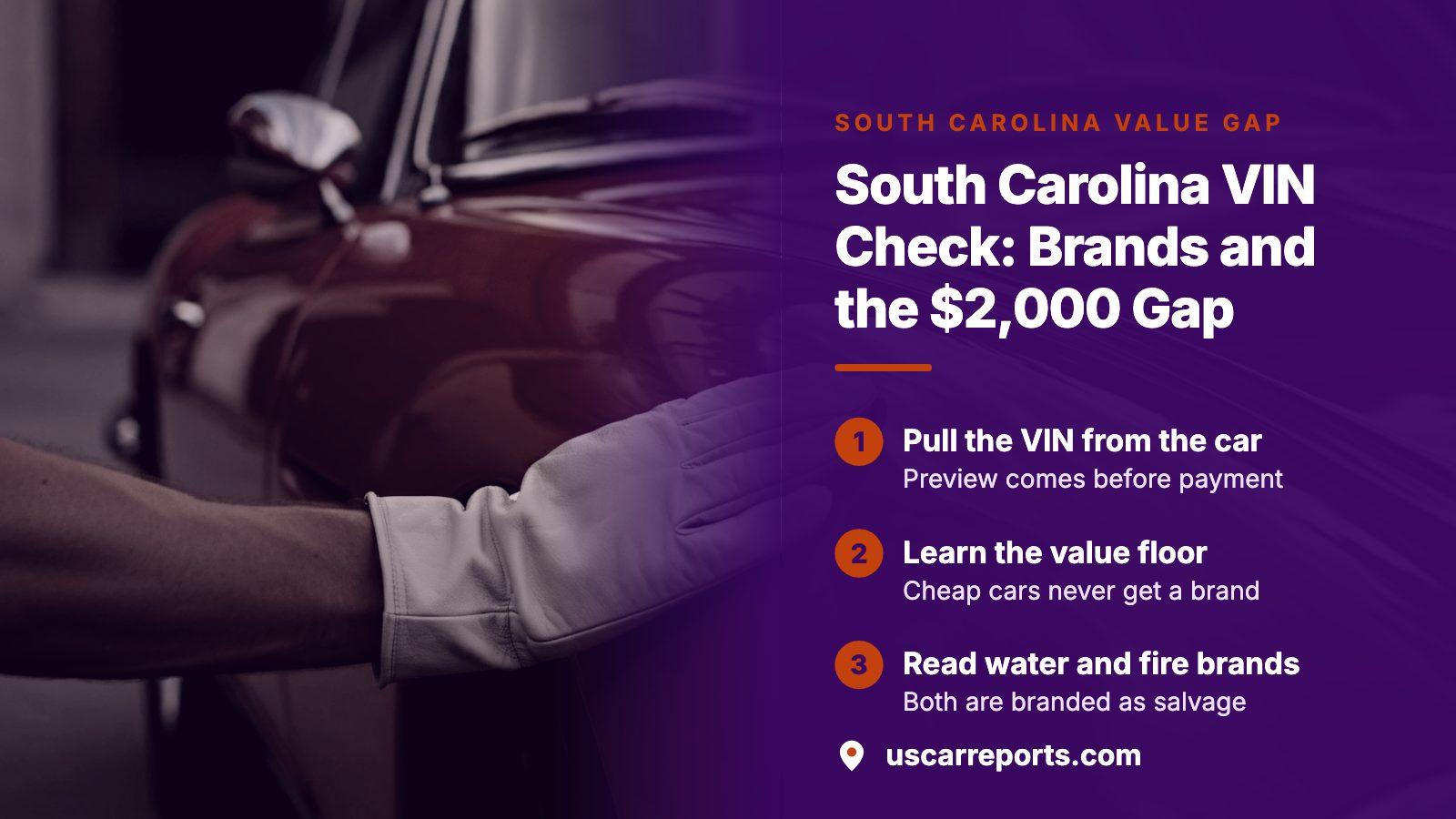
THE SHORT ANSWER
A free preview comes first, and one payment then opens the full report: brands, crashes and damage, salvage and auction photos, odometer readings, liens, theft and insurance entries, open recalls. In South Carolina, an insurer's total-loss decision, repairs above 75 percent of pre-damage value, or damage that leaves a vehicle unsafe to operate each earn a salvage brand. Per the SCDMV, vehicles valued under $2,000 escape it, so an unbranded title on a low-value car proves little.
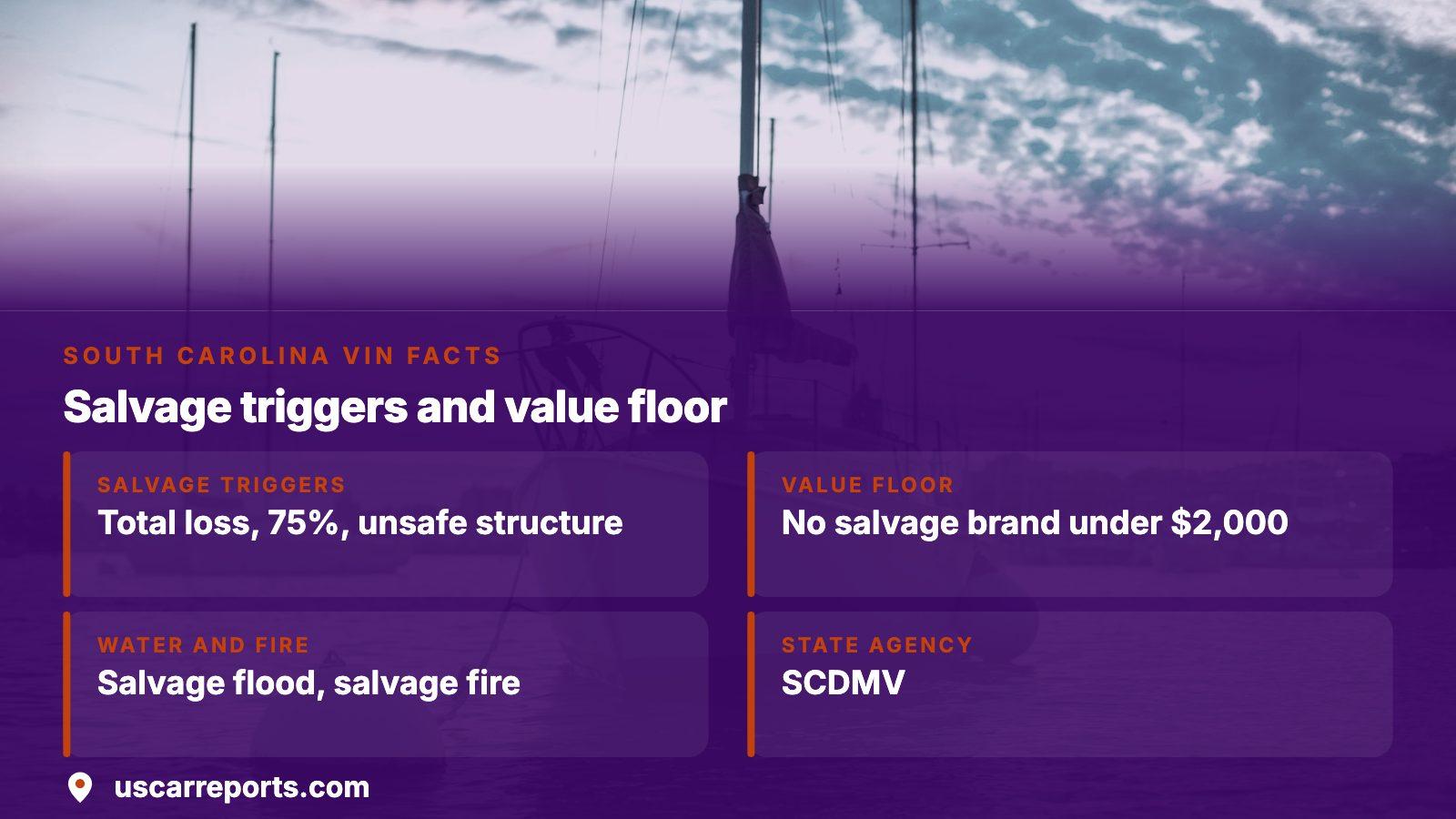
- Salvage triggers
- Insurer total loss, repairs above 75 percent, or an unsafe structure
- Value floor
- No salvage brand under $2,000
- Water and fire
- Branded as salvage flood and salvage fire
- State agency
- SCDMV
What the check covers on a South Carolina car
The check is keyed to the VIN, so it follows the car rather than one state's files. That matters because a car titled in South Carolina may have been damaged, insured or sold somewhere else first. A report gathers:
- Title brands, including ones that other states applied.
- Accident and damage entries, and salvage or auction history with the sale photos.
- Odometer readings from different dates, so you can see whether the miles rise in a believable line.
- Liens and impounds, theft records, and insurance records.
- Open recalls, who owned the car and how it was used, market value and factory specs.
Owners' names and addresses stay out of it. A federal privacy statute limits what motor vehicle records may release, and a plate number cannot talk its way past that.
Pulling the VIN from the car itself
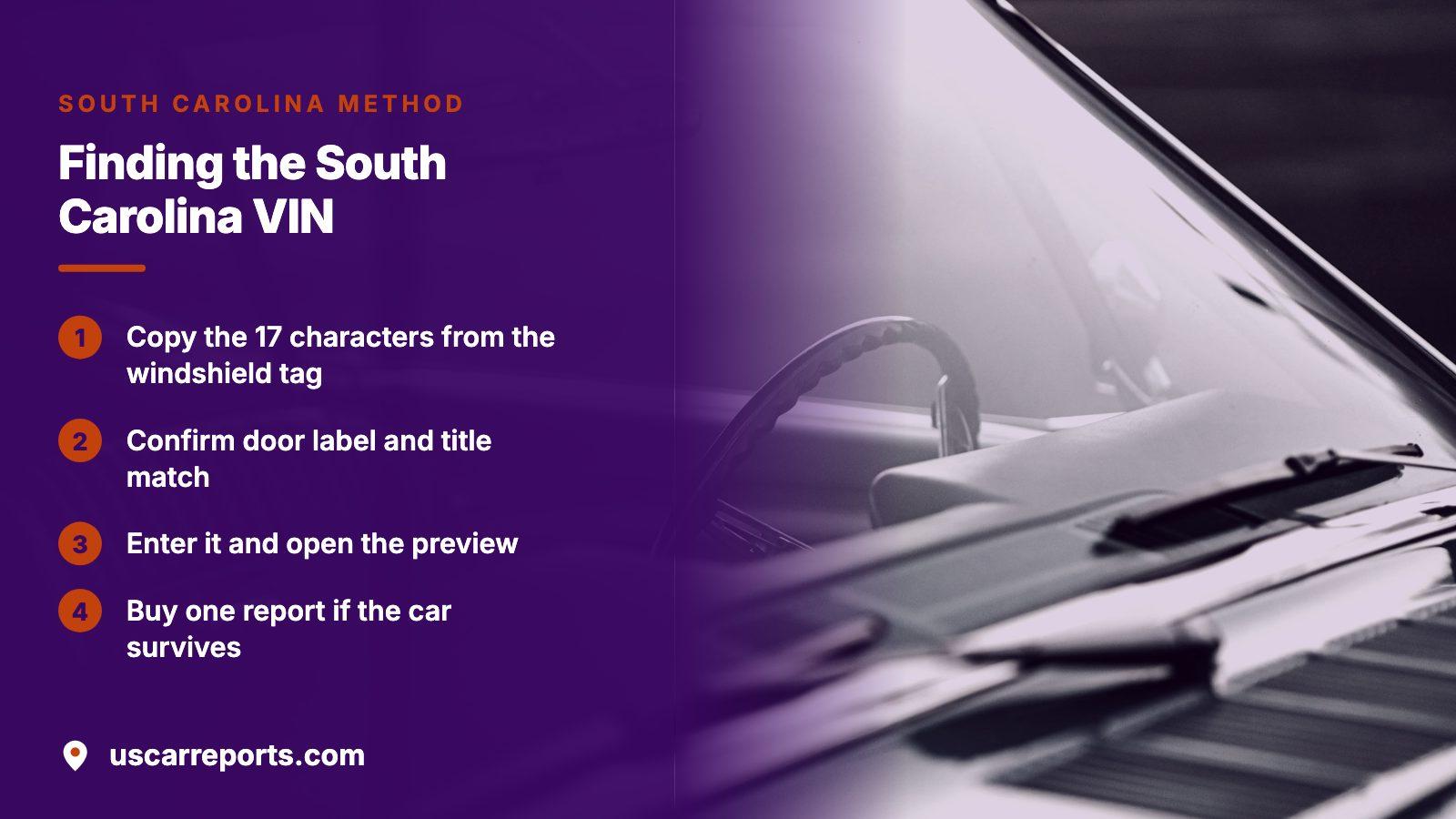
Read the number off the vehicle, then compare it with the paperwork. The metal tag in the lower corner of the windshield nearest the driver is one source. The label on the driver's door frame is another, and the title lists it too. A mismatch of even one character means the paperwork and the car may not belong together.
- Copy the 17 characters from the windshield tag.
- Confirm that the door label and the title show the same string.
- Enter it where this page asks for a VIN and open the preview.
- If the car survives the preview, buy one report. Shoppers weighing several cars can take 3, 5 or 10 as a pack; nothing renews.
South Carolina's title rules at a glance
Each state page on this site starts from that state's own rules, because they decide how much a title can tell you. For South Carolina they work out like this:
| Rule | What the state says | What it means at the sale |
|---|---|---|
| Salvage after a total loss | An insurer's total-loss decision brings a salvage brand | Search insurance and salvage records for a claim the seller never mentioned |
| Salvage by repair cost | Repairs above 75 percent of pre-damage value | Damage under that line can keep a clean title |
| Salvage by structure | Body, unibody or frame damage that leaves the vehicle unsafe to operate | A judgment call, so inspect the underbody on any car with a repair story |
| Value floor | No salvage brand on a vehicle valued under $2,000 | A clean title says little about a car in that range |
| Water and fire | Salvage flood and salvage fire are separate brands | The wording names which event the car went through |
| Return to the road | A rebuilt application describes the work and the parts | Ask the seller to show you those details |
Confirm the current wording with the SCDMV before you rely on any of it.
Why a low-value car can wear a clean title
The floor works on value, and a cheap car sits beneath it. Say a sedan is worth $1,800 and has been through a heavy front-end crash. No salvage brand follows, however bad the damage, because the state does not apply the brand below $2,000. The seller may hold a perfectly clean title and describe it honestly.
Weigh the title by the car's worth
The lower the car's value, the less a clean South Carolina title proves. Let the insurance, salvage and odometer records, and your own inspection, carry more of the decision.
The 75 percent line leans the same way at higher values. Some states set it at half a car's value, so South Carolina's higher line leaves more repaired cars unbranded. Unbranded means only that a car stayed beneath the line.
A title moves with the car, so the effect is not local. Sell the car across the state line and the next title copies what the old one showed, which may be nothing. Anyone in any state who shops for an older, low-priced car with a South Carolina past is working under this rule.
Flood, fire and the hurricane coast
South Carolina keeps salvage flood and salvage fire apart from ordinary salvage, so a title can name the event. If the car is also worth little, ask the SCDMV how the value exclusion treats water damage rather than guessing.
The Atlantic coast and the hurricane season feed water-damaged vehicles into the used market, from storm surge near the shore and rain flooding farther inland. The risky ones are not the dramatic cases. They sat in water up to the sills, were dried and detailed, and sold looking normal. The wiring faults arrived later and came and went.
- Pull up the trunk floor and inspect the spare-tire well for silt, rust or a tide line.
- Look at the bolts and tracks under the seats for rust a dry car would not have.
- Check the plugs and wiring under the dashboard for crusty buildup.
- Shut the doors, sit inside and breathe in. A damp smell outranks a clean title.
- Ask whether the car ever stood in water, and whether an insurer ever totaled it.
Rebuilt vehicles: ask for the application details
A branded vehicle returns to a regular title only after an application. It must say the vehicle was rebuilt, identify it, and account for the parts (their source and cost) and for the repair work performed. More recent legislation adds a safety-equipment test: air bags, three-point restraints and the devices that prevent fuel spills must be installed and operating.
Those items were singled out for a reason. They cost a lot, a shortcut is easy, and nothing looks wrong from the driver's seat until the day they are needed. Ask the seller for the parts and cost details, and pay a mechanic to confirm the restraint systems are the real thing before you agree on a price.
Reading the report: what should change your plans
Set the report beside the paper title and see whether they agree.
- A brand from another state: the car was damaged elsewhere. Price it as a branded car or move on.
- An insurer total loss behind a clean South Carolina title: the value floor or another gap may be at work. Ask for repair records and an underbody inspection.
- Odometer readings that drop or stall: ask for service records and compare pedal and tire wear with the miles shown.
- A lien without a release: get the lender's release in writing before paying.
- A theft record: stop and contact the police or the insurer.
- An open recall: ask for the repair at a dealer, or reflect the trip in your offer.
Cost, and the order to do things in
Nothing is charged for the preview. Buying the report is a one-time payment, with no subscription to cancel later, and current options sit on the pricing page.
- Open the preview and drop any car that already looks wrong.
- Look up open recalls on NHTSA and theft and salvage entries on NICB VINCheck. Both are free.
- Buy the report for brands, odometer readings and liens across states.
- Inspect the car for water, and ask for the rebuilt-title details if it carries a brand.
- Confirm the title paperwork with the SCDMV before money changes hands.
Where this information comes from
- SCDMV: Title brands — Where the state sets out the salvage thresholds, the value exclusion and the flood and fire brands.
- SCDMV: Total loss claims — How an insurer's total loss moves a South Carolina title into a branded category.
- U.S. Department of Justice: NMVTIS approved providers — The federal title record that gathers brands across state lines.
- NICB VINCheck — A free search of theft and salvage records contributed by insurers.
- NHTSA: Recalls — A free lookup of open safety recalls by VIN.
Sources and photos: Facts checked against the sources above in November 2026. Photos by Mohamed Gado, Dylan Michaud and Johnny killroy on Unsplash; diagrams by USCarReports.
Keep reading
- South Carolina Title Check by VIN: Brands, Rebuilt Wording and ExemptionsThe same state read from the title side, brand by brand.
- North Carolina VIN Check: Run the Report Before You PayThe neighboring state, with its own rules for the sale.
- Sample reportA finished report, so you know what you would be buying.
- PricingThe current options for one report or a pack.
Frequently asked questions
How do I do a South Carolina VIN lookup?
Copy the VIN from the windshield tag, check it against the door label and the title, and enter it on this page. The preview appears at no charge. Run it before you hand over a deposit, because a mismatch or a brand is easiest to act on early.
Is a South Carolina VIN search free?
Part of it. The preview here costs nothing, and NHTSA's recall tool and NICB VINCheck are free too. The full report is one payment. Compare whatever you run with the paper title, and slow down if they disagree.
What does the $2,000 rule mean for a South Carolina car?
According to the SCDMV, a vehicle valued under $2,000 does not get the salvage brand. The test is value rather than asking price, but a low price is a decent hint. On such a car, rely on insurance, salvage and odometer records, not the title alone.
Will a VIN report show whether a South Carolina car flooded?
It shows a flood brand when one was recorded, and South Carolina has its own salvage flood brand for that. It cannot reveal water damage that no insurer or agency logged. For a car with a coastal past, inspect it in person too.
Can a car damaged in South Carolina arrive elsewhere with a clean title?
Yes. A vehicle valued below the floor can be damaged without being branded, and when another state issues its title, it copies what the old one showed. On a low-priced car, the report's insurance and salvage entries are the better evidence.
Now check the car itself
The guide explains what to look for. The report shows what this VIN has on record.