THE SHORT ANSWER
Read the VIN off the car, enter all 17 characters on USCarReports and open the preview. The full report adds brands from any state, crash and auction history, mileage, lender claims, theft records and any recall still open. In Utah, most passenger cars have no state safety inspection, and emissions testing covers only five counties.
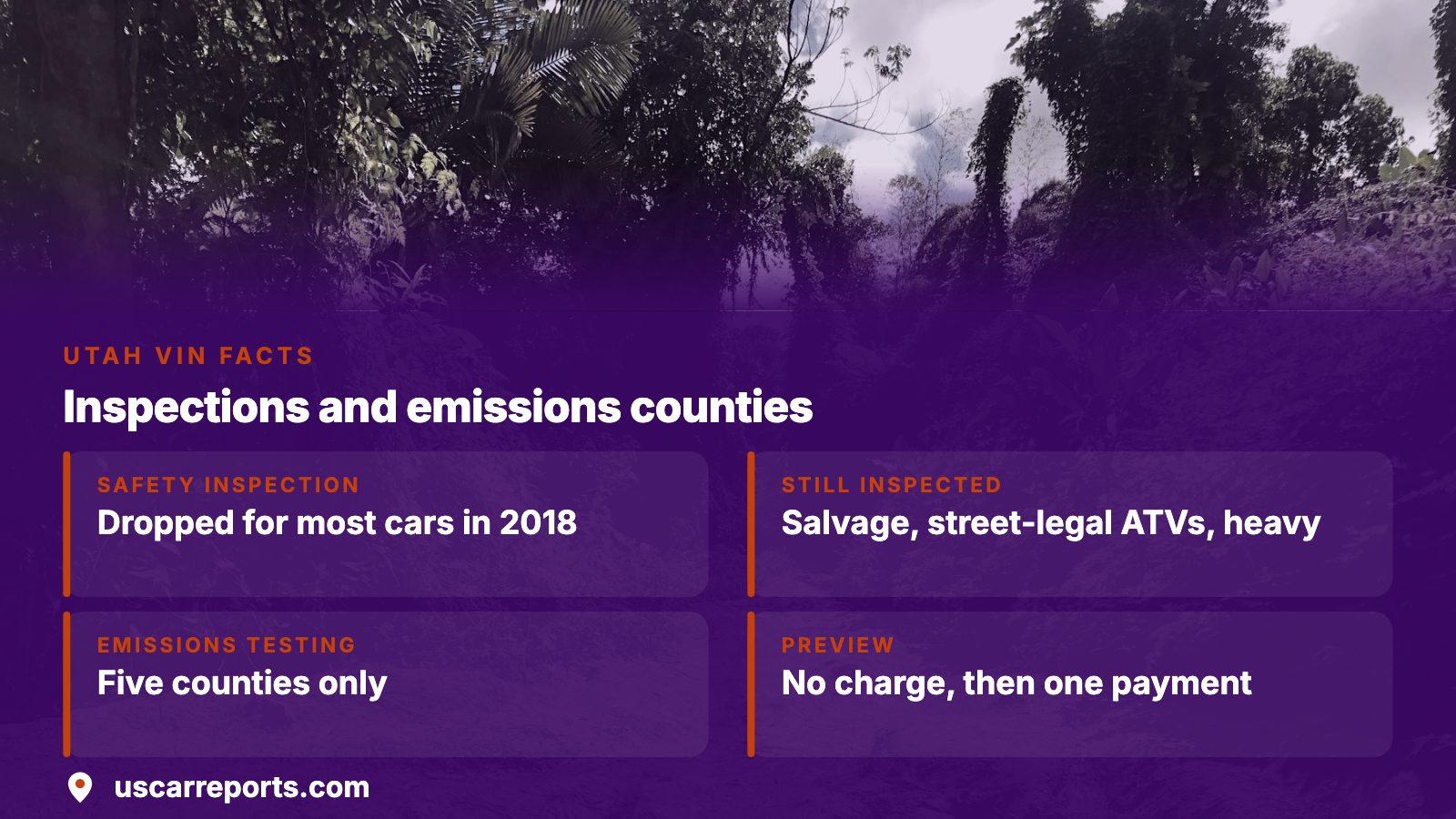
- Safety inspection
- Dropped for most passenger cars in 2018
- Still inspected
- Salvage, street-legal ATVs, heavy commercial
- Emissions testing
- Five counties only
- Preview
- No charge, then one payment per report
What a Utah VIN lookup turns up that the seller may not mention
The record follows the number, not the state line, so a lookup on a Utah car also reaches back to wherever it was titled before. Five kinds of entry decide most deals:
- Brands, meaning salvage, junk or flood labels, including any a different state stamped on the title.
- Damage entries and, where the car passed through an auction, photos taken before repair.
- Mileage readings over time, which expose a drop or a long stall.
- Lender claims and impound entries the seller's papers do not mention.
- A theft flag or a recall nobody fixed, neither of which registration brings up.
Utah dropped the ordinary-car inspection on January 1, 2018
From that date, the Utah Highway Patrol's owner page says, most passenger vehicles no longer need a safety inspection to renew registration. Cars must still meet equipment and safety laws on the road, but nobody checks at the counter or at a private sale. A few categories kept the rule.
| Vehicle | State safety inspection |
|---|---|
| Most passenger cars and light trucks | No longer required |
| Salvage vehicle | Once, when first registered as salvage |
| Street-legal ATV | At first registration and at each change of owner |
| Heavy commercial vehicles, buses, taxis, tow trucks | Annual |
Clean title, no examiner
A clean-title Utah car has probably never been looked at by anyone official. Whatever reassurance you want has to come from a record or from a mechanic you hired.
Emissions testing: five counties and a hurdle at registration
Emissions testing is a separate program, and it runs by county. Weber, Davis, Salt Lake, Utah and Cache counties test, and a passing result comes before registration there. Elsewhere in Utah it does not apply.
- A certificate lives for two months from issue, so a seller's old printout may be too stale to register on.
- Salt Lake County will not register a failing car until it has been fixed and passes a retest, so a lit warning light is a repair bill for the buyer to price in.
- That county tests newer cars every second year: a model under six years old is due in years matching its model year, even with even, odd with odd. Its 2026 chart listed 2024 and 2022 models as due, 2025, 2023 and 2021 as not.
- Work out which county you will register in, and ask the seller to show the newest certificate with its date.
Running it: read the number off the car, then open the preview
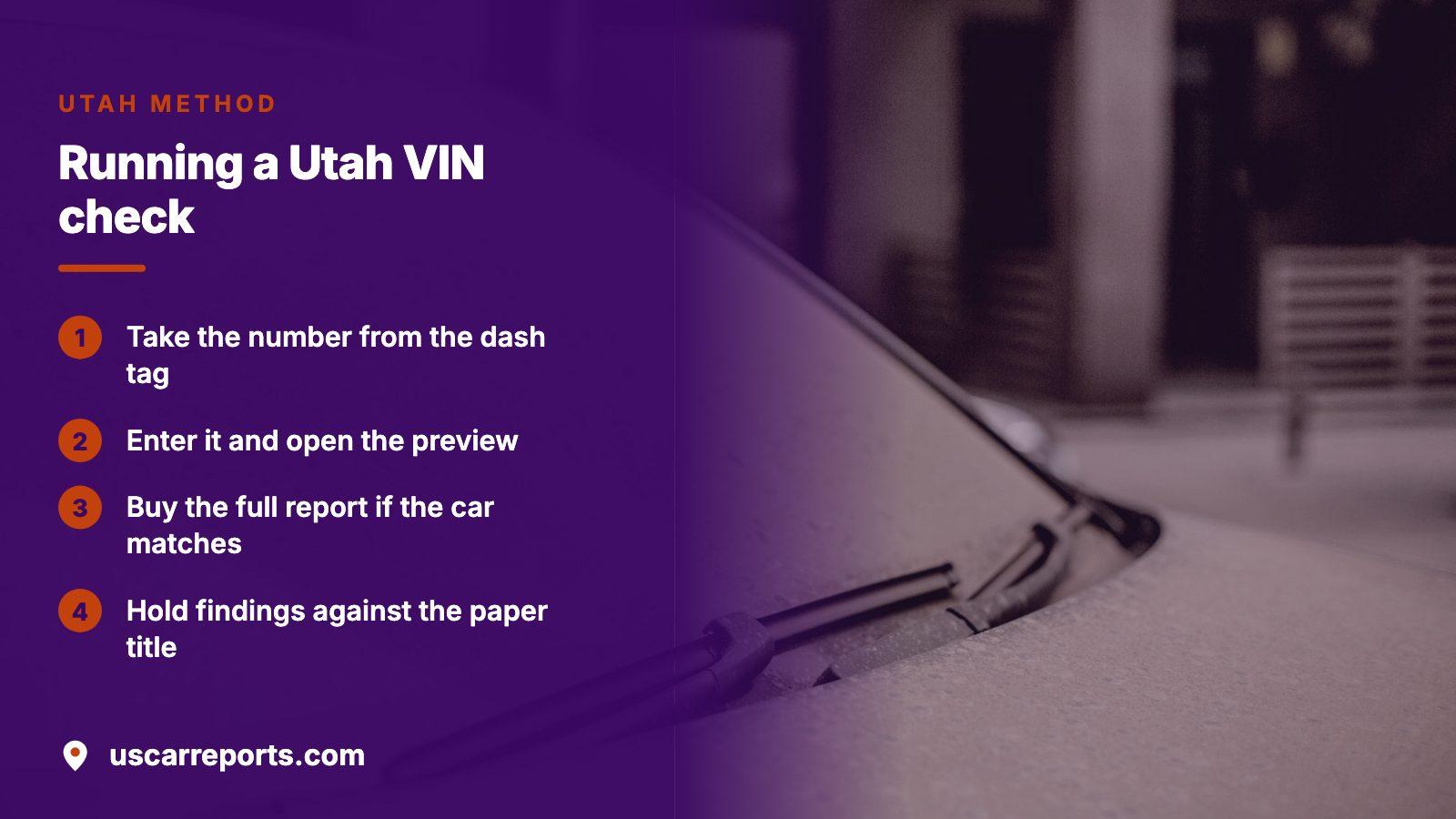
- Take the number from the tag seen through the glass, low in the driver's corner of the dash, not from the ad, and compare every character with the registration and the seller's title. One character off means another car or an altered paper.
- Type the VIN into USCarReports and open the preview, which decodes the car, counts open recalls and flags whether title and auction entries exist.
- If the decoded car matches the ad, buy the full report and go through every entry.
- Hold the findings against the paper title, then arrange your inspection.
A seller who dodges the VIN has told you something already. A plate is no stand-in: federal privacy rules limit who may see personal data held in motor vehicle records.
The no-cost federal and insurer lookups, and what each skips
Three public tools each cover a slice. Run them first, then look at what remains.
| Tool | What it shows | What it skips |
|---|---|---|
| NHTSA recall search | Whether that exact VIN has an unrepaired recall | Recalls already fixed, those older than 15 years, small manufacturers, non-safety campaigns |
| NICB VINCheck | Theft reports not recovered, and salvage or flood reports, from participating insurers; capped at five lookups daily per IP address | Police records and insurers that opt out; a clean result is no guarantee |
| Federal NMVTIS record | State of title and date, brands any state applied, odometer, total loss, salvage history | Repair and upkeep records, plus damage that never reached a title office, insurer or yard |
The USCarReports report folds title, damage, mileage, lien, theft and recall entries into one document, after a preview that costs nothing.
A rebuilt Utah car has been inspected once, which is not the same as clean
Utah's salvage rule asks for a safety inspection the first time a car is registered as salvage, and only then. A rebuilt car you meet years later carries one old check, and the paper behind it is worth requesting. It speaks to the repair, not to the brand, which stays on the record. NICB explains that a salvage entry means an insurer wrote the car off because repairs would have cost more than a set percentage of its value, and that such cars may legally be repaired and titled again.
- Ask for the date and paperwork of that inspection. If you plan to register a car still titled salvage, that inspection applies to you, and since May 2026 each station sets its own fee, so ask the price before booking.
- See which state applied the brand; the federal record keeps every brand any state has set on the car.
- Lay the auction photos beside the car now: gaps between panels, paint texture, parts newer than the rest.
- Price it against other branded cars, and expect the same discount at resale.
Red flags in the results
- A brand from another state on a car advertised as clean, whether salvage, junk or flood.
- Auction photos showing damage the ad never mentioned, especially behind new paint.
- An odometer entry that drops, or silence in the record for years.
- A lien no one has explained, or an impound entry.
- A theft entry, or an open recall.
A short report is not a perfect car
The record contains what reached a title office, an insurer or a yard. The federal system is brief by design, so a quiet result narrows the risk without ending it.
Your mechanic supplies the inspection the state no longer does
With no state safety inspection behind most cars, one mechanic's visit is the only hands-on examination a car will get. The FTC cautions that such reports concentrate on crashes and floods rather than worn parts, and that a mechanical inspection differs from a safety inspection, which looks only at what makes a car unsafe to drive. Have the shop write up its repair estimate, that lists the make, model and VIN, and use it to bargain.
Utah's valleys sit under mountains that bring real winters and treated roads, so have the shop raise the car on a hoist. Brake lines, fuel lines and exhaust hangers rust first, and a driveway walk-around hides all three.
Cost, then the sequence that protects your deposit
Previews carry no charge. Beyond that you pay once: for the single report you need, or, once a shortlist forms, for 3, 5 or 10 reports taken in one go. No renewal ever occurs; current figures sit on the pricing page.
- Preview the VIN you read off the car.
- Buy the report if the preview matches the ad, before leaving any deposit.
- Run the NHTSA and NICB searches alongside it.
- Confirm the registration county and the emissions certificate.
- Book the mechanic, then settle the price.
Where this information comes from
- Utah Highway Patrol: vehicle owner safety inspection information — The 2018 change, which vehicles still need an inspection and where emissions testing applies.
- Salt Lake County Health Department: vehicle emissions program — County test timing, the model-year chart and links for the five testing counties.
- Salt Lake County Health Department: failing vehicles — A failing car cannot be registered in the county until it passes a retest.
- NHTSA: check for recalls — Open-recall search by VIN, and what that search leaves out.
- NMVTIS: understanding a vehicle history report — The items held in the federal title record and who reports into it.
- NICB VINCheck — No-cost theft, salvage and flood search, with its stated limits.
- FTC: buying a used car from a dealer — Why a history report does not replace a mechanic's inspection.
Sources and photos: Facts checked against the sources above in November 2026. Photos by Erik Mclean, JavyGo and Frederick Rosa on Unsplash; diagrams by USCarReports.
Keep reading
- Tennessee VIN check: what to run, flood risk and county clerk titlingAnother state with no safety inspection, where the buyer is the only checkpoint.
- Nevada VIN Check: Title Brands, Liens and Registration RulesHow county-based emissions testing lands on a used-car sale next door.
- Registering a car in another state: deadlines, title and checksWhat a new state looks up before it titles a car you bought elsewhere.
- Sample reportSee a finished report before you run one.
Frequently asked questions
Does Utah inspect used cars before they can be registered?
For most passenger cars, no. The Utah Highway Patrol says that since January 1, 2018 an ordinary passenger vehicle needs no safety inspection to renew registration. Salvage vehicles, street-legal ATVs and heavy commercial vehicles are still covered, which leaves a clean-title car resting on whatever your own mechanic finds.
Which parts of Utah require an emissions test?
Utah, Salt Lake, Davis, Weber and Cache counties. A test is a prerequisite for registering in any of them, and the certificate lasts two months. Registration elsewhere skips the program, so the county on your own registration decides what applies.
Can a license plate reveal a Utah owner's name?
Not to a private buyer. Federal rules restrict how much personal data motor vehicle records may release, and no consumer service returns an owner's identity from a plate. A plate can confirm that the car you are standing beside is the one advertised; the history itself hangs on the VIN.
Does an inspection make a rebuilt Utah car safe to buy?
It supports the repair, not the history. Utah's check happens once, when the car is first registered as salvage, so it may be years old. Read the total-loss entry and the auction photos, price against other branded cars, and have your own mechanic go over it.
What will a Utah VIN check miss?
Worn parts, rust underneath, and damage that never reached a title office, insurer or salvage yard. The FTC notes that history reports rarely list mechanical trouble. Pair the report with a mechanic's inspection and a proper test drive.
Now check the car itself
The guide explains what to look for. The report shows what this VIN has on record.