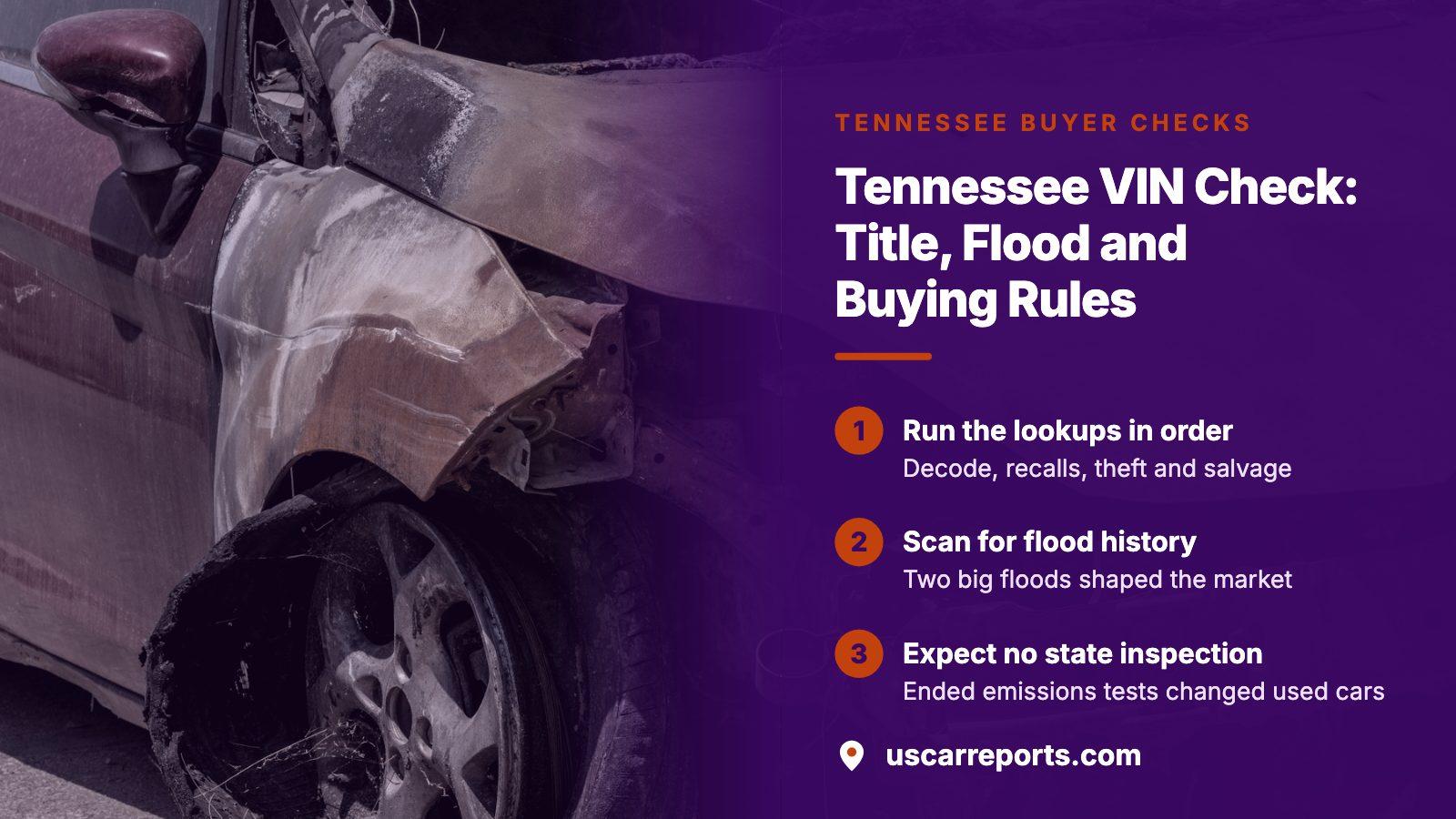
THE SHORT ANSWER
Three lookups cost nothing: a VIN decode, NHTSA's open-recall search and NICB's theft and salvage check. Next comes the national title record, bought through an NMVTIS-approved provider, which gathers brands from every reporting state. Then cover what Tennessee skips: plug a scanner into the car to read stored faults, and look hard for water damage when the car has lived in Middle Tennessee or along the Gulf. A USCarReports preview shows what the report holds before you pay.
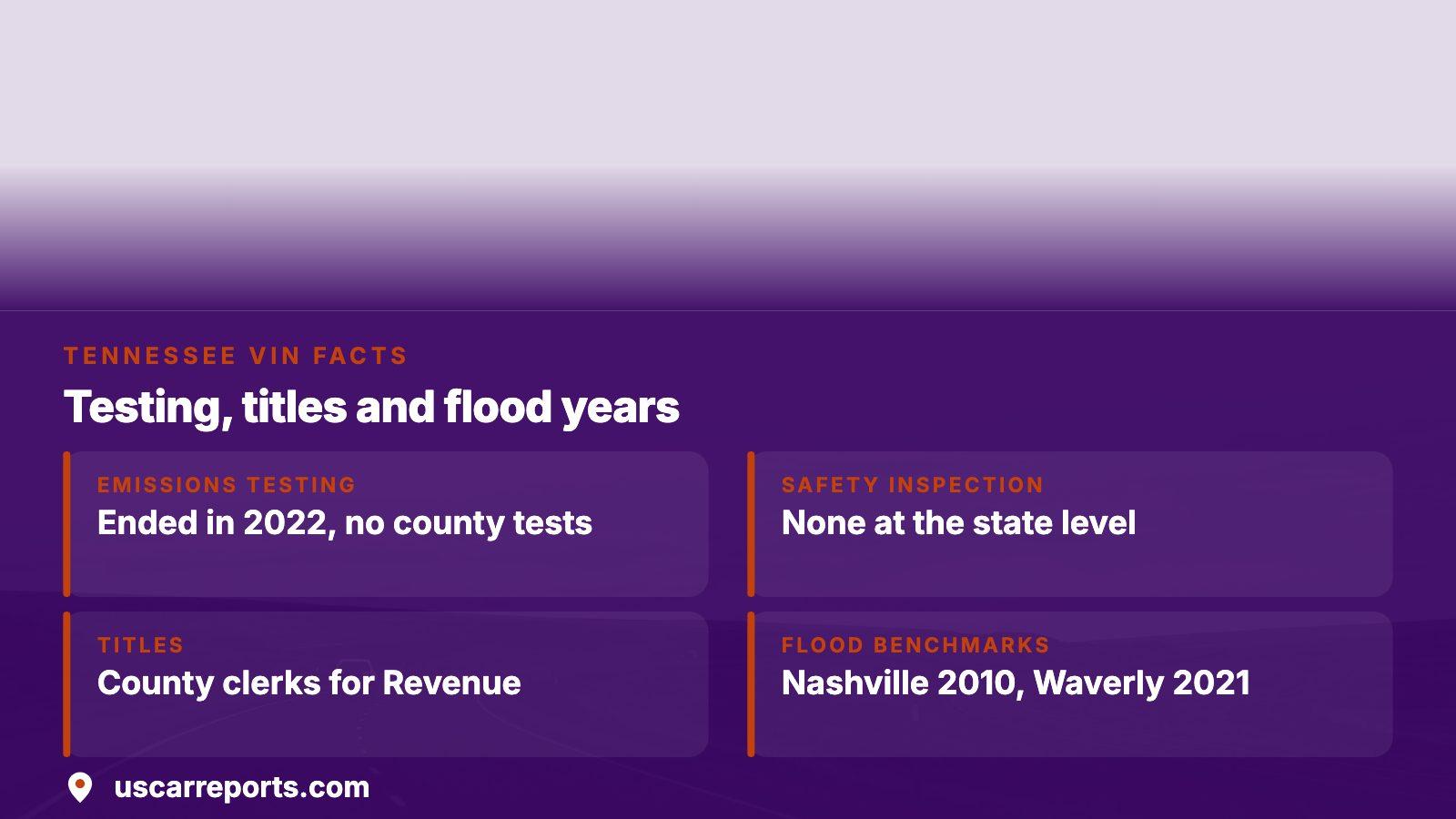
- Emissions testing
- Ended in 2022, no county tests now
- Safety inspection
- None at the state level
- Titles
- Handled by county clerks for the Department of Revenue
- Flood benchmarks
- Nashville in 2010, Waverly in 2021
Why Tennessee gets its own check
USCarReports runs a page for every state because the VIN is the only thing that crosses a border. The history follows the number, while the rules for titling, testing and inspecting stay with the state where you buy. A state check has to cover both halves, and in Tennessee the second half is thin.
Since 2022 the state has asked nothing of a used car's engine or brakes. No county tests emissions and no statewide inspection exists, so a registered Tennessee car can reach your driveway having been examined by nobody. The records still tell you a great deal. They just cannot describe the condition of the car today.
What a Tennessee VIN check covers, and what each part costs
| Check | What it tells you | Cost |
|---|---|---|
| VIN decode | The factory build, to confirm the listing describes this car | Free |
| NHTSA recall search | Open safety recalls attached to the VIN | Free |
| NICB VINCheck | Theft and salvage reports from participating insurers | Free |
| Approved NMVTIS provider | Title brands reported by any state | A few dollars |
| USCarReports report | Brands on the title, crash and mileage entries, salvage and auction photos, liens, theft claims, insurer records, estimated value | Free preview, then one payment |
| OBD scan | Fault codes the engine computer has stored | A few dollars for a reader |
No single lookup covers everything. A decode says nothing about crashes, insurer databases miss damage nobody claimed, and a title record cannot flag a car that was never branded.
Running the lookup, from the listing to the preview
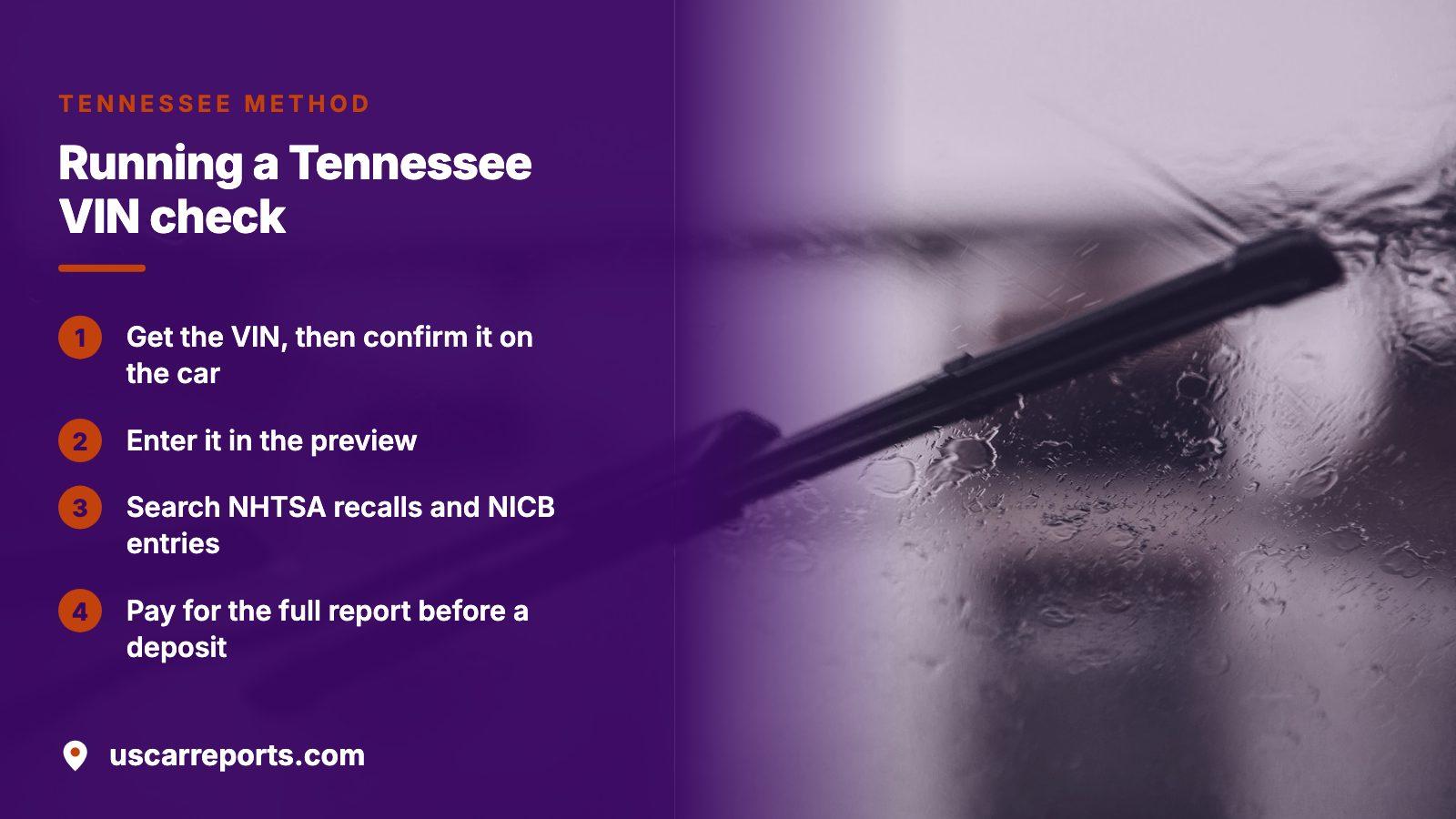
- Get the VIN from the seller before you drive over, then confirm it on the car itself: the metal tag visible at the corner of the dashboard and the sticker on the driver-side door frame. Neither should differ from the other or from the title.
- Enter the VIN on USCarReports to open the preview, and read what it lists for the title and any damage.
- Search NHTSA for open recalls, then NICB for theft and salvage entries.
- If the preview raises nothing alarming, pay for the full report ahead of any deposit.
- Scan the car's computer, look for water damage, then pay a mechanic to go over it.
What stopped in 2022, and why used buyers still feel it
Until 2022, registering a car in the counties around Nashville and Chattanooga, among others, meant passing an emissions test. The state ended that program, and Tennessee has no testing county today.
The old test did quiet work. A car with a failed catalytic converter or a dead sensor could not renew its registration until someone paid for the repair, so it was fixed or sold off cheaply. Once testing stopped, those cars stayed legal without a fix. A share of them is still for sale, and the seller has no renewal deadline forcing the repair.
Scan the car's computer before you discuss price
In a testing county, a lit check-engine light was a registration problem, and that gave a buyer bargaining room. In Tennessee the same light is just an indicator on the dash, and sellers are aware of that.
- Plug an OBD reader into the port under the dashboard. It lists faults the computer has stored or is still watching.
- Check the readiness monitors. After codes are cleared they need real driving to reset, so a car showing most of them not ready just before a sale may have had its codes wiped.
- Price a lit light as a repair. Catalysts and oxygen sensors cost from hundreds of dollars into the thousands.
- Look under the car for missing emissions parts. Ending the test did not legalize deletes, and a car without that equipment would fail in any state that tests.
Cleared is not clean
An empty fault list with ready monitors is a good sign. An empty list with mostly not-ready monitors may mean someone erased the history. Ask why the battery was disconnected or the codes were reset.
Flood history: Nashville, Waverly and the Gulf route north
Flooding is a recurring part of Middle Tennessee's story. In 2010 Nashville's flood put thousands of cars underwater, Waverly's disaster in 2021 repeated the damage on a smaller and deadlier scale, and river-valley flash floods add vehicles in wet springs. After a hurricane season, Gulf coast cars also drift north along the roads that cross the state.
Insured flood cars get written off and branded, so they show up in a title record. Uninsured ones get dried, detailed and sold on clean titles, and only an inspection catches them.
- Grit or dried mud in the trunk's spare-wheel recess and under the seat tracks
- Corroded plugs and bare metal beneath the dashboard
- Condensation or a tide line inside the lamp housings
- Power windows, gauges or warning lights that misbehave off and on
- Carpet cleaner than the seats, or heavy air freshener
How a Tennessee title changes hands
Tennessee runs titles and registration through its county clerks, under the Department of Revenue, instead of a walk-in state motor vehicle office. Georgia works the same way. The clerk completes the transfer, so the counter is the last step of a purchase, not the first screen.
- Read the title before you agree on a price. The name printed on it must be the seller's, spelled exactly as on the seller's identification.
- Compare the title with the history report. Brands, a lienholder and the odometer reading should agree.
- Do not pay a seller who says the title is elsewhere or still on its way.
- Ask the clerk's office which documents your purchase needs before you go.
Reading the results: what each finding means
| Finding | What it suggests | Your next move |
|---|---|---|
| Salvage, rebuilt or flood brand | An insurer or state treated the car as a loss | Negotiate as you would for any branded car, and get a mechanic to examine the frame |
| Recent arrival from a Gulf state | Possible storm exposure with no claim on record | Run the water inspection before anything else |
| Odometer readings that drop or stall | A rollback, or a replaced instrument cluster | Ask for service records, and walk away without a clear answer |
| A lien on the title | A lender may still hold a claim to it | Do not pay until a release is in hand |
| Damage record without a brand | A crash that never ended in a write-off | Judge the quality of the repair in person |
Cost, and the order to spend money
The preview costs nothing. After it, the full report is a single payment: no subscription, nothing that renews. Anyone weighing several cars can buy a pack of 3, 5 or 10, and /pricing shows the choices.
Run the free lookups, read the preview, and buy the report if the car still looks right, before you leave a deposit. The report covers records, not mechanical condition, so book a mechanic next. With no state inspection, nobody else will ever put this car on a lift.
Where this information comes from
- Tennessee Department of Revenue: Title and Registration — The state agency behind titling and registration, which counties carry out through their clerks.
- NMVTIS: National Motor Vehicle Title Information System — The federal title record that approved providers report from, covering brands in every reporting state.
- NICB VINCheck — A no-cost theft and salvage lookup fed by participating insurers.
- NHTSA: Recalls — The open-recall search by VIN.
Sources and photos: Facts checked against the sources above in November 2026. Photos by engin akyurt, Thibault Valjevac and John Kakuk on Unsplash; diagrams by USCarReports.
Keep reading
- Georgia VIN check: find liens and title problems before you buyA neighboring clerk-titling state, with a lien risk of its own.
- Florida VIN check: title records, flood risk and Florida buying rulesThe longer water inspection for cars with Gulf coast history.
- Washington VIN check: the history to pull and the rules you buy underAnother state that ended its emissions program, in 2020.
- Sample reportSee how title, damage and odometer entries are laid out before you buy.
Frequently asked questions
Can I run a Tennessee VIN check for free?
Partly. Decoding a VIN, searching NHTSA's recall database and checking NICB's theft and salvage lookup all cost nothing. The national title record is the paid part, sold by approved NMVTIS providers. USCarReports shows its free preview first, so you can see what is there before paying once for the full report.
Does Tennessee still test emissions?
No. The testing that counties like those around Nashville and Chattanooga ran ended in 2022, and no county tests now. A car with its emissions parts removed would still fail the day it moved to a state that tests, which makes a missing catalyst a resale problem, not a clever shortcut.
Can I look up a Tennessee license plate to find the owner?
No, not as a private individual. Plate records fall under the Driver's Privacy Protection Act, a federal law that closes personal details in motor vehicle files to anyone without a listed purpose, and curiosity about a stranger's car does not qualify. When buying, ask the seller for the VIN instead.
Does a clean Tennessee title mean the car never flooded?
No. Flood branding depends on an insurance claim or a state record, and a car that went uninsured can be dried out, detailed and sold with a clean title. Nothing on paper marks it. Look in person for grit, corroded connectors and tide lines, mainly on cars that lived in Middle Tennessee or along the Gulf.
Where do I title a car I just bought in Tennessee?
At your county clerk's office, which handles titles and registration on behalf of the Department of Revenue. Bring the signed title, and phone ahead to learn what else your sale requires. Before paying, make sure the seller's name on the title is exactly the name of the person in front of you.
Now check the car itself
The guide explains what to look for. The report shows what this VIN has on record.