
THE SHORT ANSWER
Read the VIN off the car itself, match it to the title, and run the search before you pay a deposit. Watch for salvage, nonrepairable, rebuilt and nonnegotiable wording. Virginia's brand tests target cars from this model year or the five before it, plus any car valued at $10,000 or more before the damage. A rebuilt brand never comes off, and the buyer has thirty days to send the title to the DMV.
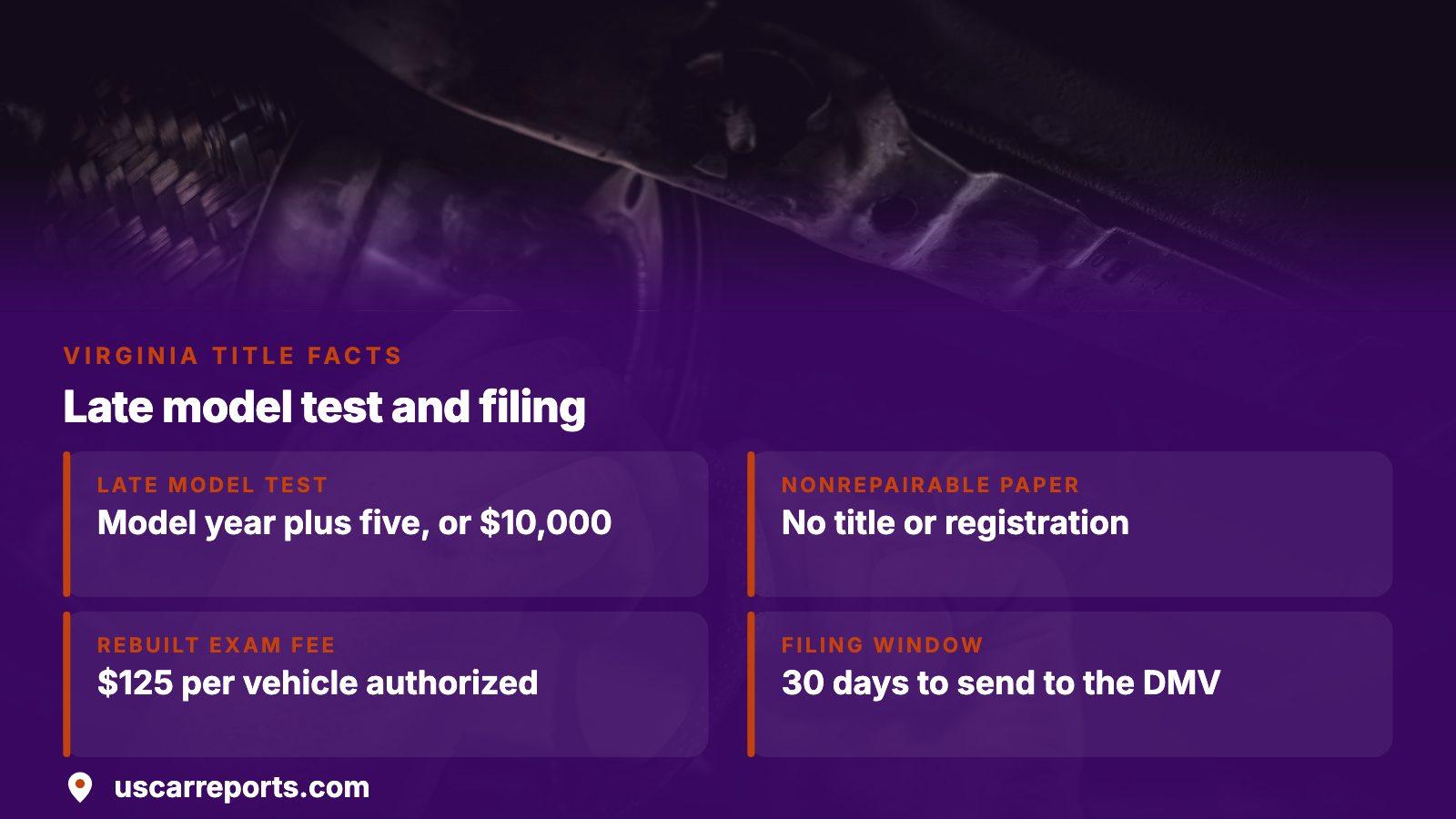
- Late model test
- This model year plus five, or $10,000 before damage
- Nonrepairable paper
- No title or registration, with narrow exceptions
- Rebuilt exam fee
- $125 per vehicle is authorized
- Filing window
- 30 days to send the title to the DMV
What the record adds to the Virginia title in your hand
A Virginia title tells you what the DMV knew on the day it was printed. The record behind the VIN reaches into years the car spent under other states' paper. USCarReports lays it beside the title, so a mismatch shows before you commit.
- Brand history from every reporting state, including entries earned across the border.
- Total-loss, salvage and auction entries, with photos where the auction took any.
- Odometer readings from different dates, which should climb steadily.
- Liens, impounds, theft claims, insurance entries and open recalls.
The federal title database is narrower on purpose, limited to five items: title state and date, brands, an odometer figure, and total-loss and salvage flags. Repair histories, recall data and service records are left to private providers, per the Justice Department's own guide.
The late model gate in front of every Virginia brand
Virginia writes its salvage rules around late model vehicles, and the code opens that door two ways. One is age. The other is money: a car counts if it was worth $10,000 or more before the damage.
| Car | Inside the automatic tests? |
|---|---|
| Current model year, or any of the five before it | Yes |
| Older car valued at $10,000 or more before it was hurt | Yes, through the value door |
| Older car valued below that | Mostly no; a brand usually follows only if someone applies for one |
Value means retail price just before the damage, as set by the insurer handling the claim or, absent an insurer, by the DMV. Below that line and past the age window, a plain title says little about the car's past.
Three Virginia documents and what each allows
| Document | What it means | On the road? |
|---|---|---|
| Salvage certificate | A car declared salvage. The DMV issues it for a $10 fee once the old title and registration are surrendered. | No registration or plates until it is rebuilt and retitled |
| Nonrepairable certificate | A car judged worth only parts and scrap. No issuing fee. | Never titled or registered, apart from exceptions elsewhere in the chapter |
| Title branded rebuilt | A repaired salvage car that passed the DMV exam and a safety inspection | Can be registered; every later title carries the brand |
Mind the vocabulary. Virginia cancels the title when it issues a salvage certificate, so a damaged car's paper is a certificate, not a title. Read the exact words on the document.
How a car becomes salvage, and what the 75 percent test skips
The salvage test subtracts before it compares. A late model car is salvage when the repair estimate, with towing, storage, rental and diminished-value payments left out, would top its value minus its worth as wreckage. That salvage figure is the insurer's own, or 25 percent of value where no insurer is involved.
Rebuilt status uses a second yardstick: a repaired late model car whose estimate went past 75 percent of value, with engine, transmission and drive axle repair costs taken out of the sum. Those parts rank among the priciest on any vehicle, so a big bill can sit beside a modest figure on the brand test.
Owner-retained cars come next. If the owner keeps a late model car after the insurer pays a claim past 75 percent of its value, the insurer has to report that to the DMV. An uninsured or self-insured owner past that mark must obtain a salvage certificate personally.
Where a clean title can hide a hard hit
No report is due on an owner-retained loss when a supplemental claim covers replacing an engine, transmission or drive axle with parts of like kind and quality. Request the repair paperwork, then pay a mechanic to examine the driveline first.
Out-of-state brands and the nonnegotiable title
Virginia carries other states' brands forward. A car arriving on another state's salvage paper, not yet rebuilt and examined under Virginia's steps, gets a salvage certificate. A brand reading junk, for destruction, for parts only or not to be repaired counts in Virginia as a nonrepairable certificate from that state, whether it sits on the printed title or in the national database.
If such a car was rebuilt, titled and registered elsewhere, and repair records accompany the application, Virginia issues a nonnegotiable title. The car can be registered, but no negotiable title is ever issued for it. The code permits transfers after a death, by operation of law, and to an insurer. An ordinary private sale is not listed, so ask the DMV before paying for one.
What the DMV rebuilt examination proves, and what it does not
A rebuilt salvage car clears two gates. First comes a state safety inspection by an inspector with no tie to whoever asked for it. Then the DMV examines the car before issuing any title: photos or video from before the repair, receipts for parts and labor, and the VIN, odometer and engine, transmission or electronic modules. The code authorizes a $125 fee.
The code calls this an antitheft and antifraud measure and says it does not certify safety or roadworthiness. A pass shows the paperwork and parts add up. It cannot tell you how well the repair was done.
The narrow exemption
The exam can be waived, but only when all three of these apply: the rebuilder's license is 10 or more years old and penalty-free, the car is a decade old or older but not an antique, and it would resell for less than $10,000. That rebuilder must still keep the repair records, so ask where they are kept.
Running the check in order
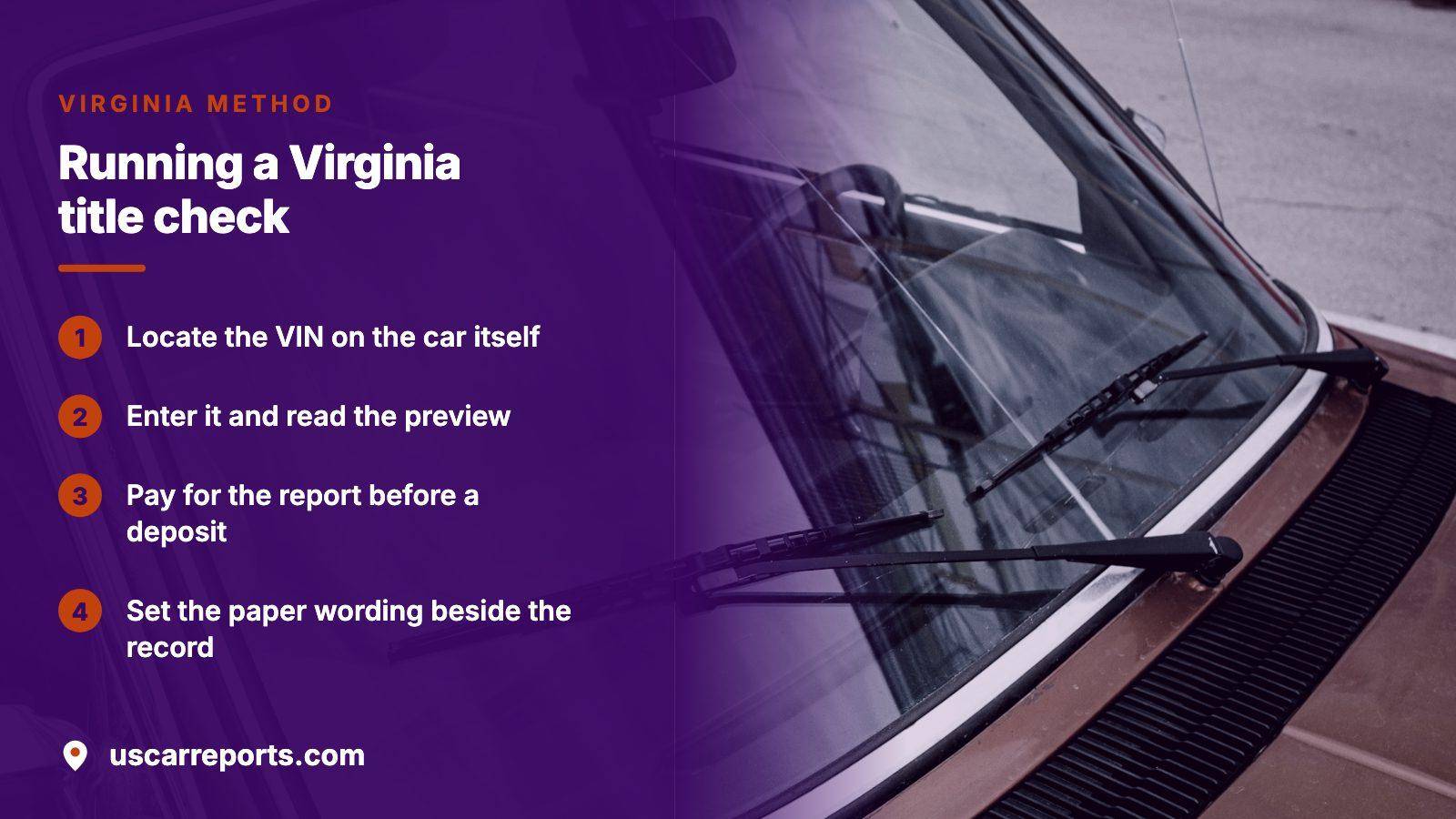
- Locate the VIN on the car itself: through the windshield at the dash corner, and on the sticker in the driver's door frame. Compare both with the title, character by character.
- Enter that VIN in the box above and read the free preview first.
- Pay for the full report only if the preview leaves the car standing, and do it before any deposit changes hands.
- Set the wording on the paper beside the record: salvage certificate, nonrepairable, rebuilt or nonnegotiable. A mismatch is a reason to stop.
- On a rebuilt car, ask for the exam paperwork and the repair receipts.
- Pay a mechanic to look the car over, driveline first.
Virginia buying rules: filing the title
After the sale, the buyer inks a name and address onto the title. Thirty days is the window to send it to the DMV with an application for registration and a certificate of title. This page quotes no fees; check current amounts with the DMV first.
If the record shows a lien, get the lender's payoff release in writing before you pay. Photograph the front and back of the title before you hand it over, and keep the report with your sale paperwork.
What the report costs and what comes next
The preview costs nothing to open. If it shows a brand, an out-of-state history or a mismatch with the paper, you can stop there and spend nothing further. Continuing means one payment for the report, and nothing renews. Multi-report packs of three, five or ten are priced on /pricing.
A clean result narrows the risk without replacing a mechanic. If the preview and report agree with the paper, file the title inside the thirty days.
Where this information comes from
- Code of Virginia: Sec. 46.2-1600, definitions — Source for the late model test, the salvage and rebuilt definitions, and the salvage value figure.
- Code of Virginia: Sec. 46.2-1603, salvage certificates — Covers the $10 fee, the no-plates rule and the owner-retained notice.
- Code of Virginia: Sec. 46.2-1603.2, nonrepairable certificates — Shows the no-title, no-registration rule and how other states' junk brands are treated.
- Code of Virginia: Sec. 46.2-1605, rebuilt vehicles — Supports the two-step inspection, the exam fee, the exemption and the permanent brand.
- Code of Virginia: Sec. 46.2-1606, out-of-state titles — Explains carried-forward brands and the nonnegotiable title.
- Code of Virginia: Sec. 46.2-630, title transfer — Backs the thirty-day filing window for the new owner.
- NMVTIS: Understanding a vehicle history report — Lists the national report's contents and what private providers cover instead.
Sources and photos: Facts checked against the sources above in November 2026. Photos by Owen Michael Grech, Max Tokarev and Martin Fennema on Unsplash; diagrams by USCarReports.
Keep reading
- Virginia VIN check: salvage rules, title steps and inspectionThe VIN side of a Virginia purchase, beyond the title rules.
- Registering a car in another state: deadlines, title and checksWhat a buyer faces when a car arrives from outside Virginia.
- Certificate of destruction by state: what the paper allowsWhat it means when a car's paper ends in scrap.
- Title status check: what the state lookup tells a car buyerHow a title's status reads wherever the car was last registered.
Frequently asked questions
Is there a free Virginia title search by VIN?
Parts of the picture cost nothing, such as the federal recall lookup. For the title record, the national database's website lists approved providers, and you buy each provider's report on that provider's own site. The preview here is free; the report that follows is a single purchase.
Can a Virginia nonrepairable car ever be registered?
Generally not. Once a nonrepairable certificate has been issued, the code bars any later title or registration unless another part of the chapter says otherwise. A car holding a nonnegotiable title from a rebuild done elsewhere is a separate case.
Does the rebuilt brand ever come off a Virginia title?
No. The title issued after a passed exam, and every later title for the car, is permanently branded as rebuilt. Each later owner inherits the disclosure.
Can a clean Virginia title still sit on a wrecked car?
Yes. An older car below the value line may never be branded, driveline repair costs drop out of the 75 percent sum, and a wreck nobody reported leaves nothing for any record to show. Treat an unbranded title as no finding and inspect the car.
How long do I have to file a Virginia title after a purchase?
Thirty days is the window in the transfer statute: the new owner signs the title in ink and forwards it to the DMV with the application. This guide quotes no fees, so confirm them with the agency.
Now check the car itself
The guide explains what to look for. The report shows what this VIN has on record.