
THE SHORT ANSWER
Start from the number stamped on the car and set it against the paper title. Check the brand lines on that title, then run WisDOT's lien holder search and a national history search on the same number. Wisconsin brands damage only in set cases: an owner who holds on to the car after an insurance loss of 30% to 70% of its value gets no brand, so a plain title does not clear the car.
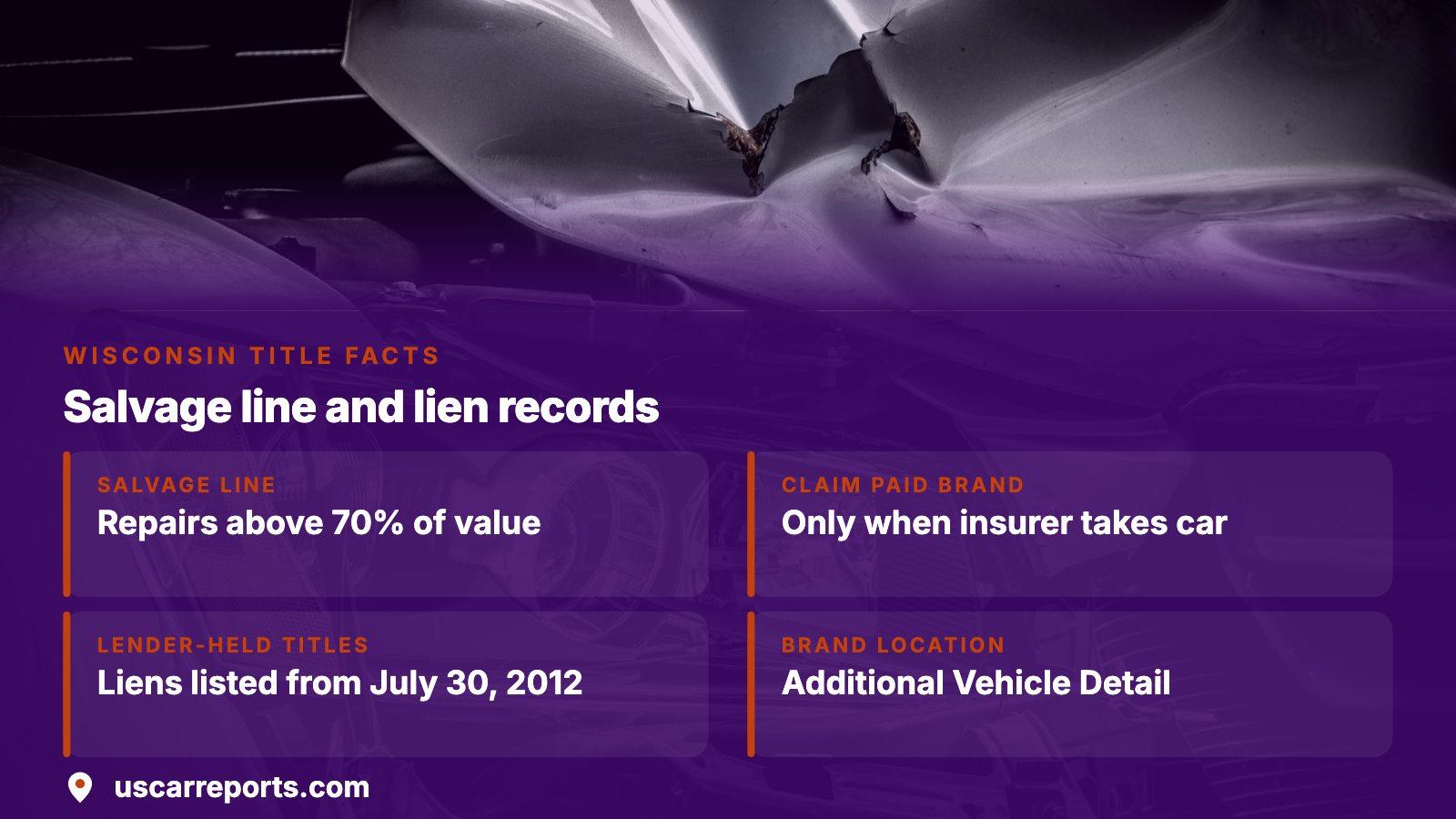
- Salvage line
- Repairs above 70% of pre-damage value, cars under seven years old
- Claim paid brand
- Only when an insurer takes the car
- Lender-held titles
- Liens listed from July 30, 2012
- Brand location
- Additional Vehicle Detail on the title
The three records a Wisconsin title search should reach
A Wisconsin title search is not one lookup. The state keeps a title and lien record, the federal NMVTIS database gathers brands from participating states, and neither shows what a bent frame looks like. WisDOT notes that NMVTIS data reaches consumers through third-party sites, which is where a VIN report fits.
| Record | Where it comes from | What it settles |
|---|---|---|
| Paper title | The seller, in person | Owner's name, brands Wisconsin printed, odometer statement, any lender |
| Lien holder search | WisDOT, online, by VIN | Whether the title was delivered to the owner or to a lender, and which business lender |
| History by VIN | The preview here, then the report | Brands, total-loss and auction entries, odometer readings and liens from other states |
| Inspection | A mechanic | The condition no record describes |
Reading the paper title before anything else
Wisconsin prints brand wording in the Additional Vehicle Detail area of titles issued after December 2004, and that area also repeats brand information on file from another state. WisDOT ties its description to that date, so an older document deserves extra questions.
- The seller's name must be the titled owner's. WisDOT lets only a licensed dealer sell a car that is not titled to them.
- Owners joined by "and" must both sign the back. Owners joined by "or" need only one signature.
- On a model year 2011 or newer car, the back shows a mileage figure marked actual, not actual, or over the mechanical limit. The dashboard should not read lower.
- A seller who lost the title must sign over the replacement, not an original that turns up later.
Wisconsin's brands, and the question each one earns
A brand is permanent: it prints on every later title. The common ones follow, each with a question for the seller.
| Brand | What WisDOT means | Ask the seller |
|---|---|---|
| Salvage | Non-hail damage above 70% of pre-damage value on a car under seven years old, or any car last titled elsewhere as salvage | Has it passed the state inspection? |
| Rebuilt salvage | A salvage car that passed inspection by a certified state inspector | Where are the repair invoices? |
| Flood damaged | Water damage above 70%, at any age | How deep did the water get? |
| Hail damaged | Hail alone above 70%, on a car under seven years old, fixed without replacing exterior panels | Were any panels replaced? |
| Claim paid | A car under seven years old, damaged past 30% of value, that an insurer took after paying a claim | What did the insurer pay for? |
| Prior police, prior taxi, buyback | Used as a police car or taxi, or bought back by the maker after a defect went unfixed | What was the use, or the defect? |
| St Farm not inspected | A State Farm total loss never reported as salvage; not a salvage brand | Will it pass a salvage inspection? |
Four ways a Wisconsin title stays plain on a damaged car
Brands follow set tests, and a car can fall outside every one of them.
- The owner keeps it. When damage runs 30% to 70% of value and the owner holds on to the car, WisDOT says no brand is required. The claim paid brand appears only when an insurer takes the car.
- It is seven years old or more. Wisconsin's own salvage, hail and claim paid tests reach only newer cars. Flood damage has no age limit, and another state's salvage brand carries over at any age.
- Nobody reported it. A brand starts with an insurer's filing or the owner's disclosure, so a private repair can leave no trace.
- A looser state. NMVTIS notes that each state keeps its own damage tests, so a car hurt where the damage fell short of the local line arrives with nothing to carry over.
What a plain title says
No brand means no brand was applied. It does not mean nothing happened. Weigh the title by the car's age, then let the history search and a lift inspection add what it leaves out.
Liens, lenders and the paper that looks like a title
For any lien listed from July 30, 2012 onward, WisDOT sends the title to the lender rather than the owner. The owner holds a Confirmation of Ownership instead, and WisDOT says that paper cannot transfer ownership. A seller who still owes money has to pay off the loan before selling.
WisDOT's lien holder search takes the VIN and reports who received the title, the owner or a lender. A business lender's name and address appear. A personal lender's stay hidden. The separate title transfer search returns only the date WisDOT last processed a title, and it asks for the owner's driver license or ID number, so in practice it is the seller's tool.
A confirmation is not a title
Offered a Confirmation of Ownership, hold your money until the lender releases the lien. Where a lien shows on a title, get the lender's release document as well, since the state needs both papers to title the car.
Running the search in order
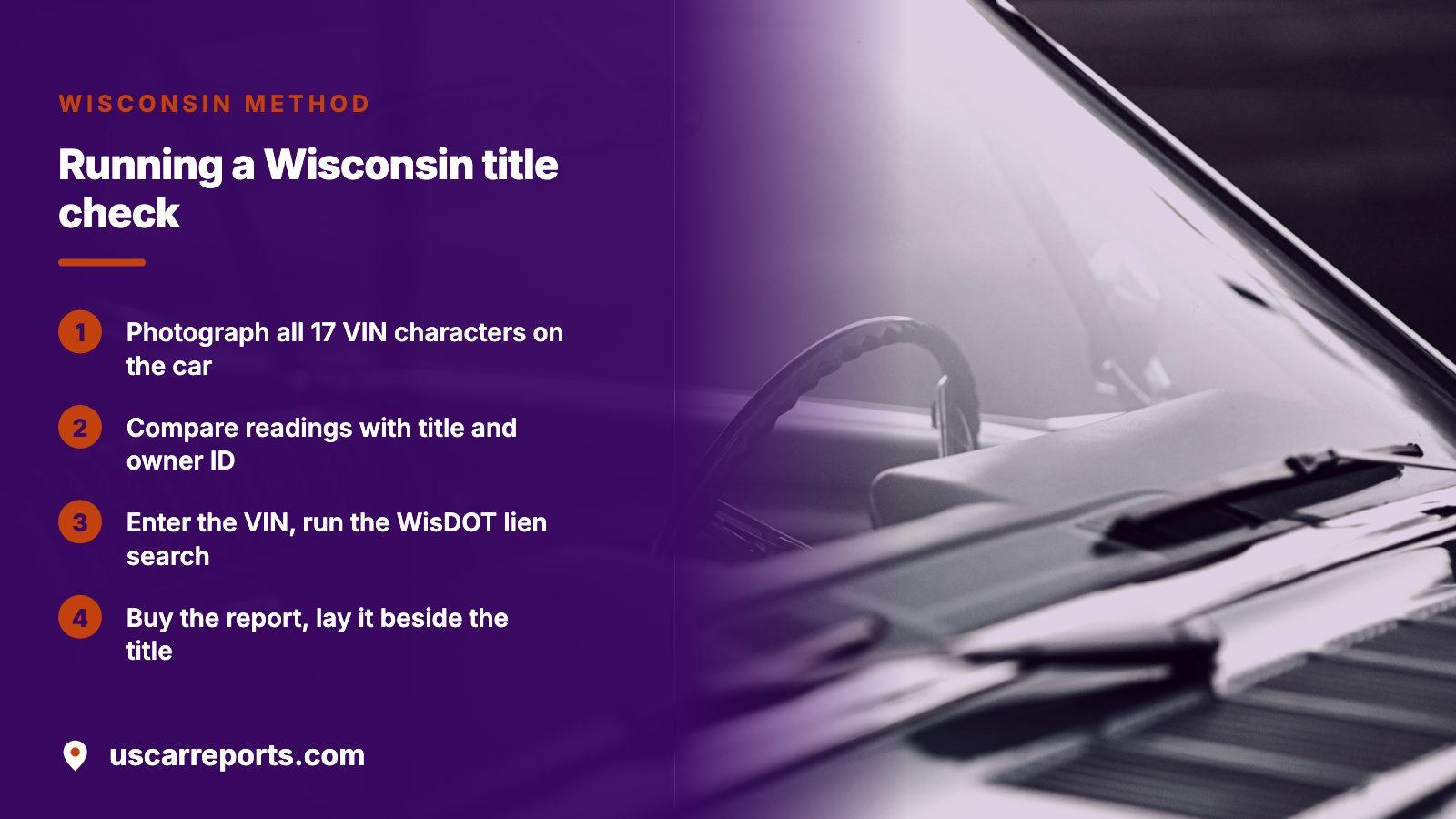
- Photograph all 17 characters of the VIN on the car itself, not the listing: the metal tab visible through the windshield first, the door-jamb sticker second.
- Compare both readings with the title, and the seller's ID with the owner's name.
- Enter the VIN on this page for the preview.
- Run WisDOT's lien holder search on the same number.
- Use NHTSA's recall search, which WisDOT's history page points buyers to.
- Buy the report once the car still looks right, before a deposit.
- Lay the report beside the title: brands, mileage, lender, total-loss entries.
- Book a mechanic for a look underneath.
Red flags when the results come back
- A total-loss or salvage-auction entry beside a Wisconsin title with no brand.
- A salvage brand from another state that the Wisconsin title omits, though WisDOT carries it over at any model year.
- A Confirmation of Ownership, or a lender in the lien search that the seller never mentioned.
- Mileage that stalls, drops, or sits above the figure written on the title.
- A St Farm not inspected brand: no registration until it passes a salvage inspection.
- A seller with several cars to sell. WisDOT requires a dealer license above five sales in 12 months.
A seller who hides a brand risks a fine of up to $5,000, yet no fine repairs the car. A clean search also lowers the odds without ending them: NMVTIS itself warns that reporting gaps can return a falsely clean result.
Cost, sale-day paperwork and the next step
No payment is taken to see the preview. After that, one purchase buys one report with no renewal to cancel, and packs of 3, 5 or 10 exist for a longer shortlist. The amounts sit on /pricing.
Once you buy, WisDOT expects a driver to title and register the car within two business days, using the original title rather than a photocopy. Its fee page lists $214.50 for an original title or a transfer, so confirm the current figure. If the title reads salvage, price the inspection into your offer, or walk away.
Where this information comes from
- WisDOT: flood damaged vehicles and other title brands — Each Wisconsin brand, the 70% and 30% tests, the seven-year limit, brand placement on the title and the penalty for hiding one.
- WisDOT: insurance company title notice — Form MV2849 and the note that an owner keeping a car after a 30% to 70% loss needs no brand.
- WisDOT: sell your vehicle — What a seller must sign and fill in on the back of the title, and the lien release and dealer license rules.
- WisDOT: lien holder search — Lender-held titles from July 30, 2012, the Confirmation of Ownership and what the search shows.
- WisDOT: title search — The title transfer search, its owner identifier requirement and the date it returns.
- WisDOT: vehicle title fees — The state fee for an original title or a transfer.
- NMVTIS: information for consumers — What a federal title search covers, why state definitions differ and why a clean result can still be wrong.
Sources and photos: Facts checked against the sources above in November 2026. Photos by Dimitri Karastelev, Dylan Michaud and Clark Van Der Beken on Unsplash; diagrams by USCarReports.
Keep reading
- Wisconsin VIN check: the seven-year salvage line and what a clean title missesThe buying rules for dealers and private sellers, and the salvage inspection before plates.
- Title status check: what the state lookup tells a car buyerHow a state's status lookup reads, and what it leaves out.
- Illinois Title Check by VIN: Brands, Rebuilders and RecordsThe neighboring state's brands and rebuilder rule, for cars that cross the border.
- Sample reportSee how brands, damage photos and mileage sit on a finished report.
Frequently asked questions
How do I run a Wisconsin title check?
Compare the car's VIN with the seller's paper title, read the brand lines, and run WisDOT's lien holder search. Then enter the VIN here for the preview, buy the report before a deposit, and have a mechanic inspect the car last.
Is there an online Wisconsin title search by VIN?
Partly. WisDOT offers a lien holder search by VIN and a title transfer search that needs the owner's ID. Brands from participating states sit in NMVTIS, which WisDOT says is sold through third-party sites. USCarReports shows a preview at no charge, then bills the report once.
Can a Wisconsin car be badly damaged and still have no brand?
Yes. If the owner keeps the car after an insurance loss of 30% to 70% of its value, WisDOT says no brand is required. Cars seven years old or more fall outside the salvage and claim paid tests, and unreported repairs leave no filing.
What if the seller only has a Confirmation of Ownership?
That paper cannot transfer ownership. It means a lender holds the title. Do not pay until the loan is paid off and the lien released, and use WisDOT's lien holder lookup to confirm the lien is gone from the record.
Can a Wisconsin title say junk?
No. WisDOT issues no junk brand. A car sold as junk gets that word written across its title, and once junked it can never be titled or licensed again, whatever repairs follow. Salvage is different: a salvage car can return to the road after a Wisconsin salvage inspection.
Now check the car itself
The guide explains what to look for. The report shows what this VIN has on record.