THE SHORT ANSWER
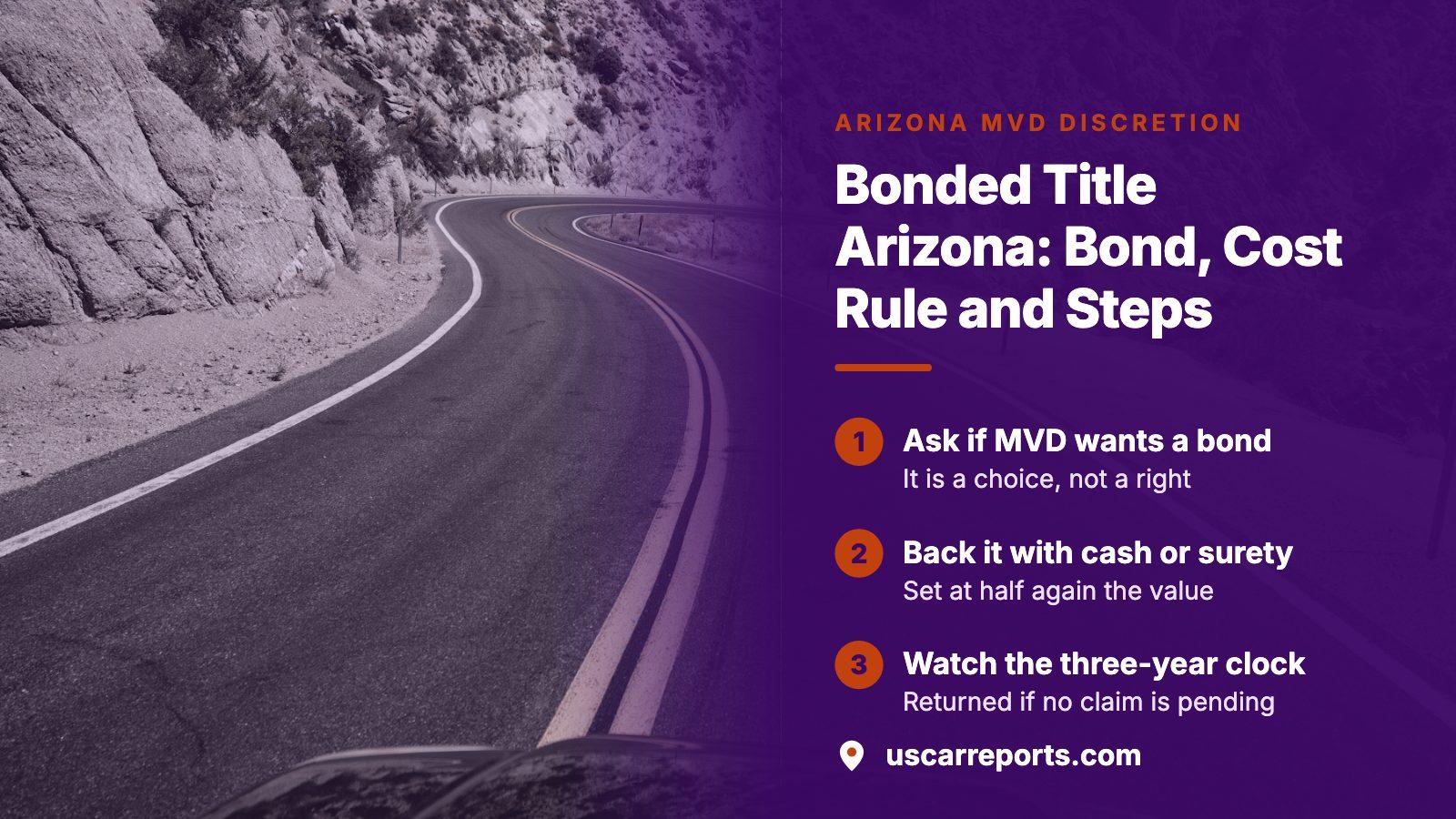
Under Arizona law, the Motor Vehicle Division may withhold a title until you prove ownership, or it may issue one if you file a bond. The bond is set at half again the car's worth by MVD's own valuation, backed by cash or a licensed surety. It is returned after three years if no claim is pending. The statute makes it a choice for MVD, not a right.
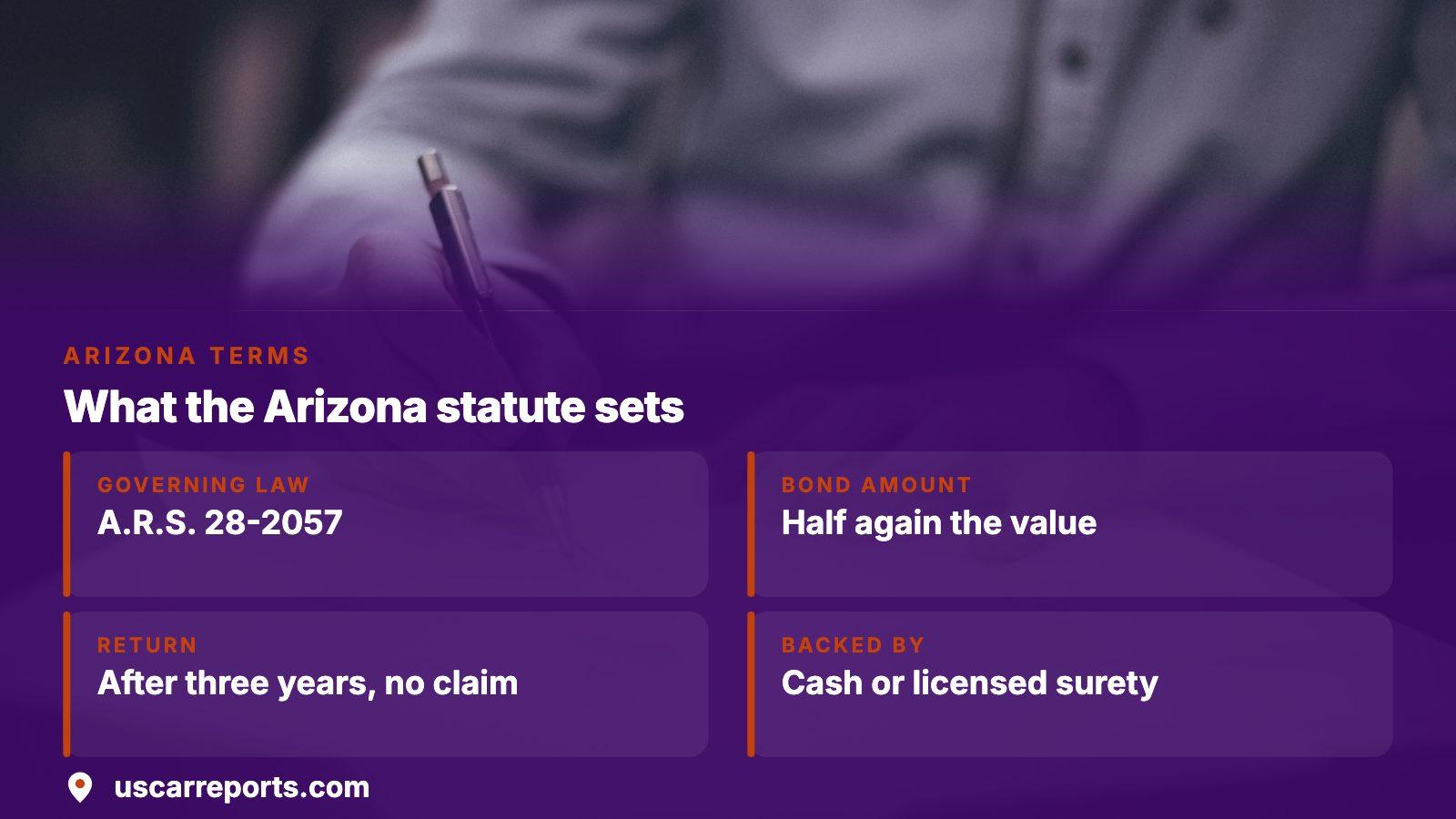
- Governing law
- A.R.S. 28-2057
- Bond amount
- Half again the car's value, per MVD
- Return of bond
- After three years, if no claim is pending
- Backed by
- Cash deposit or an Arizona-authorized surety
When Arizona MVD asks for a bond at all
The bond comes from a single statute, A.R.S. 28-2057, whose heading reads registration without certificate of title or bond. It applies when the Motor Vehicle Division is not satisfied about ownership, or is not satisfied that no undisclosed security interest sits on the car. In that spot the division may still register the vehicle, but it has two choices for the title itself.
- Hold the title back until you hand over documents that reasonably prove you own the car and that no lender has a hidden claim.
- Issue the title, but only after you file a bond with the department.
Notice the word may. Nothing in the statute entitles an applicant to a bond. It is a tool the division can use, so what you actually get depends on what you bring and how the office reads it. Many buyers land here because the seller never signed the title over.
How the bond is set up and priced by the statute
MVD prescribes the form. You sign it and attach one of two backings: a cash deposit, or a co-signer that is a licensed Arizona surety firm. The face amount is half again the car's value, and the value is the department's own figure, not your purchase price or a listing's claim.
| Piece | What the statute says |
|---|---|
| Amount | Half again the value MVD determines |
| Backing | Cash deposit, or a licensed Arizona surety firm co-signs |
| Who is protected | Earlier owners, lienholders, later buyers and later lenders |
| Losses covered | Expense, loss or damage, attorney fees included |
| Ceiling | The surety's total liability to everyone stops at the bond amount |
If you go through a surety instead of cash, the premium is a separate cost from the bond amount, and this page does not quote one because no official page I opened sets it. The title certificate fee in the statute is $4, but MVD can attach other charges, so ask the office for the current total.
What the bond protects, and why it is not protection for you
The bond is a promise to the state and to anyone with a better claim. The statute lists the people it indemnifies: prior owners, lienholders, later purchasers and anyone taking a security interest afterward. If a person with stronger proof of ownership appears, or a lender nobody told MVD about turns out to be real, that person can bring a suit against the bond if its terms were breached.
Who pays in the end
A surety that pays a claim usually looks to the applicant afterward. Read the indemnity terms on the bond form before you sign, and ask the surety what happens if a claim lands in year two.
Treat the bond as the last step of a clean purchase, not a patch for a murky one. A hidden lien is exactly what a VIN history can surface before you commit.
The three-year clock and how the bond comes back
The statute returns the bond, and any cash that went with it, at the end of three years. There is a shortcut: if the car drops off Arizona's registration rolls and you turn the current title in to the department, the bond can come back earlier. The one exception is a pending lawsuit. If MVD has been told an action to recover on the bond is underway, it keeps the bond until that matter is resolved.
- Day one: the bond is filed and the title issues.
- Years one to three: an interested person can still bring a claim.
- After three years with no notice of a claim: the bond and deposit are returned.
- Sooner, if the car leaves Arizona and you surrender the title.
Selling during those three years is the part buyers overlook. Whoever buys from you inherits a title that was issued on a bond, so keep your paperwork and be ready to explain it.
Run the VIN check before you spend on a bond
A bond answers one question: whether the state will title a car with a gap in its paper trail. It says nothing about whether the car is worth owning. Start with the preview and see what a full report would add. These entries matter most here.
- Title brands: a salvage, flood or junk label from any state that applied one.
- Liens: an open lender claim is the thing a bond is supposed to cover, so find it now.
- Theft records: a car that was reported stolen cannot be fixed with a bond.
- Odometer readings: a rollback is easier to spot on a timeline than on a dash.
The Justice Department's title system keeps a brand in a car's record once a state applies it, and it was built to catch brand washing, where a car is retitled somewhere that does not look at earlier states. It also warns that coverage is incomplete: roughly 87 percent of vehicles nationwide are covered, so an empty result can mislead. Inspect the car too.
Paperwork that may spare you the bond
Because the statute's first path is to withhold the title until documents prove ownership, the cheaper fix is usually better paper. The director may title a car on satisfactory proof of ownership even if no title was ever issued, which is a wide door. Useful papers answer two questions: who owns it, and who else might claim it.
- A bill of sale with the seller's name, the date, the price and the full VIN.
- Any earlier title, registration or plate paperwork from the seller.
- A lender's release if a loan existed and was paid off.
- A copy of the seller's identification matching the name on whatever records exist.
I could not open the MVD's own pages to confirm which forms it asks for, so ask the office or its authorized providers for the current list before you assemble anything.
If MVD refuses the title
A separate statute lets the director refuse to issue a title or registration when an applicant is not entitled to one, and even revoke a title already issued. The notice goes out in person or by first class mail. You then have 15 days from the date it was mailed to ask for a hearing, so the date on the notice matters more than the date it reaches you.
Do not miss the window
Put the mailing date in your calendar the day the notice arrives. The statute counts the 15 days from mailing, not from when you opened the envelope.
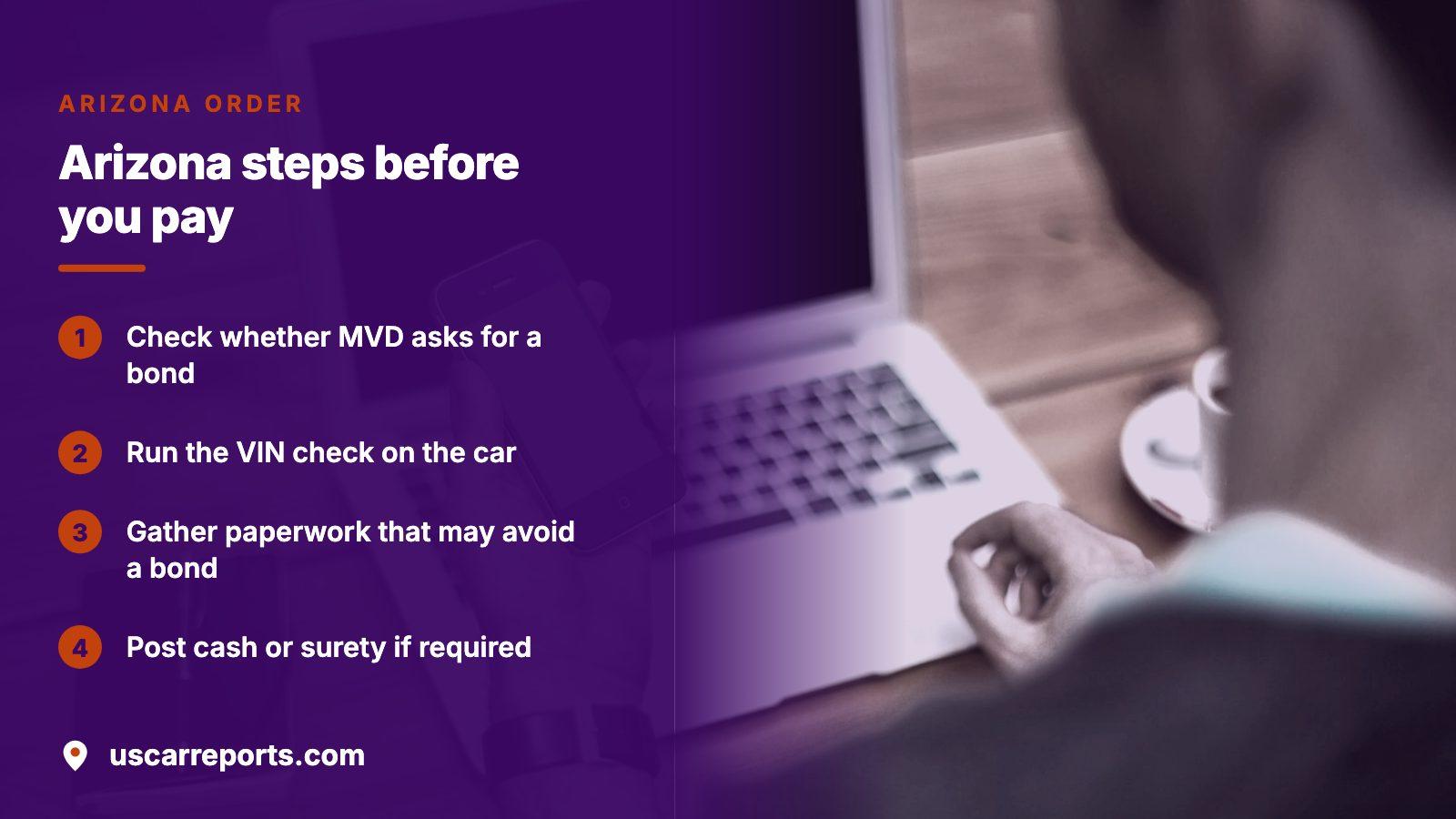
A short order of operations before you pay anyone
- Take the VIN from the car and test it against every document, digit by digit.
- Add the two government-adjacent lookups that charge nothing: NHTSA recalls and NICB's VINCheck.
- Buy the report once if the preview shows a clean enough record.
- Ask the MVD whether it will take your documents or require a bond.
- Get surety quotes once the division confirms the bond route.
The preview opens at no charge, and a report is then a one-time buy. See the pricing page for the going rate.
Where this information comes from
- Arizona Revised Statutes 28-2057 — Where the bond rule, its amount, its backing and its three-year return come from.
- Arizona Revised Statutes 28-2059 — Covers refusal of a title and the hearing request window.
- Arizona Revised Statutes 28-2003 — Lists the statutory fee for a certificate of title.
- NMVTIS for consumers, US Department of Justice — Explains brands, brand washing and coverage gaps.
- FTC: buying a used car — Supports reading a history report and also inspecting the car in person.
Sources and photos: Facts checked against the sources above in November 2026. Photos by Will Truettner, Alejandro Escamilla and Scott Graham on Unsplash; diagrams by USCarReports.
Keep reading
- Bonded title: what it means for a buyer, state by stateHow the bond rule differs from state to state.
- Arizona VIN Check: Title Brands, Heat Wear and Flood HistoryWhat an Arizona VIN lookup shows before you spend on paperwork.
- Abandoned vehicle title: what each state issues, and to whomAnother route when the previous owner cannot be found.
- Title status check: what the state lookup tells a car buyerHow to read a title's current status and brands.
Frequently asked questions
How much is a bonded title in Arizona?
The bond is set at half again the car's worth, using the figure MVD arrives at. A cash deposit or a licensed surety firm stands behind it. A surety also charges a premium, and I found no official figure for it, so ask for quotes and confirm current fees with MVD.
How long does an Arizona bonded title last?
The bond is held for three years under the statute. It is returned after that, with any cash deposit, unless MVD was told a claim is pending. It can come back sooner if the car leaves Arizona registration and the title is surrendered.
Can I get a bonded title if the seller never signed?
It is possible, but the statute leaves it to MVD's judgment. The division can ask for proof of ownership instead, or require the bond. Bring a bill of sale, any earlier paperwork and the VIN history, and ask the office which route it will accept.
Does a bonded title hide a salvage or flood past?
No. The bond covers claims by prior owners, lenders and later buyers; it does not erase a brand. A brand placed by any state remains in the national record, so read the title section of a VIN report before bonding anything.
Is a bonded-title car hard to resell?
The statute does not bar it, but the bond stays in force until its term ends or the title is surrendered after the car leaves Arizona. A buyer will see how the title was issued, so keep your documents and explain it plainly.
Now check the car itself
The guide explains what to look for. The report shows what this VIN has on record.