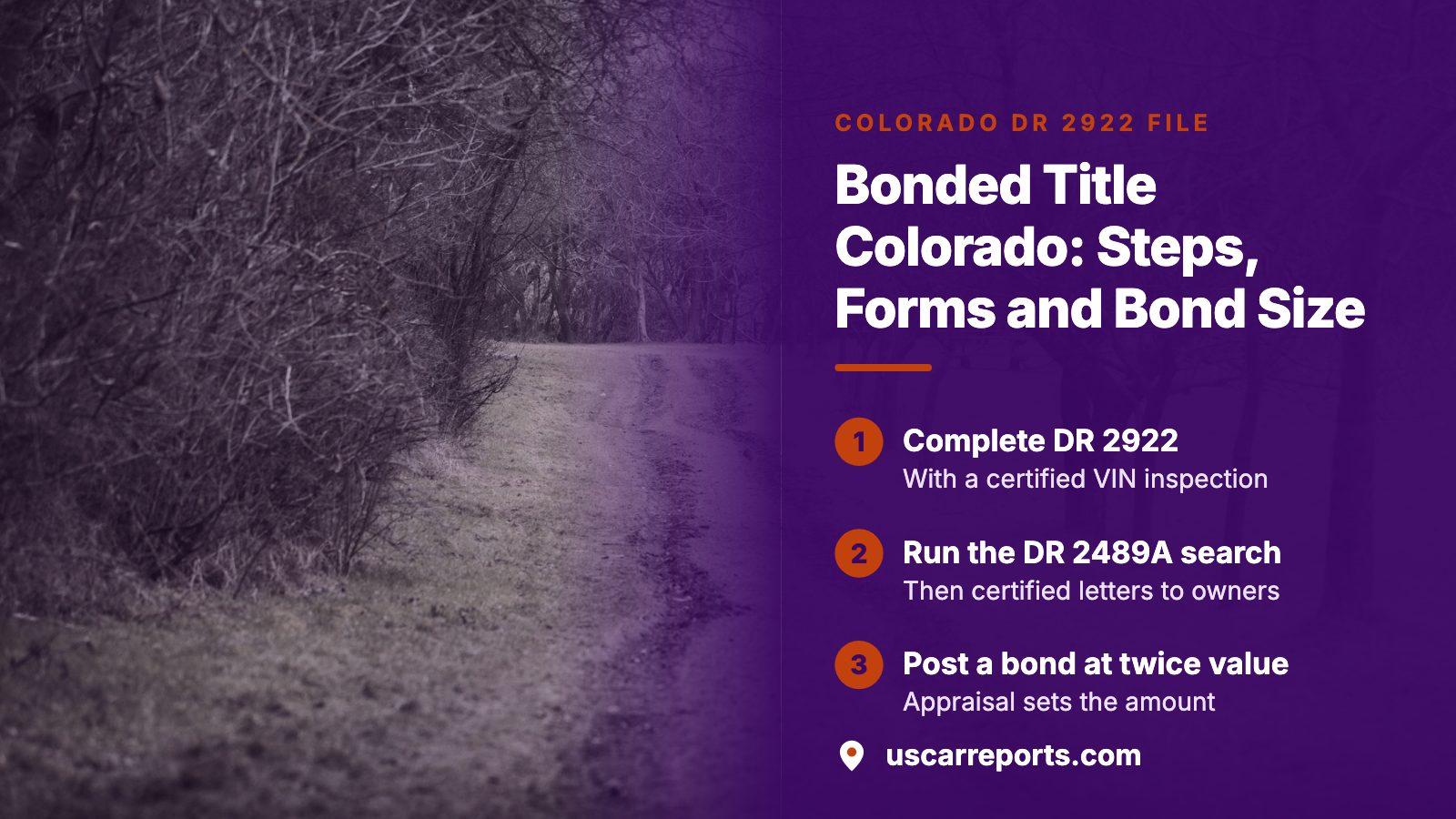
THE SHORT ANSWER
Colorado handles a missing or unusable title through bonding for title under C.R.S. 42-6-115. You complete form DR 2922 with a certified VIN inspection, a record search on DR 2489A, certified letters to anyone on record, an appraisal and a one-time surety bond set at twice the appraised value. Vehicles 25 years or older follow a lighter in-lieu-of-bond route.
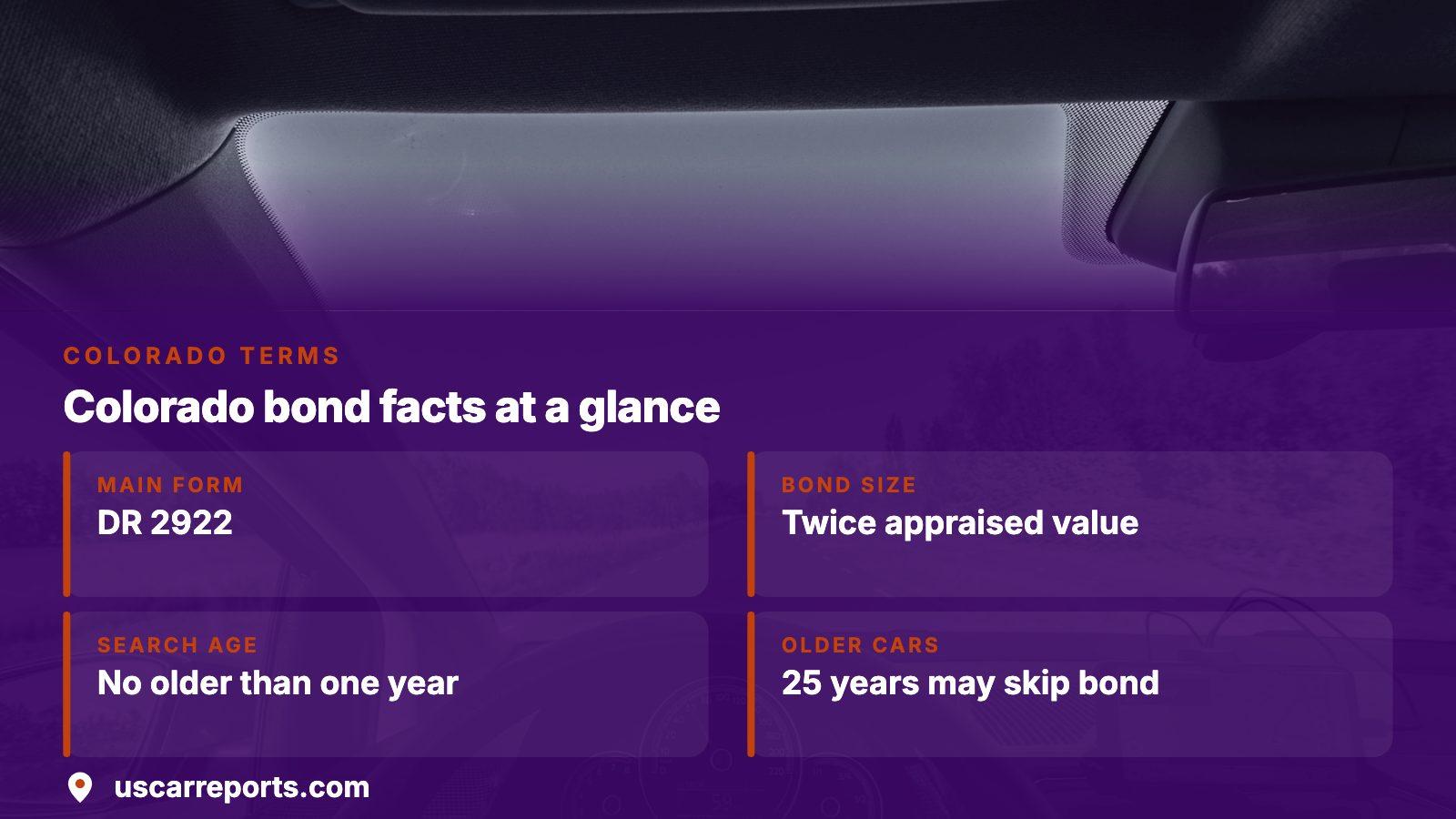
- Main form
- DR 2922, regular bond application
- Bond size
- Twice the appraised value
- Inspection and search age
- No older than one year
- Older cars
- 25 years or older may skip the bond
When Colorado lets you bond for a title
Bonding is the state's answer to a specific problem: you have the vehicle, you paid for it, and the ownership papers are missing, wrong or cannot be corrected. Colorado's own title manual lists lost documents, a title that does not line up with the car, and mistakes in the last six characters of the VIN as the standard cases. Your county motor vehicle office handles the filing, and the car must be sitting in Colorado while you do it.
One situation is closed off. A car left somewhere with no agreement with the owner of record cannot be bonded; it must be towed and processed as abandoned. A property sale that included a vehicle is different: a bill of sale naming the car by VIN, year and make can support a bond.
Not the same as a lost title
If you are the titled owner and only lost the paper, ask about a duplicate. Bonding is for people who cannot show a chain of ownership at all.
The six pieces the county office expects
The rule behind this process is 1 CCR 204-10-19, and it reads like a checklist. Gather everything before you go, because each piece has its own age limit.
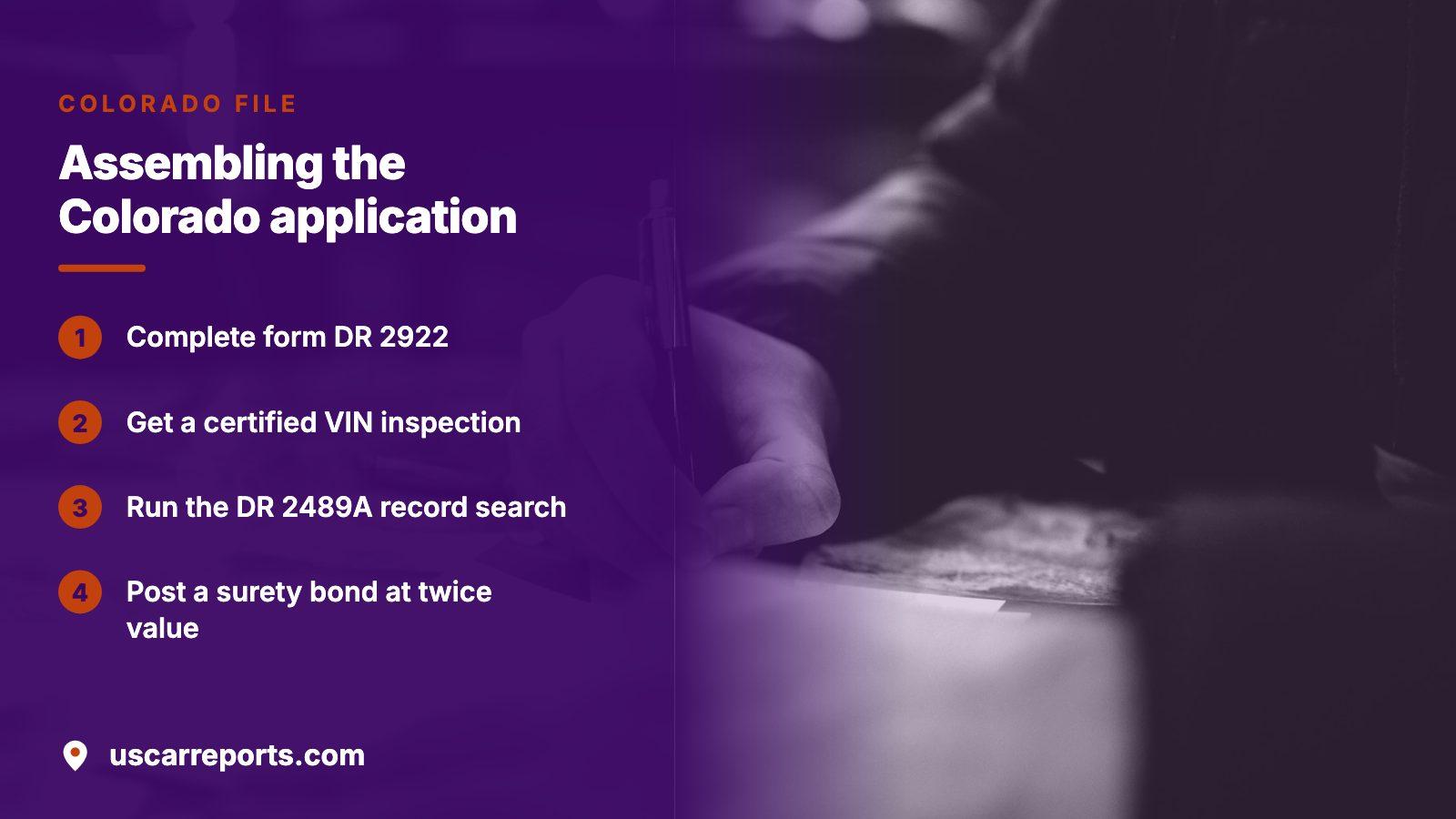
- A VIN inspection on form DR 2704, done by a POST-certified individual, with the plate line filled in or marked N/A.
- A title record search on form DR 2489A, which names the last owner of record and any liens.
- Certified-mail letters to every owner and lienholder the search turned up, with proof of delivery or of failed delivery.
- A lien release for each active lien, unless the lender cannot be reached and you can document that.
- A value for the car from an approved source, covered in the next section.
- The surety bond itself, plus the DR 2394 bond statement explaining how you ended up without a title.
Newer cars need an odometer statement too: for model years under twenty years old, the mileage is recorded on the DR 2173 sale form.
The inspection and the record search, and their shelf life
Both documents expire. The VIN inspection can be no more than a year old when the county accepts the application, and the same limit applies to the record search. An inspection done out of state is not accepted, so the vehicle has to be in Colorado for this step.
The search is Colorado-only at first. When it finds no Colorado record, the manual calls for a national search on applications dated after April 1, 2024, and for notice to whoever that search names. The search can come back several ways: nothing on file, a Colorado owner with liens, a lien filed elsewhere, or a suspense record that points you to another state.
Send the search with the inspection and the fee to the Vehicle Services Section in Denver, or use the online request. Neither the manual nor the rule I read prints the fee for either step, so confirm those amounts with your county office.
How the bond amount gets decided
The bond is twice the appraised value, and you pick the appraisal from a short menu. A licensed Colorado dealer can write one on letterhead with the VIN, year and make, a signature, the dealer license number and a stated value above $350.00 that matches the car's condition today. The alternative is a Blue Book or NADA guide value with the exact model highlighted, supported by form DR 2444. For cars and light trucks the retail figure is allowed if you state it was your choice.
| Situation | Bond the state expects |
|---|---|
| Ordinary missing title | Twice the appraised value, using the higher figure when retail and wholesale both appear |
| Lienholder cannot be reached | The larger of the lien amount and double the appraisal |
| Car 25 years or older | No bond or appraisal, but an affidavit and a sale document from the last two years |
| Homemade or in-lieu trailer, 2,000 pounds or less | No surety bond with form DR 2697 |
The bond is a single payment and is not refundable. It cannot be written to a trade name.
Older cars and the other ways around a bond
A vehicle 25 years or older gets an in-lieu-of-bond path on form DR 2462. You still do the inspection, the record search and the owner notices. You skip the appraisal and the bond, but the bill of sale must be no more than 24 months old when you apply. A sale further back brings the bond requirement back.
There is also a cash-style substitute for a surety company. A bank account or certificate of deposit at an institution doing business in Colorado can stand in, provided it is assigned to the state agency and is not your personal savings. A separate form, DR 2711, covers a car left at a shop or storage lot when the owner has been silent for more than 30 days.
What a bond leaves untouched
The bond answers one question, who gets paid if a better owner shows up. It says nothing about the car's past. When the record search shows a salvage history, the rule also sends you to form DR 2415, the rebuilt-from-salvage paperwork, and the car carries that history onto its next title.
- A car can arrive with theft, flood or total-loss history that no title application would ask about.
- A lien that never reached Colorado records can sit on the car until you find it.
That is why a VIN history belongs at the start, before you pay for an inspection, an appraisal or a bond premium. A report can show title brands, salvage records and odometer readings, and a mismatch tells you to walk away after spending very little.
Red flags that should stop you before the county office
- The seller will not say where the title went, or tells a different story each time you ask.
- The VIN on the dash, the door and the paperwork do not agree.
- The record search names an owner or lender in another state, and nobody has contacted them.
- The price sits far below the appraisal you would need, which suggests someone expects the bond to absorb a problem.
The DR 2394 statement asks for the seller, the purchase date, the price and your efforts to reach the owner of record. If you cannot answer honestly and specifically, the purchase is the problem, not the paperwork.
If the office says no, and where to run the check
A denial can be appealed. The rule allows a written hearing request within 60 days after the notice, and the hearing is held virtually before a designated officer. Include your VIN and a copy of the denial letter.
Before any of that, start with the VIN. USCarReports offers a free preview from the 17-character number, and the full report is one payment with no subscription, with terms on the pricing page. The preview helps you decide whether the car deserves the rest of this process. The federal NMVTIS database exists to keep unsafe and stolen vehicles out of resale, and approved providers draw on it.
Where this information comes from
- State of Colorado title and registration manual: bonds — Source for the steps, forms, appraisal options, bond sizing and in-lieu-of-bond routes.
- 1 CCR 204-10-19: Bonding for Colorado Certificate of Title — Text of the DMV rule, including the age limits, salvage cross-reference and the appeal window.
- NMVTIS, US Department of Justice — The national title database's purpose and its link to vehicle history checks.
Sources and photos: Facts checked against the sources above in November 2026. Photos by Ahmet Yüksek ✪, Owen Michael Grech and Sander Jeurissen on Unsplash; diagrams by USCarReports.
Keep reading
- Bonded title: what it means for a buyer, state by stateHow bond multiples and terms compare across states.
- Colorado Title Check by VIN: Salvage Test and Rebuilt RulesHow Colorado brands salvage and what a Rebuilt from Salvage title means.
- Colorado VIN Check: Title Brands, Hail History and Winter WearThe Colorado VIN checks worth running on any used car.
- Title status check: what the state lookup tells a car buyerHow to read the status of a title before you pay.
Frequently asked questions
What is a bonded title in Colorado?
It is a title issued after you post a surety bond because you cannot show the usual ownership documents. The bond protects anyone with a better claim, including earlier owners and lenders. Colorado calls the process bonding for title and bases it on C.R.S. 42-6-115, with the county motor vehicle office taking the application.
How much is the bond for a Colorado bonded title?
The bond is set at twice the appraised value of the vehicle, using the higher figure when an appraisal lists retail and wholesale values. When a lender cannot be found, it is the lien amount or twice the appraisal, whichever is greater. The premium you pay the surety is a separate cost I could not confirm.
Can I apply for a Colorado bonded title if I live out of state?
Not for the regular route. The vehicle must be physically in Colorado, and an inspection done in another state is rejected. If you are elsewhere, ask the Division of Motor Vehicles before spending money, since the manual page I read describes no remote option.
Do I need a bond for a car that is 25 years or older?
Usually not. An older vehicle can use the in-lieu-of-bond route, which drops the appraisal and the bond. You still need the inspection, the record search, owner notices, an affidavit, and a bill of sale no more than 24 months old.
What if a bonded title application is denied?
You can request a hearing in writing, within 60 days after the denial notice. Send your full name, mailing address, email, the VIN and a copy of the denial letter to the department's regulatory hearings contact. A hearing officer holds it virtually.
Now check the car itself
The guide explains what to look for. The report shows what this VIN has on record.