THE SHORT ANSWER
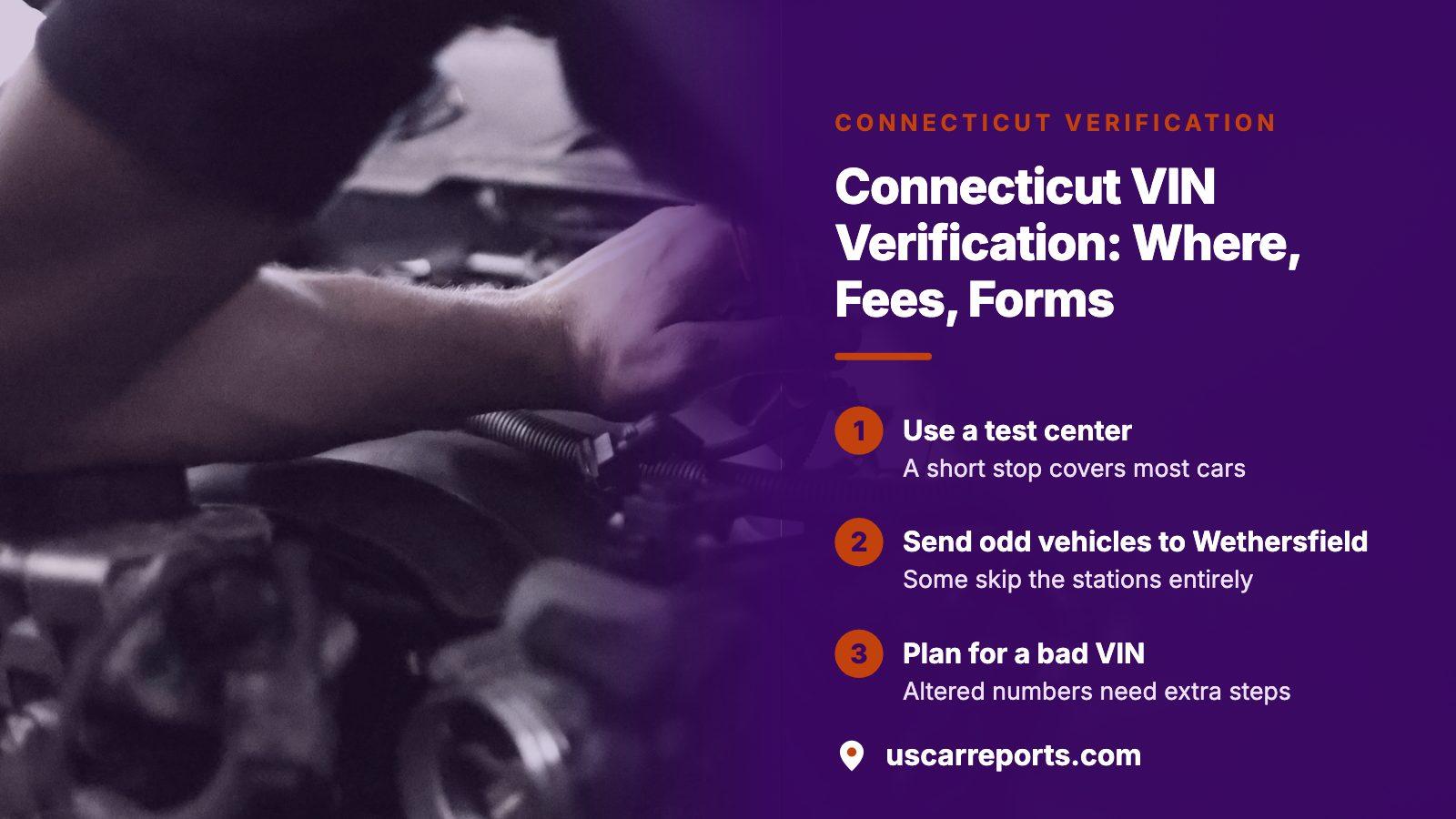
Connecticut verifies a VIN by looking at the vehicle itself, not by running a database report. A $10 stop at a contractor-run test center covers most vehicles, and the form you receive goes with you to a DMV office for registration. Salvage cars, homemade vehicles, grey market imports and a few other types go to the DMV Inspection Lane in Wethersfield instead.
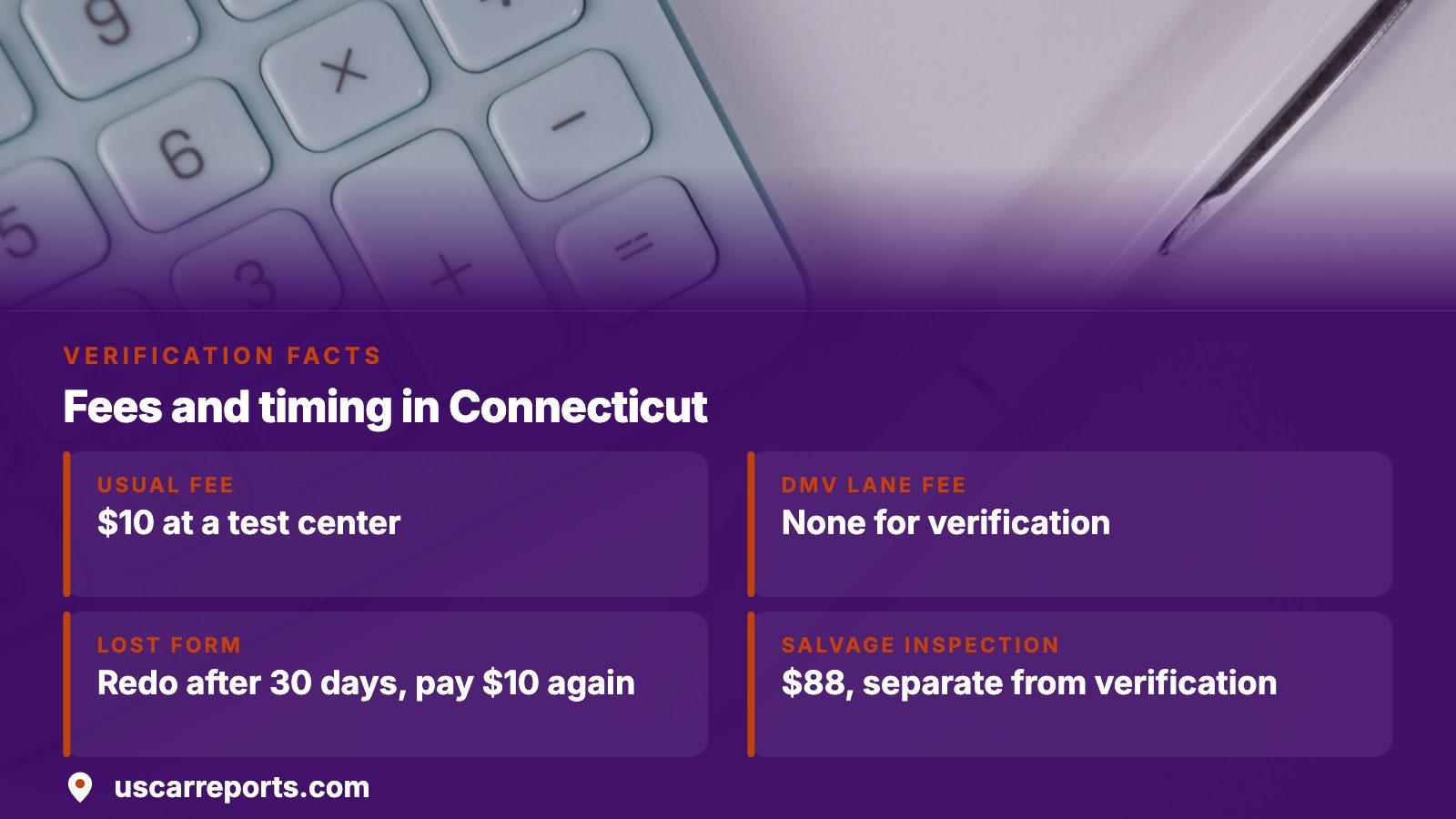
- Usual fee
- $10 at a test center
- DMV lane fee
- None for verification
- Lost form
- Redo after 30 days, pay $10 again
- Salvage inspection
- $88, separate from verification
What Connecticut means by VIN verification
The phrase covers two different things, and buyers mix them up. The state's version is an in-person look: someone qualified finds the VIN on the vehicle and confirms it is real, readable and matches what you are about to register. It happens when you bring a vehicle to the DMV's attention, typically one that came from another state or has no clean Connecticut record.
A history lookup is the other meaning. That one reads records tied to the number, such as title brands and insurer losses, and it never touches the car. Connecticut's verification cannot tell you whether the vehicle was wrecked in Ohio or flooded in Louisiana. It vouches only for a match between the stamped number and your documents.
Two jobs, two tools
Verification answers whether the car is the car on paper. A history check answers what happened to it before. Get both answers before paying. The second one you can do from home.
The test center route for ordinary cars
If your vehicle is not on the DMV's special list, the state sends you to a VIN verification test center. These are emissions stations operated by a contractor, and the DMV points you to the contractor's station finder rather than to its own offices. The fee there is $10, paid to the station.
The DMV's page names the vehicle as the thing to bring. It lists no other paperwork for the verification itself, though you will want your purchase documents ready for the registration visit that follows. The station's own site refused my automated request, so check it for hours and whether a walk-in is accepted.
When you finish, you receive a verification form. That form is your ticket to the DMV office, where the registration actually happens. Emissions testing is not performed at DMV offices, which is one reason the state uses the station network for this job.
Vehicles that skip the stations and go to Wethersfield
Some vehicles cannot be handled at a station, and the DMV lists them. They go to the Inspection Lane at 60 State Street in Wethersfield, where verification carries no fee. The list is blunt about what belongs there:
- Homemade or composite vehicles and trailers, such as dune buggies and kit builds
- Cars carrying a salvage brand
- Grey market imports, among them cars brought in from Canada
- Amphibious vehicles and ex-military ones
- Older motorcycles, model year 1980 and earlier
- Three-wheeled vehicles, except Harley Davidson and Can Am Spyder
- Makes missing from the DMV's approved manufacturer list, with utility trailers excepted
- Dirt bikes and motorcycles that closely resemble them
The lane is not a quick glance. Expect a full safety inspection, and arrive with a vehicle that runs and meets state law. If it comes on a trailer or truck, unload it so the inspector can test brakes, lights and horn. Inspectors turn away anything that cannot legally be driven, or that is positioned so they cannot test it.
When the VIN is missing, altered or unreadable
This case has its own front door. Do not drive to the DMV and hope. The state asks you to email its commercial vehicle safety unit at mcsap.reports@ct.gov, put VIN Verification in the subject line, include a phone number, and wait for a call.
Treat the situation as a warning when you are the buyer. A number that has been ground off or replaced is a classic sign of theft or a rebuilt wreck. An honest explanation can exist, but you should not hand over money until the DMV has dealt with the vehicle. Assigning a fresh VIN is a separate service, offered only at the Wethersfield lane by appointment.
The form, the deadline and what happens if a station balks
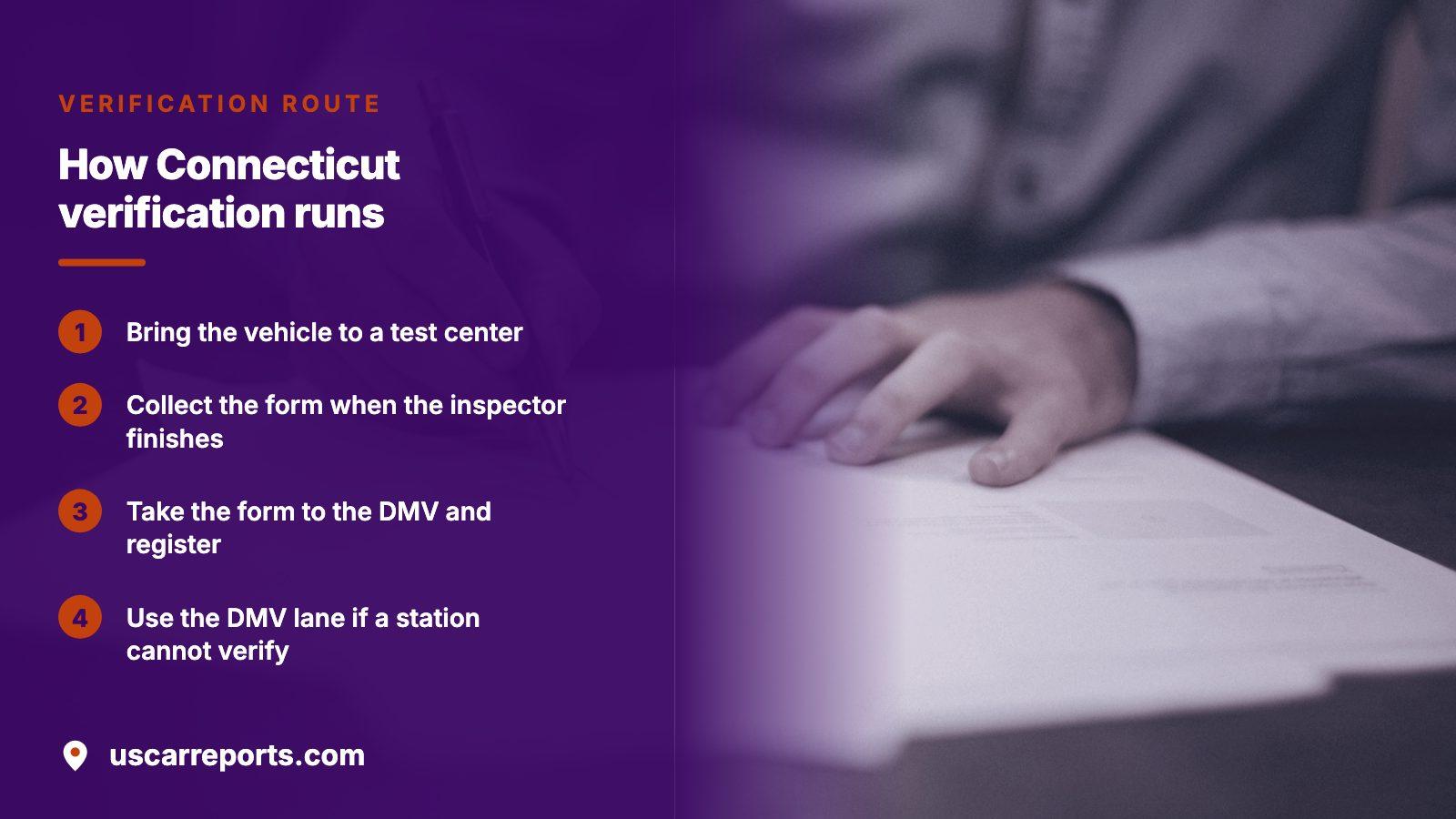
- Bring the vehicle to a test center or the Wethersfield lane.
- Collect the verification form when the inspector finishes.
- Take the form to a DMV office and register the vehicle.
- If a station cannot verify the number, take its document and the vehicle to the DMV lane.
Keep the form safe. If you lose it and 30 or more days have passed since the verification, you start over: a new verification and a second $10. Before then, the station that did the work can supply a copy. A station that fails to verify still charges its $10, and that sits on top of whatever registration fees the DMV office collects.
DMV offices are busy. Cheshire, Putnam and Stamford offer no walk-in service, and no office takes walk-ins on Saturday. Book an appointment through the DMV site, and ignore any text claiming the DMV is chasing you over a violation, since the agency says it does not make contact that way.
Salvage vehicles: verification is only the first hurdle
Because our site tracks state-specific buying rules, the salvage case deserves its own section. A vehicle stamped salvage cannot legally be driven anywhere in Connecticut, and its registration is cancelled. Verification at Wethersfield will not change that.
Getting a rebuilt car titled again means passing a separate salvage inspection, priced at $88. The vehicle has to be delivered on a flatbed, with every wheel off the pavement. The owner brings receipts for major parts, the insurer's original appraisal, a repair report with photographs, and an airbag certification if the car has airbags. A part taken from another vehicle needs a receipt showing that donor's VIN.
The permanent stamps
Three wordings close the door for good: parts only, unrebuildable and unrepairable. A title carrying any of them will never be registered or retitled. A passing rebuild gets a new title printed with the word Rebuilt. New York's MV907A salvage certificate is not accepted here.
Free and paid checks to run before the verification trip
Do your reading first, because a failed verification wastes a day and a fee. Start with the federal recall search: it takes a VIN and tells you about unrepaired recalls, though it skips repaired ones, very recent announcements, small makers and anything over 15 years old unless the manufacturer extends coverage. The NICB VINCheck is also free. It shows whether member insurers filed the VIN as stolen and unrecovered, written off as salvage, or flooded, capped at five lookups per day from a single IP address.
Neither screen amounts to a full history. NICB says so itself and will not see law enforcement records or insurers that opt out. The national title system, fed by insurers and salvage yards under federal law, lists five things: where the title sits now, brands, the odometer reading, total losses and salvage. Repair and recall data are outside it.
Where a full history report earns its place
Run the VIN on this site first. The preview is free, and the one-time report gathers brand records, crash damage, mileage readings, auction photos and open recalls under one VIN, work that would otherwise mean visiting several agencies.
| Question | Who answers it |
|---|---|
| Is the number on the car the one on the paper? | Test center or Wethersfield lane |
| Was it ever branded, totaled or salvaged? | A history report built on national title data |
| Is it stolen and unrecovered? | NICB VINCheck, plus a report |
| Any open safety recall? | NHTSA recall search |
See the sample report to judge the layout, and the pricing page for what a single report or a pack costs. For this state's stamps and the parts-only rule, the Connecticut VIN check page goes deeper than this one.
Where this information comes from
- Connecticut DMV: Verify a VIN — fees, vehicle types, the form and the lost-form rule
- Connecticut DMV: Get a vehicle inspection — VIN assignment at Wethersfield and emissions testing location
- Connecticut DMV: Salvaged and totaled vehicles — salvage inspection fee, documents and permanent brands
- NHTSA: Check for recalls — what the recall search does and does not show
- NICB: VINCheck — free theft and salvage screen and its limits
- NMVTIS: Understanding a vehicle history report — the five indicators in national title data
Sources and photos: Facts checked against the sources above in November 2026. Photos by Mustafa Sheikhmouss, Scott Graham and Sasun Bughdaryan on Unsplash; diagrams by USCarReports.
Keep reading
- Connecticut VIN Check: Salvage Stamps and Parts-Only TitlesState title stamps and the parts-only rule in detail.
- New Hampshire VIN verification form: TDMV 19A and who can sign itA neighboring state's verification process, for comparison.
- Florida VIN verification form: who signs it and when you need itHow another state handles the same in-person check.
- Sample reportSee what a finished history report looks like.
Frequently asked questions
How much does Connecticut VIN verification cost?
At a VIN verification test center the fee is $10, paid to the station. The DMV Inspection Lane in Wethersfield charges nothing for the verification itself. Registration fees are separate and are paid at the DMV office, and a salvage inspection carries its own $88 fee.
Do I need an appointment?
The VIN page gives no appointment rule of its own. The DMV does say Cheshire, Putnam and Stamford have no walk-in service and no office takes Saturday walk-ins, so book ahead for the DMV office. For a test center, check the station's own listing.
What if my verification form is lost?
Within 30 days of the verification, ask the station that did it for a copy. Once 30 or more days have gone by, the state wants a fresh verification, with another $10, before you can register.
Will verification reveal a past wreck?
No. It confirms the number on the vehicle matches the paperwork. Past damage, brands and insurer total losses sit in title and insurance records, which you read with a history report or free screens like the NICB VINCheck.
Which vehicles must go to Wethersfield?
Salvage titles, homemade and kit builds, grey market imports, amphibious and ex-military vehicles, motorcycles from 1980 and earlier, most three-wheelers, unlisted makes and dirt bikes. Any other vehicle uses a test center.
Now check the car itself
The guide explains what to look for. The report shows what this VIN has on record.