THE SHORT ANSWER
The state asks for a verification when the VIN needs a second pair of eyes: antiques, abandoned vehicles, imports from Canada, cars from states that title only newer vehicles, and some mismatches. Only a New Hampshire inspection station, authorized dealer or law enforcement officer may sign TDMV 19A. The DMV charges nothing for the form, though the agent may. It confirms identity only, not accident or title history.
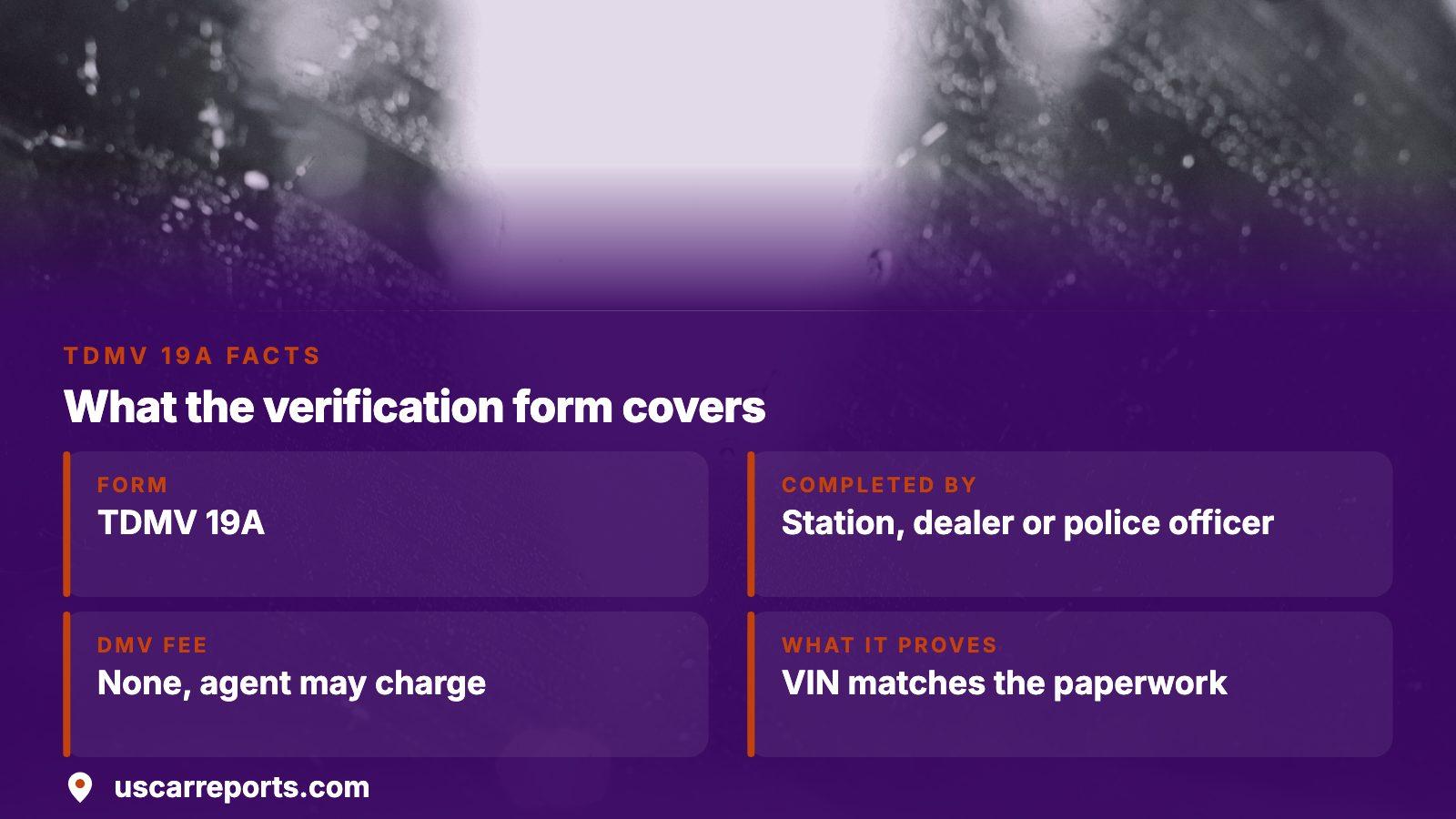
- Form
- TDMV 19A, Verification of Vehicle Identification
- Who completes it
- Inspection station, authorized dealer or police officer
- DMV fee
- None, but the agent may charge their own
- What it proves
- The VIN on the vehicle matches the paperwork
What the form does and what it leaves out
Think of TDMV 19A as a witness statement. Someone the state trusts walks up to the vehicle, reads the identification number, and writes down that it is really there. The clerk who registers the car then has a record that the metal and the paper describe the same vehicle.
That is the whole job. The form does not look up past owners, does not ask whether an insurer wrote the car off, and does not say anything about the odometer. A vehicle can pass verification and still carry a brand from another state. Treat the form as a step in registering, and treat a history search as a separate step in deciding whether to buy.
When the DMV asks for it
The DMV names a short list of situations in which a verification is required. Outside that list it can still turn up when something in the file does not line up.
- Abandoned vehicles and vehicles owned by the US government
- Antique vehicles
- Vehicles that came from another country, Canada being the example the DMV gives
- Cars arriving from a state whose titling starts only with newer models, where the DMV cites a ten-year line
- A New Hampshire-registered vehicle whose new owner has no copy of the previous registration
- Homemade trailers under 3,000 pounds
- Any case where the VIN in DMV records differs from the one the customer supplies
Notice that an ordinary used sedan with a clean New Hampshire title is not on the list. Most buyers of recent cars never see the form, and the ones who do usually arrived with a car or a document trail from somewhere else.
Who is allowed to sign, and what it costs
You cannot complete this one yourself, and neither can the seller. The DMV limits the form to three kinds of signer: a New Hampshire authorized inspection station, a New Hampshire authorized vehicle dealer, or a New Hampshire law enforcement officer.
The state takes no fee when the clerk receives the form. The person who verifies the vehicle, however, is allowed to charge for the time. A garage may quote a small amount, a dealer may waive it, and an officer is a different conversation. Ask before you drive over, and bring the title or registration you plan to present so the signer can compare numbers on the spot.
Call ahead
Because the signer sets any charge, the price and the wait are not set by the DMV. A phone call to the station tells you both before you commit to a trip.
Where the form fits a title-exempt purchase
New Hampshire does not title most vehicles of model year 1999 or older, so a private seller of an older car often has no title to hand over. The clerk then wants a proper bill of sale together with proof of the VIN. The DMV accepts several kinds of proof: the original or a copy of a title, a previous or copied New Hampshire registration, or a completed verification form.
In practice the form is the fallback. If the seller holds an old registration, copy it and skip the inspection. If the seller has nothing with the number on it, you are the one who needs the verification, and the sensible time to get it is before money changes hands.
| What the seller can hand you | What the clerk accepts as VIN proof |
|---|---|
| A New Hampshire or out-of-state title | Original or copy of the title |
| A current or expired New Hampshire registration | The registration or a copy of it |
| Neither of those | A properly completed verification form |
Getting the bill of sale right
A weak bill of sale undoes the verification. The DMV sets out what one must carry. That means the sale date, a full description of the vehicle (make, model, paint color, body type, cylinder count), its VIN, both the model year and the year it was built, and the name, signature and legal address of each party. A post office box does not count as a legal address.
Read the VIN on the paper against the VIN on the car, character by character, before the seller signs. A single transposed digit is the sort of discrepancy that makes the DMV ask for a verification, and it is far easier to fix at the kitchen table than after the seller has left town.
What to run before you pay for the inspection
Verification tells you the number is genuine, which is a low bar. The questions that cost buyers money sit elsewhere, so spend a few minutes on them first. NHTSA's recall page shows open recalls for a VIN and lets you search many numbers at once. It leaves out recalls already repaired and very old ones.
The national title system, NMVTIS, is there to stop title fraud and to make stolen cars harder to sell on. A history report built on that data shows brands from other states, which matters on any car that arrived in New Hampshire from somewhere else. USCarReports shows a free preview for any VIN, and the full report is one payment, so you can see whether a record exists before deciding to buy it.
- Read the VIN off the car in person; an ad can carry a typo or a borrowed number.
- Search recalls on the NHTSA page.
- Pull a history report to look for brands, liens and mileage conflicts.
- Only then book the verification and the clerk visit.

A different inspection for rebuilt salvage cars
Do not confuse TDMV 19A with the salvage process. A vehicle that an insurer has written off as a total loss must pass a salvage inspection at the Title Bureau before it can be registered. The DMV books those by appointment and takes $60.00 when you reserve.
After approval the owner receives a salvage VIN verification report, form DSMV 547, and every later title carries the legend Rebuilt Vehicle. A car with that wording on its title has been through a stricter process than a plain TDMV 19A check, and it should be priced accordingly.
Where this information comes from
- NH DMV: VIN verification — triggers, who may sign and the fee rule
- NH DMV: purchasing or selling a titled vehicle — private-sale paperwork for exempt vehicles
- NH DMV: vehicle registrations — what counts as proof of VIN at the clerk
- NH DMV: salvage and rebuilt vehicles — salvage inspection and rebuilt legend
- NHTSA: check for recalls — free recall search by VIN and its limits
- NMVTIS: vehicle history — purpose of the national title system
Sources and photos: Facts checked against the sources above in November 2026. Photos by Owen Michael Grech, Jakub Żerdzicki and Cole Keister on Unsplash; diagrams by USCarReports.
Keep reading
- New Hampshire VIN check: titles, the 1999 cutoff and buying rulesThe full buying rules, including the model-year cutoff for titles.
- Connecticut VIN Verification: Where to Go and What to BringHow the neighboring state handles the same inspection.
- Florida VIN verification form: who signs it and when you need itA state where buyer and seller may sign the form themselves.
- Registering a car in another state: deadlines, title and checksWhat changes when a car moves across a state line.
Frequently asked questions
What is the New Hampshire VIN verification form?
It is TDMV 19A, titled Verification of Vehicle Identification. An authorized signer inspects the vehicle, confirms the number matches your paperwork, and completes the form. You then hand it to the town or city clerk as proof of VIN when you register or title the vehicle.
Can I verify my own VIN in New Hampshire?
No. The DMV allows only a New Hampshire authorized inspection station, an authorized dealer or a law enforcement officer to complete the form. Buyers and sellers cannot sign for themselves, so plan a short trip to a garage or dealership that offers the service.
Does the DMV charge for a VIN verification?
The DMV owes no fee when you turn the form in. The agent who inspects the vehicle may set their own charge, though, so ask the station or dealer what they require before you go. A title application is a separate step with its own state fee.
Do I need a VIN verification for a car from Massachusetts?
Not by that fact alone. The DMV's list covers foreign vehicles, antiques, abandoned vehicles, cars from states that title only newer vehicles, missing previous registrations and mismatched numbers. If you hold a proper title or registration, the clerk may not ask for one.
Does a verified VIN mean the car has a clean history?
No. Verification only shows the number on the car matches the documents. A verified car can still have a salvage brand, an open lien or rolled-back mileage. Look at recalls and a title history report separately, ideally before you pay for the inspection.
Now check the car itself
The guide explains what to look for. The report shows what this VIN has on record.