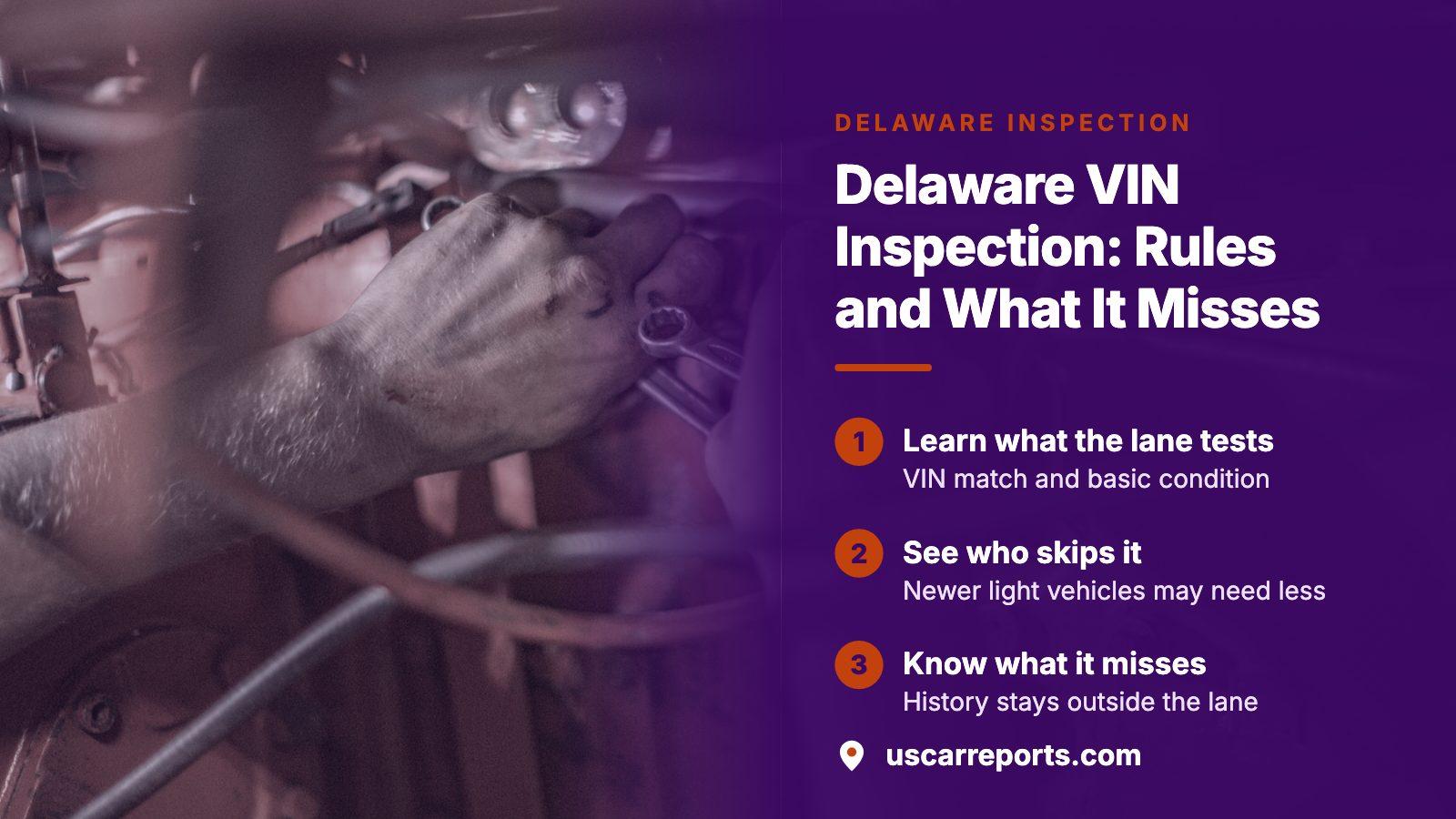
THE SHORT ANSWER
The Delaware DMV inspects, at no fee, most vehicles that arrive for a Delaware title. A car among the newest seven model years and at or under 10,000 pounds may get just a VIN verification. Older ones get the safety and emissions test. Neither step reads the car's past, so run a VIN history check before you pay.
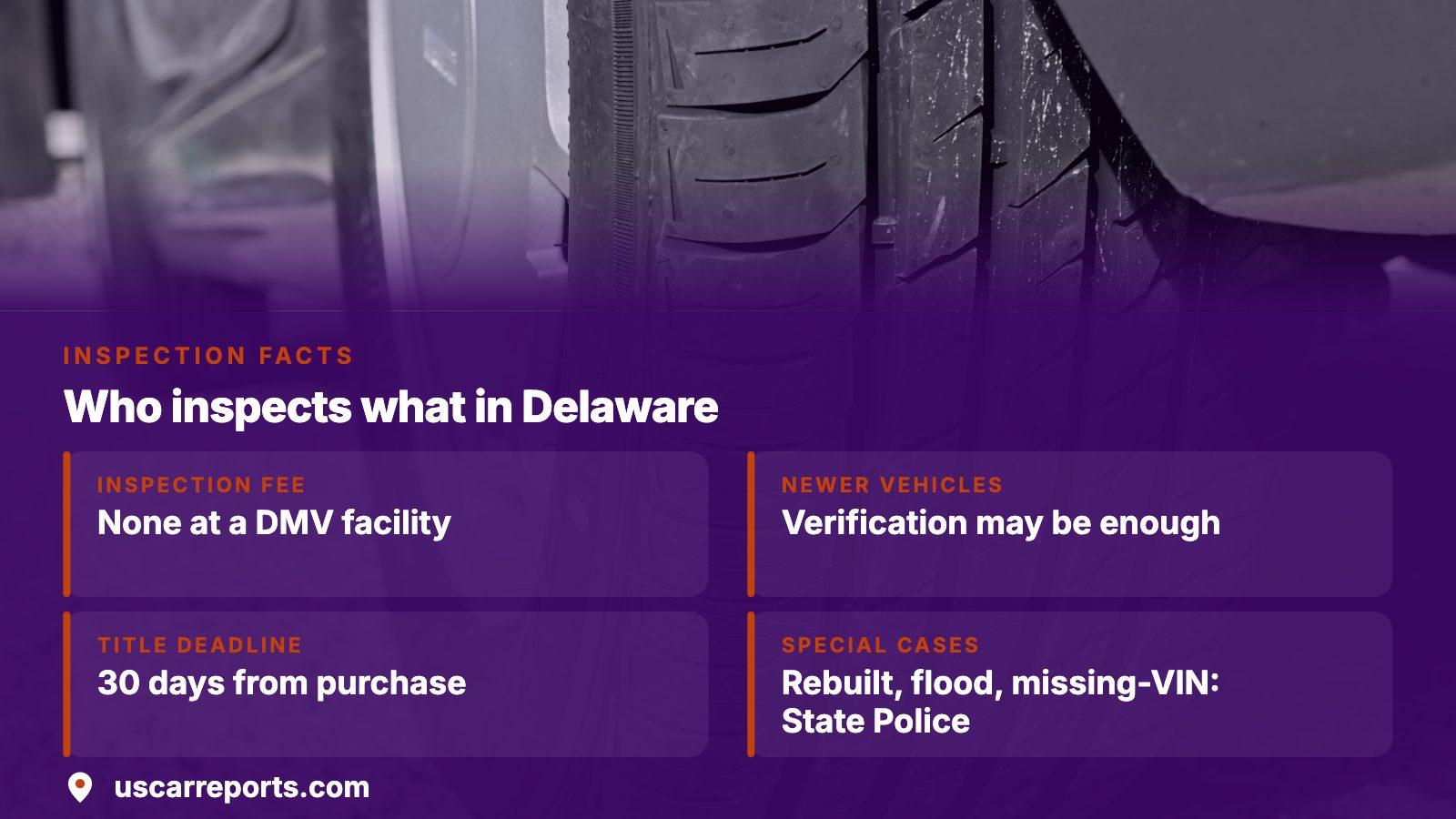
- Inspection fee
- None at a DMV facility
- Newer vehicles
- Newest seven model years at or under 10,000 pounds: verification may be enough
- Title deadline
- 30 days from purchase
- Special cases
- Rebuilt, flood and missing-VIN cars go to the State Police
When a Delaware inspection applies to your purchase
"VIN inspection" means two things at a Delaware lane. One is the full inspection, which tests the vehicle. The other is a VIN verification, which only confirms that the number on the paperwork matches the number stamped on the car. Your car's age and origin decide which you get.
Per the DMV's own pages, a vehicle new to Delaware titling usually must be inspected. A brand-new car that no state ever titled, handed over by a dealer with a Delaware title application, skips the lane. Bought a used car in Maryland or Pennsylvania? Expect to drive it to a DMV lane before any title is issued.
VIN verification versus the full inspection
Within the newest seven model years and at or under 10,000 pounds, a vehicle may need only the VIN verification. Anything older or heavier gets the whole inspection. The cutoff moves each year, so decode the model year from the VIN and confirm the current rule with the DMV before planning the trip.
| Vehicle | What the DMV asks for |
|---|---|
| New vehicle never titled, dealer supplies a Delaware title application | No inspection |
| Newest seven model years, 10,000 pounds or less, new to Delaware | VIN verification may be enough |
| Older vehicles titled for the first time in Delaware | Full inspection at a DMV lane |
| Reconstructed, flood-damaged or missing-VIN vehicles | State Police Auto Theft Unit inspection |
The verification is a clerical comparison. It shows the title paperwork and the car agree, which guards against an altered number. It does not test brakes and says nothing about earlier owners or earlier states.
What the lane actually tests
A full inspection pairs a safety check with an exhaust emissions test and a look for fuel-system leaks. The technician keys in the registration details and odometer reading, and the computer picks the standards for that model year. You leave with a printed Vehicle Inspection Report.
- Lights clean, aimed and working, including the plate light.
- Brakes that stop the car in the required distance, and tires with no bulges, cords showing or bald spots, tread at least 2/32 inch.
- Glass without holes or breaks. A crack longer than 5 inches on any window fails the car outright.
- A working horn, wipers, mirrors and latches, and an exhaust without leaks.
- No gasoline leaks, and no tint on the front windshield or front side windows.
Emissions testing follows age. Older gasoline cars get an idle test, while mid-era cars and everything after 2008, up to 14,000 pounds, get an on-board diagnostics test.
If the car fails
A failed emissions or fuel-system result means repairs first, then a retest with no charge. Registration cannot be completed until the car passes. For a buyer, a failure on a car you do not own yet is bargaining power. On a car you own, it is your repair bill.
Delaware offers an exhaust waiver, but a narrow one. A failed fuel-system test or safety item never qualifies. The car must have failed the exhaust test twice or more with the engine tuned to factory specifications, must not have failed for visible smoke or missing equipment, and the owner must have spent past a repair cost limit. The limit is $75 for the oldest cars, and for newer cars registered in Kent or New Castle County; Sussex County owners of newer cars face $200. Bring every receipt and report.
Read this before you buy
A car that is cheap because it "just needs to pass inspection" has no guaranteed path to a waiver. The safety items and the fuel system cannot be waived at all.
Cars the State Police must inspect
Some vehicles skip the ordinary lane. The DMV sends reconstructed vehicles, flood-damaged ones, cars with a missing VIN and cars with no obtainable title to the Delaware State Police Auto Theft Unit. Sessions run on the second Tuesday and second Thursday of the month in Dover, and trailers go by appointment at the troops.
An owner presenting a repaired salvage vehicle brings originals, since photocopies are refused:
- The salvage certificate, assigned to a Delaware dealer or resident.
- A bill of sale with price, date, both parties' details and the VIN.
- Typed or printed receipts for every repair, with the donor car's VIN on any used-part receipt.
- Color photos of the whole vehicle taken before repairs began.
- Photo identification for the person presenting the car.
The unit will not inspect a vehicle that a previous salvage title owner repaired, so the brand history is worth knowing before you buy a rebuilt car.
What the inspection cannot tell you
A pass says the car met the standards on the day of the test, not that it was clean the day before. A vehicle can pass with a title brand from another state, an odometer wound back two owners ago, an open lien or a theft record. The technician sees the car and the paperwork, not its history.
Delaware's own buying advice runs along similar lines. Compare the number printed on the title against the one on the dashboard, read any brand word on the title's face, and put a flood, salvage, rebuilt or reconstructed car in front of a good body shop. All of that works only on what the seller shows you.
NMVTIS, the federal title database, was set up to protect buyers from fraud and dangerous vehicles, and to keep stolen cars from being sold on. A report drawing on it reaches other states' records, which counts when so many Delaware cars were first titled next door.
Run the check before you drive to the lane
The cheapest moment to find a title brand is before any money changes hands. Paste the 17-character VIN into the USCarReports preview, which carries no charge. Ordering the full report is one purchase with no recurring fee. Read it for what a lane will never show: title brands and the issuing state, mileage readings across owners, and any damage, salvage auction, lien, impound or theft entry.
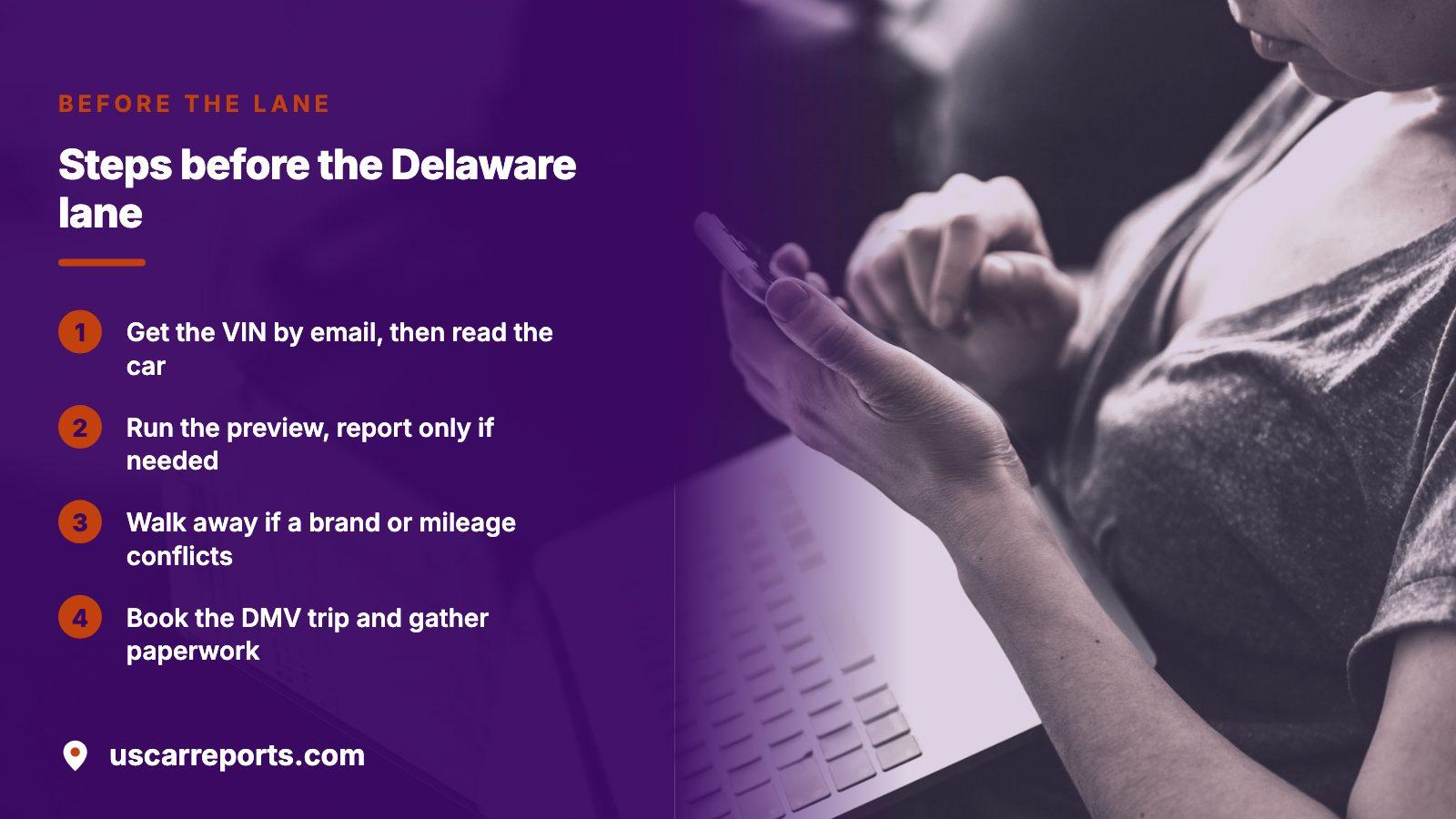
- Ask the seller for the VIN in an email or text, then read the number on the car and compare.
- Start with the preview, then order the full report just for a car that is still on your list.
- Walk away or renegotiate when a title brand or conflicting mileage shows up.
- Only then book the DMV trip and gather the paperwork.
The pricing page shows the cost before you decide.
Paperwork, fees and the 30-day clock
For an out-of-state purchase, bring the original title with its odometer disclosure or the certificate of origin, a dealer bill of sale if there was one, proof of Delaware liability insurance, and your Delaware license or other accepted proof of residency. Every owner signs. Check whether the selling state wants notarized documents; Delaware's own titles need none.
Apply within 30 days of purchase or a penalty applies. The bill includes a 5.25 percent document fee on the higher of sale price or trade-in value, so a bargain price does not shrink it. Tax paid to another state in the previous 90 days earns a credit. If the old registration expired, a 5-day temporary tag gets the car to the lane.
Where this information comes from
- Delaware DMV: Vehicle inspections — No-fee inspections, the first-titling rule and the VIN verification option.
- Delaware DMV: Vehicle safety inspection — The safety items the technician looks at.
- Delaware DMV: Inspection program FAQs — Failing, retests and the exhaust waiver rules.
- Delaware DMV: Vehicles purchased from out of state — Lane steps, documents and the titling fee for out-of-state purchases.
- Delaware DMV: Salvage and Auto Theft Unit inspections — Which vehicles go to the State Police and what paperwork they require.
- VehicleHistory.gov: NMVTIS — What the national title information system is for.
Sources and photos: Facts checked against the sources above in November 2026. Photos by Nina Mercado, Michal Biernat and Andres Siimon on Unsplash; diagrams by USCarReports.
Keep reading
- Delaware VIN check: title history, liens and the state's buying rulesThe record you can pull on a Delaware car before the DMV visit.
- New Jersey VIN check: flood history, title brands and the buying rulesMany Delaware buyers shop across the river, and the rules differ.
- Florida VIN verification form: who signs it and when you need itHow a VIN verification works in another state, for comparison.
- Registering a car in another state: deadlines, title and checksWhat changes when the car you buy must be titled somewhere else.
Frequently asked questions
Is a VIN inspection required to get a Delaware title?
Usually yes. A car new to Delaware titling generally gets inspected, except new vehicles a dealer supplies with a Delaware title application. Newer vehicles may need only VIN verification. Ask the DMV which applies to your car's model year and weight.
How much does a Delaware vehicle inspection cost?
The DMV performs inspections at no fee, and retests after a failure carry no charge either. What does cost money is titling, which includes a document fee based on value, and the late fee if a renewal is made after the registration expires.
Can I get a Delaware inspection before my registration expires?
Yes. The DMV allows an inspection up to 90 days ahead of the expiration date, and testing early does not move the expiration date. Renewal still needs proof of Delaware liability insurance and the Vehicle Inspection Report from the test.
What if my car has a flood or rebuilt brand?
Reconstructed and flood-damaged vehicles are sent to the Delaware State Police Auto Theft Unit instead of the regular lane. Expect to bring original documents, repair receipts and photos. Learn the brand before you buy, since a car rebuilt by an earlier salvage owner will not be inspected.
If a car passes inspection, is its history clean?
No. The test measures equipment and emissions on one day. It shows nothing about earlier title brands, odometer readings from other owners, liens or theft records. A VIN history report covers those, and it works best when you run it before paying the seller.
Now check the car itself
The guide explains what to look for. The report shows what this VIN has on record.