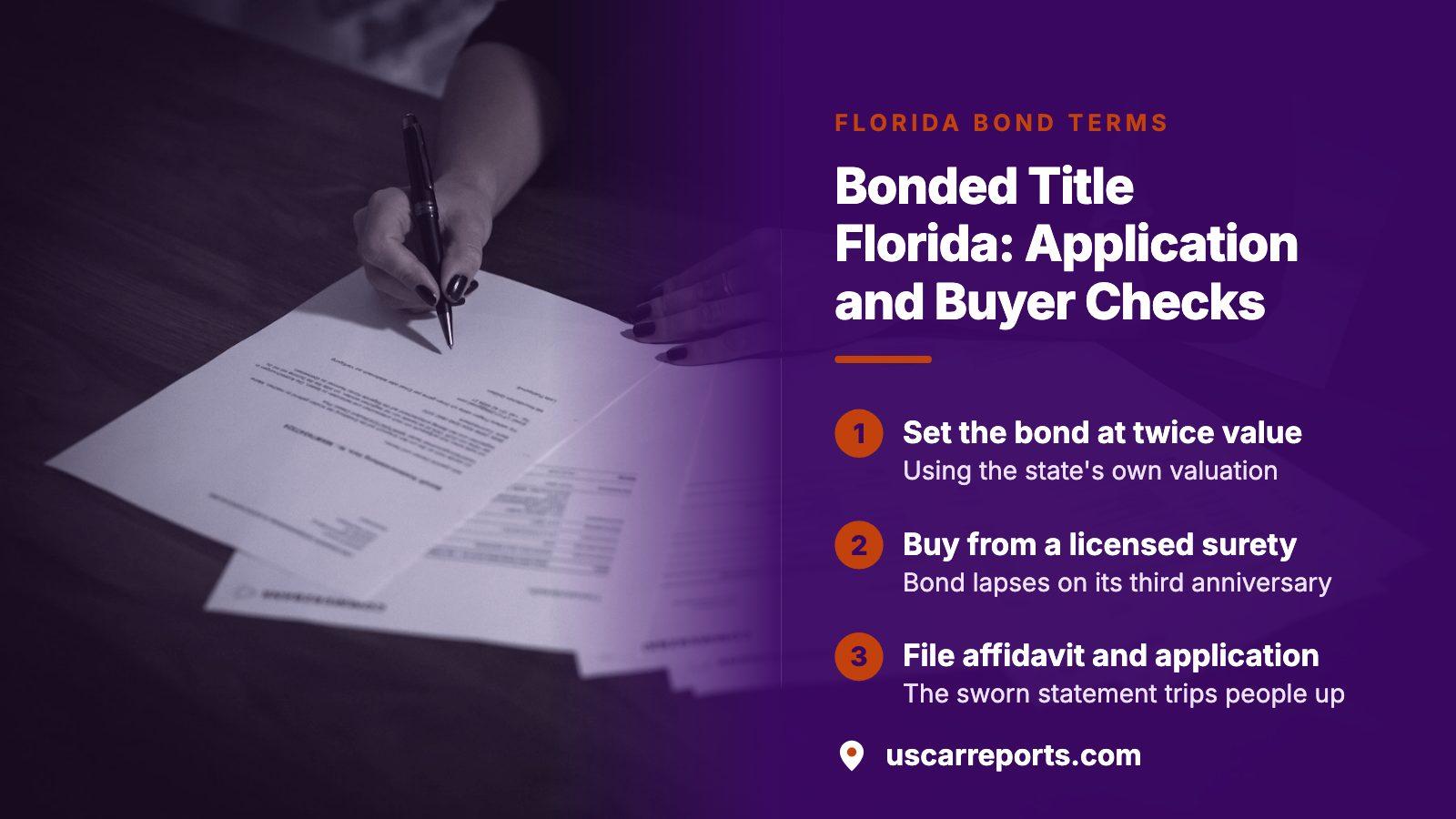
THE SHORT ANSWER
Under Florida law the state may accept a bond when an applicant cannot produce a title assigned by the prior owner. The bond is set at twice the value the state assigns, comes from a licensed surety, and lapses on its third anniversary. A sworn affidavit and a title application go with it. The bond covers ownership claims only, so liens, theft and damage need a separate VIN check.
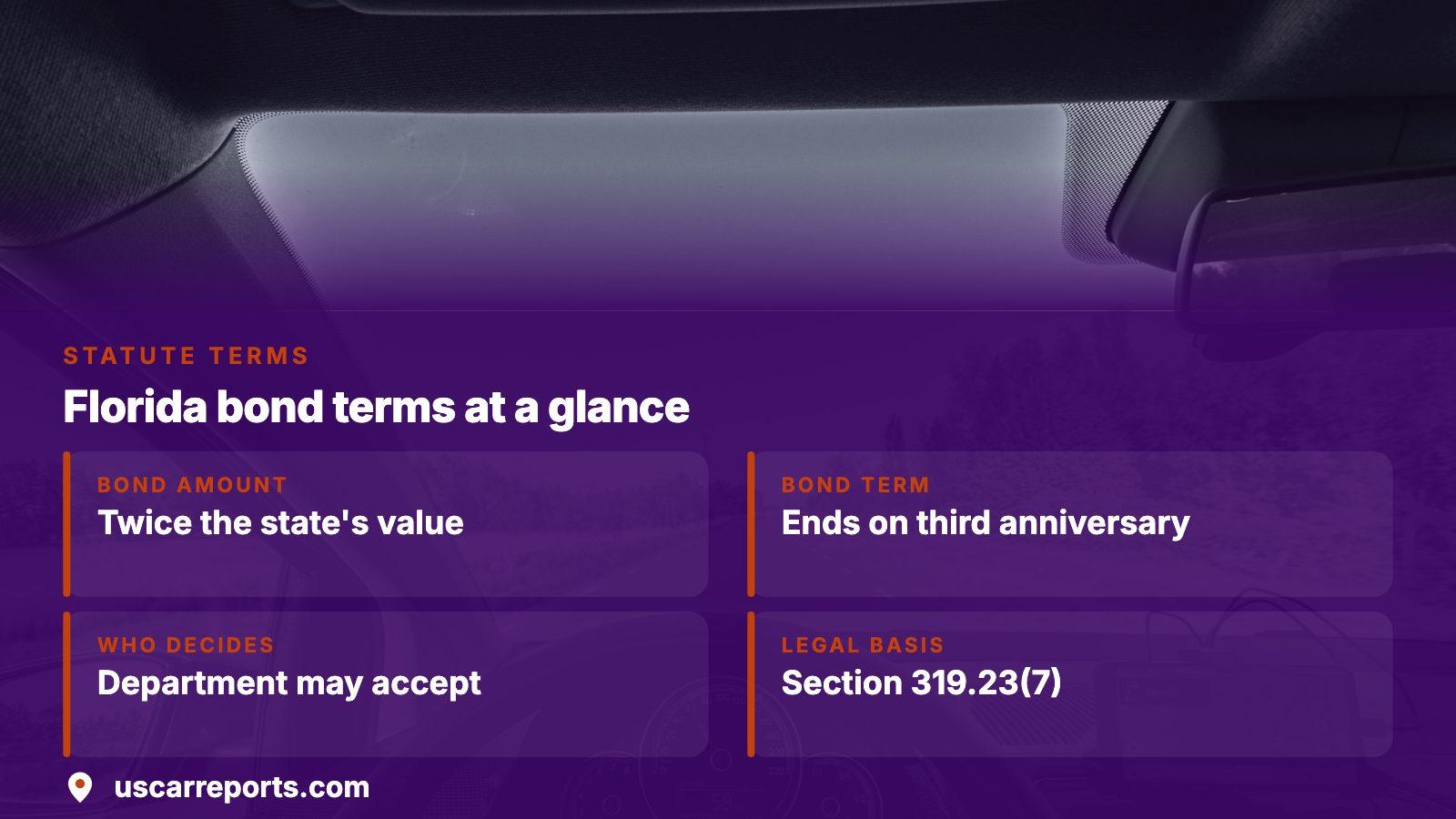
- Bond amount
- Two times the state's own value for the car
- Bond term
- Ends on its third anniversary
- Who decides
- The department may accept a bond; it is not guaranteed
- Legal basis
- Section 319.23, subsection (7), Florida Statutes
What Florida's bonded title rule actually allows
Most Florida titles change hands the ordinary way: the seller signs the old certificate over and the buyer applies for a new one. Sometimes that paper trail breaks. A seller lost the certificate, a previous owner cannot be found, or an earlier sale was never recorded. For those cases the Legislature wrote an exception into section 319.23.
The wording is permissive. The department may accept a bond, which means an application can still be turned down. Nothing in the statute promises a title because someone bought a bond. Think of the bond as one piece of a package the state weighs, not a purchase that guarantees an outcome.
The terms the statute fixes
Four terms are written into the law itself, so no surety company or notary can change them. Anything else, such as a quoted premium, comes from the company selling the bond.
| Term | What section 319.23(7) says |
|---|---|
| Bond form | The department's own template, signed by the applicant |
| Issuer | A company licensed for surety business in Florida |
| Amount | Two times the car's value, as the department determines it |
| Duration | Ends three years after the date it took effect |
The applicant does not pick a figure that makes the bond cheap. The department decides what the vehicle is worth, and the bond is sized from that number.
What goes in the application packet
The statute describes three pieces handed over together, and the state also wants proof on two more points before a title issues.
- The bond itself, on the department's form, from a licensed surety.
- A sworn affidavit that also confirms the car's VIN.
- The title application.
- Proof that sales or use tax on the transfer has been paid.
- A current registration, unless the vehicle is one the law does not require to be registered.
A car coming into Florida for its first Florida title also needs the owner's odometer statement. Transfers carry a deadline too: an application filed more than 30 days after delivery adds a $20 late fee.
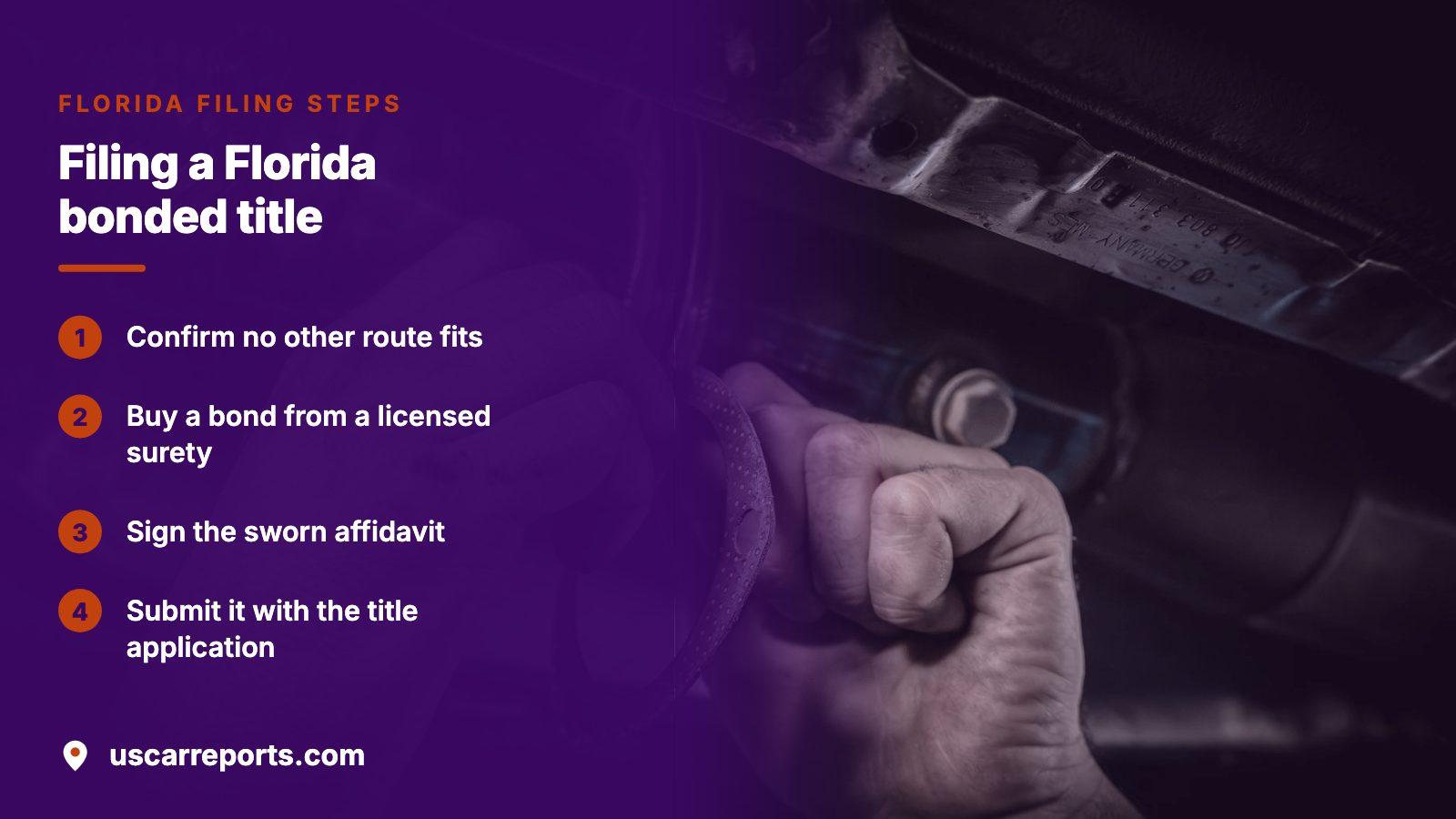
The affidavit is where applicants get tripped up
The affidavit has four required contents. It lays out how the applicant came to own and hold the vehicle. It says the applicant knows of no liens or other claims against the car. It states that the applicant is entitled to a title. And it uses the department's own form.
That lien sentence deserves attention. You are swearing to what you know, so a lien you could have found by checking the VIN first is a poor thing to discover afterward.
Before you sign
A VIN history check takes minutes and can show a recorded lien, a salvage brand or a theft entry. The free preview on this car costs nothing and keeps you from swearing to a record you never looked at.
Who the bond protects, and who ends up paying
A surety bond is not insurance for the person who buys it. It protects everyone else: earlier owners, lienholders, later buyers and anyone who takes a security interest afterward, plus their successors. If one suffers expense, loss or damage because the title was issued, attorney fees included, the bond answers.
Any interested person may pursue a claim for breach. The surety's total liability to all claimants together stops at the bond amount. A surety that pays a claim looks to the applicant for repayment, so a bond is a serious commitment, not a formality.
Check whether another route fits your situation first
The bond is not the only way Florida handles a missing signature. Section 319.28 handles ownership that changes hands by operation of law, meaning inheritance, bankruptcy, a court-ordered sale, a repair-shop sale or a repossession. Where the old title cannot be turned in, the department can issue a fresh one on satisfactory proof of ownership and the right to possess the car.
Heirs have a shortcut. When the owner left no will, an affidavit that the estate has no debts and that the spouse and heirs agree on the split can replace a probate order. A lost certificate on a car whose owner can be reached is different again: a duplicate application, showing the current odometer reading, is the natural fix. Match your situation to the right section before you price a bond.
What a bond does not fix
The bond answers one question: who gets paid if somebody else turns out to own the car. It says nothing about the car's physical history. A vehicle can carry a bonded paper trail and also have a salvage brand, flood damage, a rolled-back odometer or a lien that was never cleared.
Florida's lien rules show why this matters. Liens are meant to be noted on the face of the certificate, and an unfiled one may not hold against a later buyer who paid value without notice. But a filed lien whose payoff was never recorded is a live problem for whoever holds the car. After a payoff the lienholder owes a satisfaction and the cost of a duplicate title if the original is unavailable. When that never happened, the gap resurfaces at the next sale.
NMVTIS, a federal title database run by the Department of Justice, exists to cut title fraud and stop stolen vehicles from being resold. A VIN report built on it is the quickest way to see whether the record matches the paper in your hand.
If you are the buyer of a car that was titled this way
Under section 319.22, you do not hold marketable title until a certificate is issued in your name, and Florida courts will not recognize an ownership claim resting on anything else. So the first question is simple: does the seller hold an actual certificate, or only a promise that one is coming?
- Ask the seller to show the certificate and say when the bond took effect, since it lapses on the third anniversary.
- Ask how the seller came to own the car, and whether the affidavit story matches what the paperwork shows.
- Run the VIN and compare liens, brands, odometer readings and any theft entry against what you were told.
- Make sure the seller files the sale notice with the department within 30 days, which protects them and documents the date for you.
A seller who cannot answer the second question quickly is telling you something.
What this page could not confirm
Everything above comes from the 2026 Florida Statutes. The state motor vehicle agency's own pages refused automated requests while this guide was prepared, so it gives no form number, no fee schedule for the bonded process and no valuation method. The statute leaves the value to the department without publishing a formula.
Ask a county tax collector's office, an authorized agent of the department, for the current form and fees before you pay a surety. Premiums are set by the company, not Florida law, so compare quotes. USCarReports sells VIN history reports after a free preview; one-time pricing is on the pricing page.
Where this information comes from
- Florida Statutes 319.23: titles and bond terms — Source for the bond terms, affidavit contents, packet and deadlines.
- Florida Statutes 319.22: transfer of title — Marketable title and the seller's notice to the state.
- Florida Statutes 319.28: transfer by operation of law — The alternative routes for heirs, repossession and judicial sales.
- Florida Statutes 319.24: liens and duplicate titles — Tax collectors as agents, duplicate titles and lien satisfaction.
- NMVTIS: vehiclehistory.gov — What the federal title database is for.
Sources and photos: Facts checked against the sources above in November 2026. Photos by Dimitri Karastelev, Martin Fennema and Sander Jeurissen on Unsplash; diagrams by USCarReports.
Keep reading
- Bonded title: what it means for a buyer, state by stateHow bonded titles work in other states, for comparison.
- Florida title check by VIN: brands, liens and whose name is on itWhat to look at on a Florida title before you pay.
- Florida VIN verification form: who signs it and when you need itThe VIN inspection step Florida asks for on some transfers.
- Title status check: what the state lookup tells a car buyerHow to read what a title's status is telling you.
Frequently asked questions
How long does a Florida bonded title bond last?
The statute ends the bond three years after it took effect, after which exposure for new claims stops. Ask the seller of any such car when the bond started, so you know how much of that window is left.
How much is the bond for a bonded title in Florida?
Twice the vehicle's value, with the department deciding the value. What you pay a surety company to write it is a separate premium that the company sets, and the law does not fix it, so quotes can differ.
Is a Florida bonded title guaranteed if I buy the bond?
No. Section 319.23 says the department may accept a bond, so acceptance rests with the state. You also still owe tax and registration proof, and your affidavit has to hold up.
Can I use a bond if the owner died?
Possibly, but section 319.28 may fit better. Heirs can apply with affidavits, and when the owner left no will, the heirs can skip a probate order if the estate has no debts and they agree on the split.
Does a bond show whether the car has a lien or salvage history?
No. The bond only compensates claimants over ownership. A VIN history check is what reveals recorded liens, brands, odometer readings and theft entries, so run one before you swear the affidavit or hand over money.
Now check the car itself
The guide explains what to look for. The report shows what this VIN has on record.