THE SHORT ANSWER
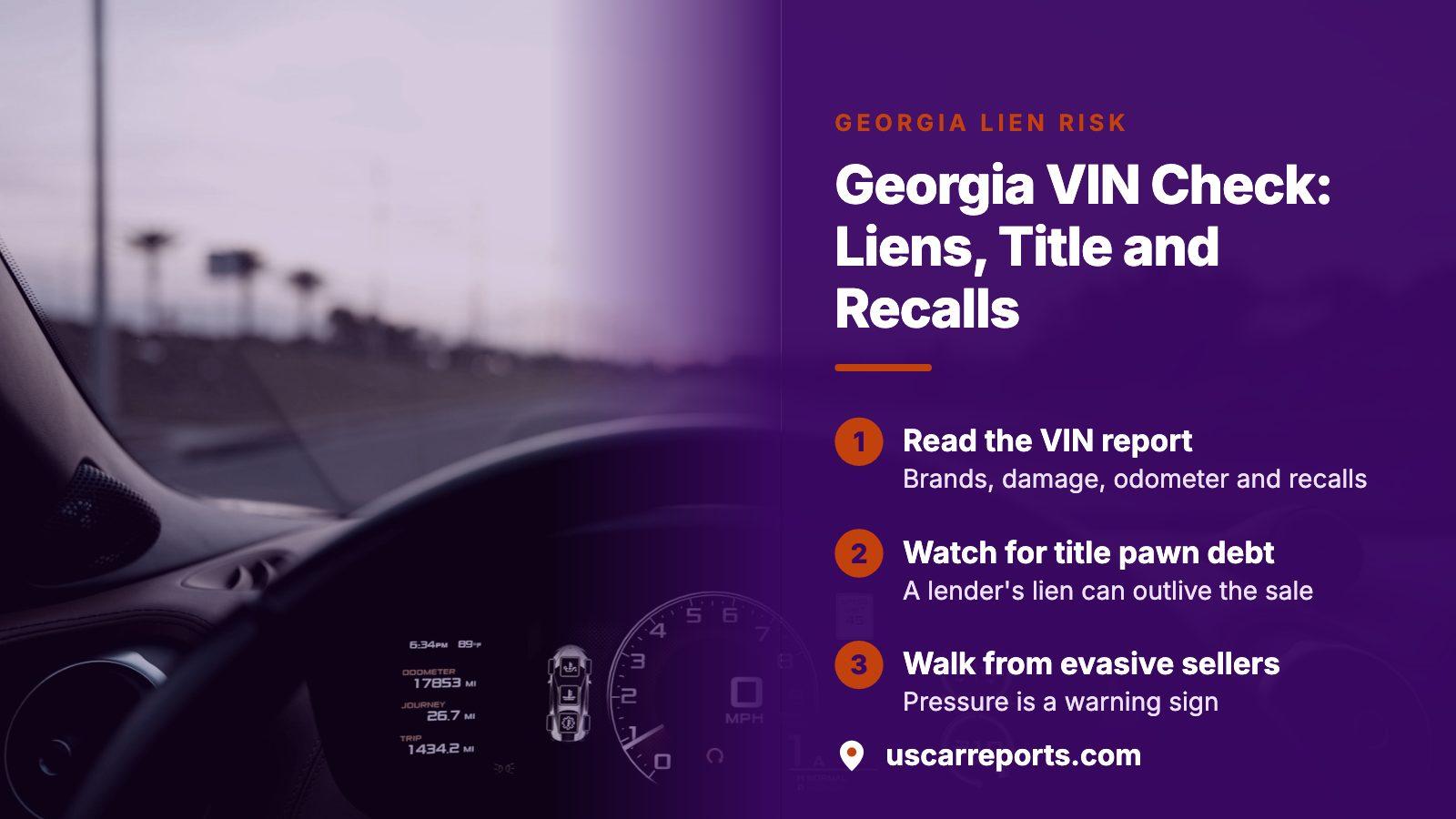
Put the VIN in for a free first look, then buy the full report, which covers title brands from any state, accident and damage records, odometer readings, liens, theft and open recalls. In Georgia, add three steps: read the original title in the seller's name with any lien release on it, search NHTSA and NICB at no cost, and hire a mechanic to look the car over, since the state has no safety inspection.
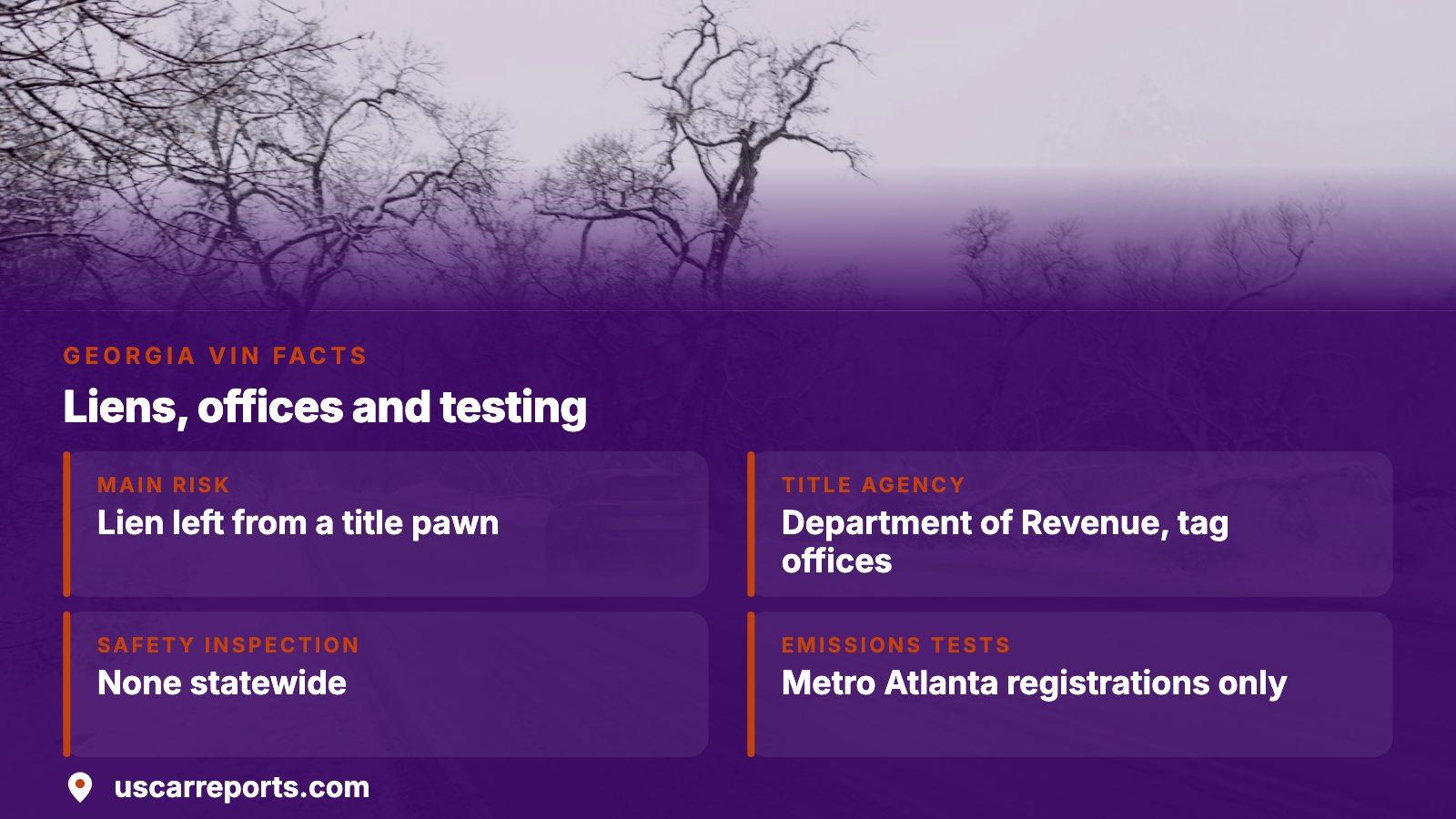
- Main Georgia risk
- A lender's lien left over from a title pawn
- Title agency
- Department of Revenue, through county tag offices
- Safety inspection
- None statewide
- Emissions tests
- Metro Atlanta registrations only
What a Georgia VIN check covers before you hand over a deposit
Run the VIN and the report pulls together records that no single Georgia office holds. These are the parts that tend to change a buyer's mind:
- Title brands, each with the state that issued it, so a salvage or rebuilt brand from out of state still appears on a Georgia car.
- Accident and damage records, along with salvage and auction history and the photos taken at those sales.
- Odometer readings from different dates, which show whether the mileage climbs in a believable line.
- Lien and impound entries, the ones that count most in this state.
- Theft and insurance claims on the car, plus any recall nobody has repaired.
- A market value to hold up against the asking price.
The report is the paper side of the purchase, done before the test drive instead of after. It does not replace looking at the car, and it does not run on a license plate.
Where the VIN is and how to run the check
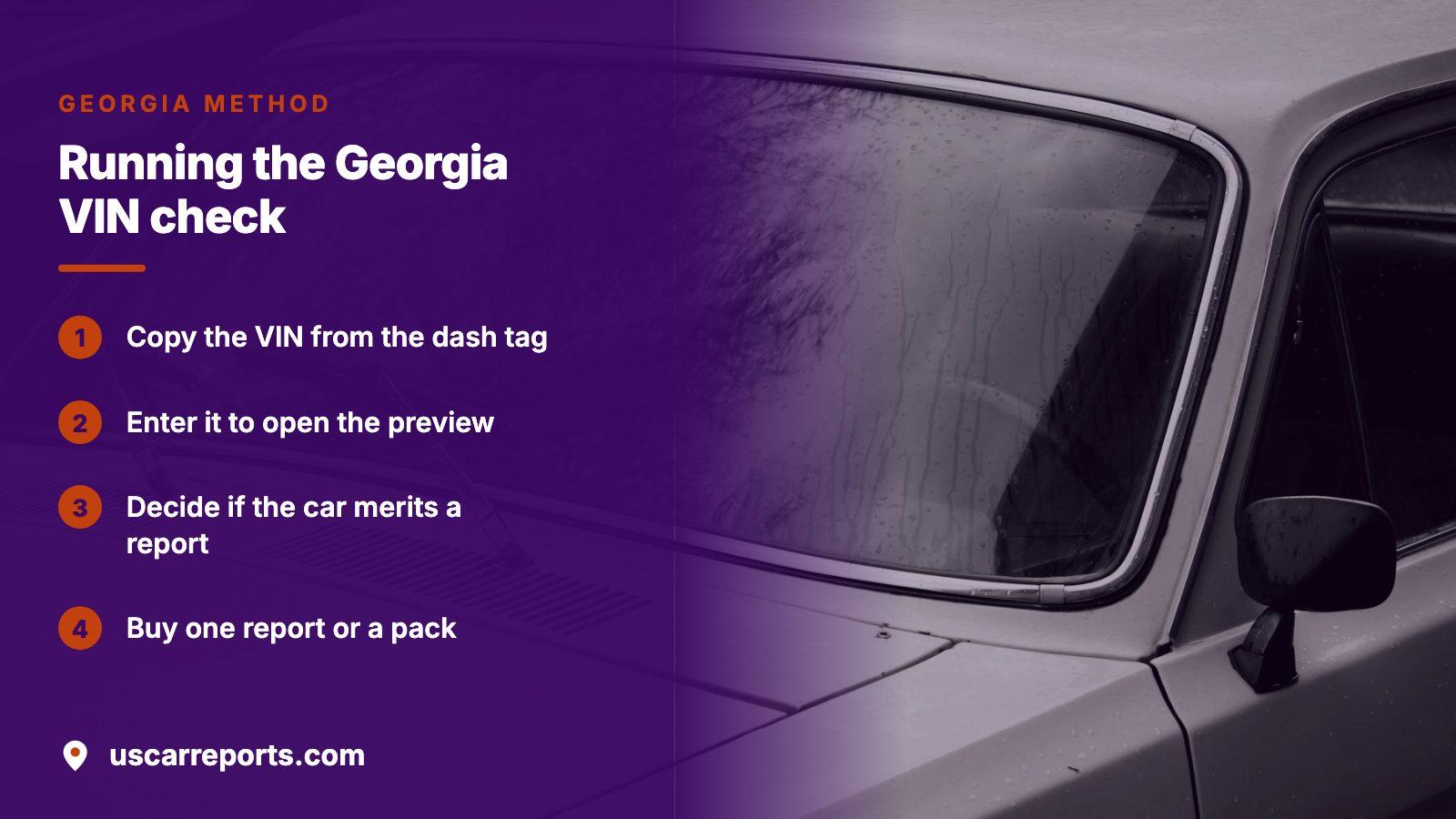
Read the VIN from the car itself, not from a listing. Stand at the driver's side and look down at the base of the windshield, then open the door and check the sticker on its pillar. Match both against the title and registration. Any difference ends the conversation before a report is needed.
- Copy the VIN from the dash tag and confirm the door sticker matches.
- Enter it in the box on this page to open the preview, which costs nothing.
- Read the preview and decide whether the car deserves a full report.
- Buy one report, or a pack if you have a shortlist of cars. Nothing renews.
Do this before the deposit, while walking away still costs you nothing. A plate number cannot stand in for the VIN: federal privacy law keeps owner details from private buyers, so get the VIN itself.
Georgia's real hazard is debt that stays on the car
Title pawns are legal in Georgia and the industry is large. The borrower hands over the title as security, keeps driving, and owes a short-term loan at a high rate. The lender's lien sits on the title until the debt is cleared.
Buyers get caught in two ways. One is a sale made while the loan is still open, sometimes backed by a duplicate title and a tidy explanation. The other is a car repossessed after a default and passed along quickly, through sellers who know little about where it has been. In both cases the lender's claim can travel with the car to its next owner, and the previous owner's debt becomes yours.
Reading the report and the title side by side
Lay the report next to the physical title and check that they tell the same story. These findings need a response:
| What turns up | What it can mean | Your move |
|---|---|---|
| A lien with no release | A lender may still hold a claim from a title pawn or a car loan | Ask for a written release or the lender's contact, and hold the payment |
| A brand from another state | Georgia records can look clean while a salvage or rebuilt brand sits elsewhere | Weigh it against the seller's story and the price, or walk away |
| Odometer readings that drop or stall | A rollback or a replaced instrument cluster | Request the service history, then compare tire and pedal wear with the miles shown |
| Salvage or auction photos | The car was damaged and sold at some point | Compare the photos with the panels and paint in person |
| A theft record | The car may be reported stolen | Stop and call the police or the insurer |
| An open recall | A safety repair has not been done | Ask the seller to have it done, or price in the dealer visit |
Seller behavior that should stop a Georgia sale
No title in hand, no deal
In a title-pawn state, a promise to deliver the title next week is often the problem itself. If the title is not on the table in the seller's name, there is nothing to buy yet.
- The title is somewhere else: with a friend, in the mail, at a lender, or still being sorted out.
- The name on the title is not the name of the person selling.
- The lien section lists a lender with no signed release beside it, or the release is only verbal.
- A rush to settle in cash at a spot nobody can document.
- A VIN on the paperwork that differs from the VIN on the car.
Put the question to the seller directly: was this car ever pawned, and does a loan remain? Notice how the answer arrives as much as what it says.
Georgia's buying rules: who handles the paperwork and who inspects the car
The Department of Revenue issues Georgia titles and handles registration, and in practice you deal with the county tag office. That differs from the DMV arrangement in most other states, so a buyer moving in from elsewhere should plan a county visit.
| Topic | How Georgia handles it | What it means for you |
|---|---|---|
| Titles and tags | Department of Revenue, delivered at county tag offices | Transfer the title promptly so state records show you as owner |
| Safety inspection | None statewide | Your own mechanic is the only inspection the car will get |
| Emissions tests | Tested only when registered in metro Atlanta, mostly gasoline cars inside an age window | If the car will be registered there, test it first, because a lit check-engine light is a likely failure |
The checks themselves stay national. Title brands, recalls and theft records come from federal and industry sources, which is why they run from the VIN and not from a Georgia system.
Water damage: Georgia's coast and Florida's storm cars
Along Georgia's coastline, storm surge and downpours put water into cars from Savannah down to Brunswick. Florida's hurricane seasons send another stream: waterlogged cars that get dried out, detailed and listed here, where buyers have not seen the storm coverage.
A brand only exists when someone formally applied it, so a quiet flood car can slip through. On any car with coastal or Florida history, look for mud lines under the trunk carpet, rust on the seat bolts, fogged headlamp housings, green crust on wiring plugs and electrics that work only some days.
Cost of the report and the steps that follow it
The preview is free and shows what the record holds before a dollar is spent. The full report costs one payment, and bundles of 3, 5 or 10 reports are sold for anyone weighing a shortlist. The pricing page lists the current options.
- Open the preview and drop any car that already looks wrong.
- Run the VIN through NHTSA's recall search, then through NICB's VINCheck for theft and salvage flags. Neither charges anything.
- Buy the report for brands, odometer readings and liens across every reporting state.
- Meet the seller, see the title, and match its VIN to the car.
- Hire a mechanic for a pre-purchase inspection, with a water check on coastal or ex-Florida cars.
- Sign a bill of sale showing the VIN and both parties' details, then transfer the title at the county tag office.
Where this information comes from
- Georgia Department of Revenue: Motor Vehicles — The state agency behind Georgia titles and registration, reached through county tag offices, where a buyer completes the transfer.
- NMVTIS: National Motor Vehicle Title Information System — The federal title database that gathers brands from every state reporting into it.
- NICB VINCheck — A no-cost theft and salvage search fed by participating insurers.
- NHTSA: Recalls — A no-cost lookup of open safety recalls by VIN.
Sources and photos: Facts checked against the sources above in November 2026. Photos by Dennis Eusebio, Tigran Shishmanyan and Zoshua Colah on Unsplash; diagrams by USCarReports.
Keep reading
- Georgia title check by VIN: brands, liens and the tax due at the counterThe Georgia title paperwork and brands in more depth.
- Florida VIN check: title records, flood risk and Florida buying rulesWhere many of the flood cars reaching Georgia start out.
- North Carolina VIN Check: Run the Report Before You PayHow the buying rules change across the state line to the north.
- Title status check: what the state lookup tells a car buyerHow to read a title's status before money moves.
Frequently asked questions
What do I need to run a Georgia VIN check?
Just the VIN. Put it in here for the preview, and buy the full report only if the car stays in the running. Before paying the seller, read the title's lien section yourself and look the car up with NHTSA's recall tool and NICB's VINCheck.
Is there a free Georgia VIN check?
Part of one. The preview is free, and the NHTSA recall tool and NICB VINCheck cost nothing. The full USCarReports report is a single payment. None of it replaces seeing the title, because a lien shows up on the paper first.
Does Georgia inspect used cars before they are sold?
No statewide safety inspection exists, so a car can stay registered with worn brakes and tires and nothing flags it. Emissions tests apply only to registrations in metro Atlanta, and only to most gasoline cars of a certain age. A buyer's own mechanic is the real inspection.
Can a Georgia VIN report show a title-pawn loan?
A report can show liens that reached its data sources, alongside title brands and odometer readings, but it cannot promise that every loan appears. Treat it as a first screen. The lien section of the physical title, and a signed release from any lender, settle the question.
Can I find a Georgia car's owner from the license plate?
No. Owner details tied to a plate fall under federal privacy law, the Driver's Privacy Protection Act, and sizing up a car as a private buyer is not a permitted use. Drop the plate idea: request the VIN from the seller or read it directly off the vehicle.
Now check the car itself
The guide explains what to look for. The report shows what this VIN has on record.