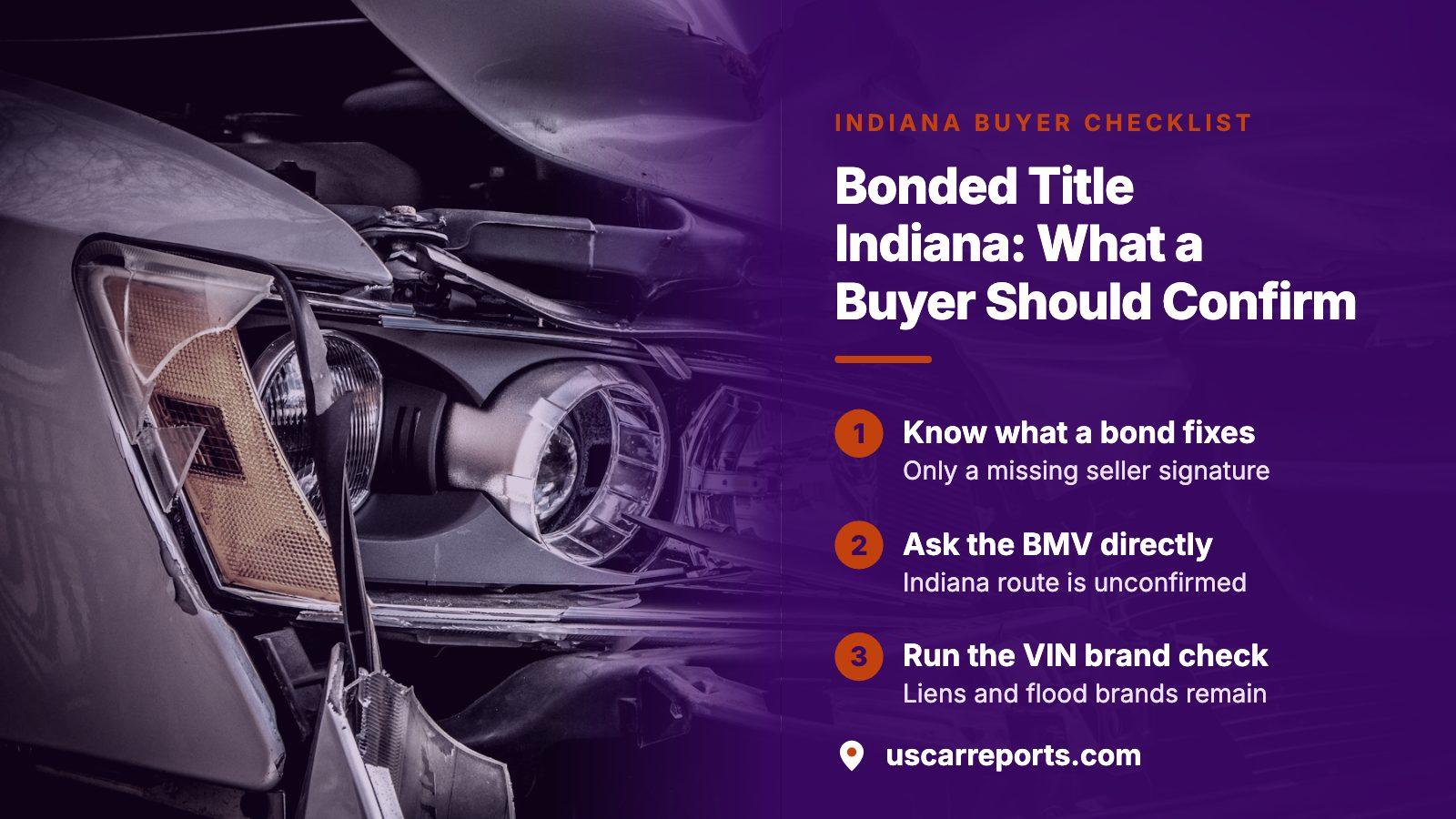
THE SHORT ANSWER
A bond fixes one problem: a missing signature on the title. It leaves a lien in place, leaves a salvage or flood brand in place and says nothing about the car's past. The BMV's pages would not load for us, and a published state-by-state survey reports that Indiana issues no bonded titles, so put the question to the BMV directly. Run the VIN first, because that shows whether a bond is even the right question.
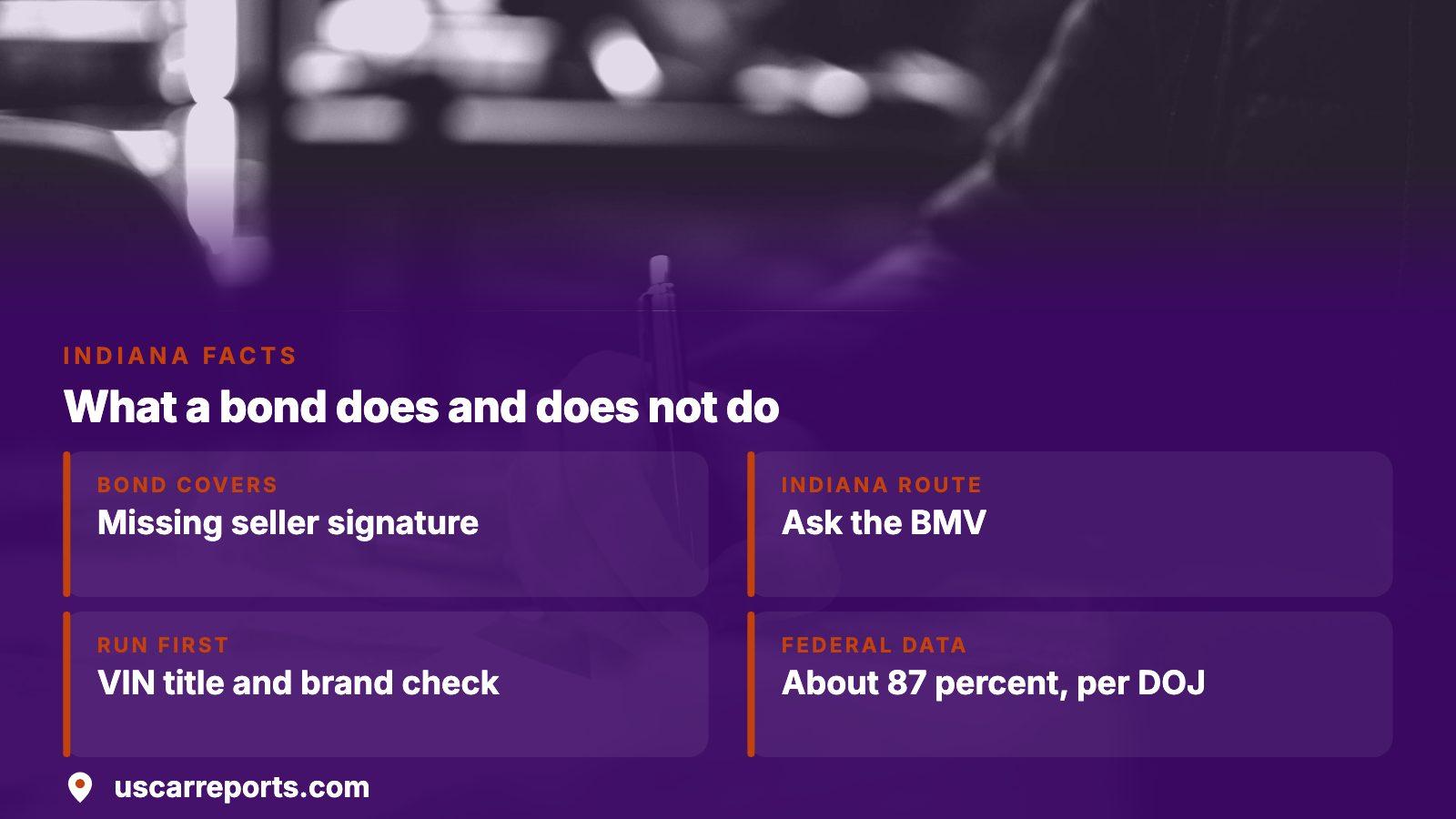
- What a bond covers
- A missing seller signature, nothing else
- Indiana route
- Not confirmed here, ask the BMV
- Run before paperwork
- A VIN title and brand check
- Federal title data
- Close to 87 percent of vehicles nationwide, per DOJ
What a bonded title is meant to solve
Picture an Indiana buyer who pays cash for a pickup, gets a handshake and a bill of sale, and then finds the seller never held a proper title or cannot produce one. The buyer cannot register it, cannot insure it comfortably and cannot resell it. A bonded title is the fix some states created for that gap.
The idea is simple. You buy a surety bond, usually from an insurance company or bonding agency, and the state issues a title that carries a bond brand while the bond is active. If a real owner turns up later and proves a better claim, the bond is the fund that pays. You are the one the surety collects from, so the bond is a cost you carry, not free protection.
What we could and could not confirm for Indiana
We tried every Indiana BMV page that covers titles and bonds. The connections were refused or timed out, and the forms host returned a block page. We did not use mirrors or copies to get around that, so nothing printed here about Indiana fees, form numbers, bond amounts or deadlines was read from the BMV.
A claim we could not verify
A published state-by-state survey puts Indiana on its list of states with no bond option, reporting a sworn affidavit for cheaper vehicles and a judge's order for pricier ones. No Indiana page we could open backs that up. Treat it as a lead, and ask the BMV which route applies to your car and its value.
Three problems a bond does not touch
Buyers sometimes assume a bond is a general repair for a messy ownership history. It is narrower than that. Where states publish eligibility rules, a bond answers the question of who can sign, and that is all.
- A recorded lien. A lender with a live claim is a findable party, so the lien has to be released by the lender, not covered by a bond.
- A salvage, junk or flood brand. That describes the car's history, which a bond never addresses. A branded car is normally handled through a separate rebuilt process.
- Hidden damage or mileage rollback. Ownership paperwork records neither, so a record check and a hands-on inspection still earn their keep.
Run the VIN before you chase a bond
The VIN tells you what is already recorded against the car. That can end the question early. If a lender is still listed, the fix is a release, not a bond. If a brand shows up, the car belongs in a different conversation altogether, and the price you agreed may be wrong.
USCarReports gives a free preview from a VIN, then one paid report if you want the full title, brand, salvage and lien detail. It is a sensible step to take before you spend on a surety or a court filing. See the pricing page for how the report is bought.
Look at the plate on the dash and the paper side by side. If they differ, stop; no bond repairs that.
What the federal title database shows
The federal vehicle title database, run under the Department of Justice, takes in data from state title offices, insurers and the yards that handle wrecks. Enter a VIN and it returns the current title entry, brand labels like junk, salvage or flood, the latest mileage reading, an insurer's total loss decision, and reports that it went to a recycler or wrecking yard. Some records also include past theft.
| Shows | Does not settle |
|---|---|
| Brand history on the VIN | Whether a seller can sign it over to you |
| Latest odometer reading on file | Whether the car was repaired well |
| Total-loss or salvage ruling by an insurer | Whether a lender still holds a claim in the state file |
| Reports of a trip to a salvage yard | Mechanical condition |
The Department of Justice describes the report as intentionally concise. Use it as a screen, not a final verdict.
Where the records run out
Coverage is partial: the Justice Department puts the share of vehicles in the database near 87 percent, and only a bit more than half of states feed it, so a blank result can simply mean missing data. Definitions of salvage also differ between states, so a car once handled as salvage could still have no brand on file.
The total loss label can mislead the other way. The Justice Department notes that a theft unsolved after 30 days can trigger the label, and it sticks if the car later turns up undamaged. Look at the dates and the stated reason, not only the label.
The database is also thinner than a state's own title file. Each consumer report points toward the state's record, and the Justice Department encourages buyers to read that record before paying.
A sensible order for an Indiana buyer
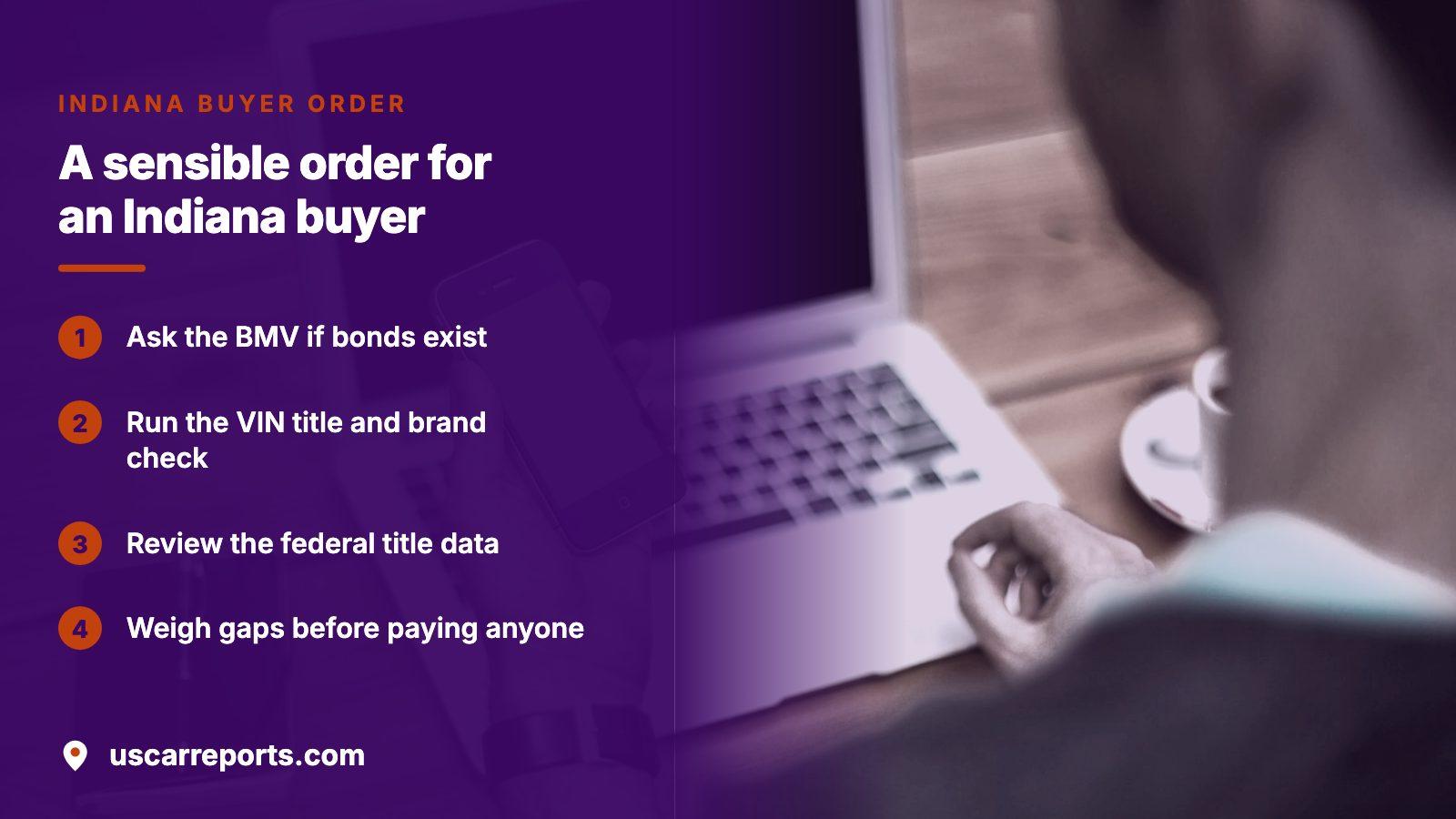
- Hold the seller's title and read its VIN against the one on the dash and door jamb.
- Run a VIN check to see any lien, brand, odometer reading or total-loss ruling on file.
- If the seller cannot sign, ask the Indiana BMV which route applies to your car and its value, and which forms it wants.
- Do not pay in full until the paperwork route is settled in writing.
- Hire a mechanic of your choosing and get repair costs written down.
Step three is the one this page cannot do for you. The BMV is the only source for the current Indiana route, and requirements change.
If the car came from a dealer
Under Federal Trade Commission guidance, every used car on a dealer lot carries a Buyers Guide, ticked as is or with a warranty. Buying as is leaves later breakdowns with you. Verbal assurances are difficult to hold anyone to, so have them written onto the Guide.
The FTC also warns that a history report is a different tool from a mechanic's inspection: crashes and flooding may appear, worn or failing parts typically do not. A dealer who refuses an outside inspection, in the FTC's view, is a reason to shop elsewhere.
Title first, then price
A car without a clean title in the seller's name is a car worth less than the listing, because you inherit the cost and delay of fixing it.
Where this information comes from
- US Department of Justice: NMVTIS consumer information — what a VIN title search shows, and where its coverage runs out
- FTC: Buying a used car from a dealer — independent inspection, Buyers Guide and as-is sales
- Indiana BMV — the agency to ask about its title route; its pages would not open for us
Sources and photos: Facts checked against the sources above in November 2026. Photos by Clark Van Der Beken, Alejandro Escamilla and Owen Michael Grech on Unsplash; diagrams by USCarReports.
Keep reading
- Indiana VIN check: what to pull and the title rules that applyHow an Indiana VIN check works and what the state's buying rules add.
- Bonded title: what it means for a buyer, state by stateThe general picture of how bonded titles work and where they differ by state.
- Abandoned vehicle title: what each state issues, and to whomAnother way people end up with a car and no signed title.
- Title status check: what the state lookup tells a car buyerWhat a state title lookup tells you about the paperwork on a car.
Frequently asked questions
Does Indiana issue a bonded title?
Unconfirmed. Indiana's BMV pages refused every request we made. A state-by-state survey says the state skips bonds in favor of an affidavit or a court order, but that is unverified, so ask the BMV which path fits your car before paying a surety.
What does a bonded title application usually require?
It varies by state, and we could not read Indiana's rules. In states that offer one, expect a bond from a surety, proof you own the car, a value for the vehicle and a form from the titling agency. Get the exact list and fees from the Indiana BMV.
Will a bond clear a lien on the car?
No. A bond addresses a missing signature, not a lender's claim. If a lien shows up on a VIN check, the lender has to release it. Sorting that out first can save you from paying for paperwork the car cannot use.
Does a bonded title make a car clean?
No. It is still a title carrying a brand while the bond is active, and any buyer who checks the history can see it. It also says nothing about salvage, flood damage or odometer history, which are separate records.
Should I run a VIN check before paying a seller who has no title?
Yes. A check shows liens, brands, odometer readings and total-loss rulings on file, which can end the deal or lower your price. Pair it with the seller's ID, a matching VIN on the car and an inspection by your own mechanic.
Now check the car itself
The guide explains what to look for. The report shows what this VIN has on record.