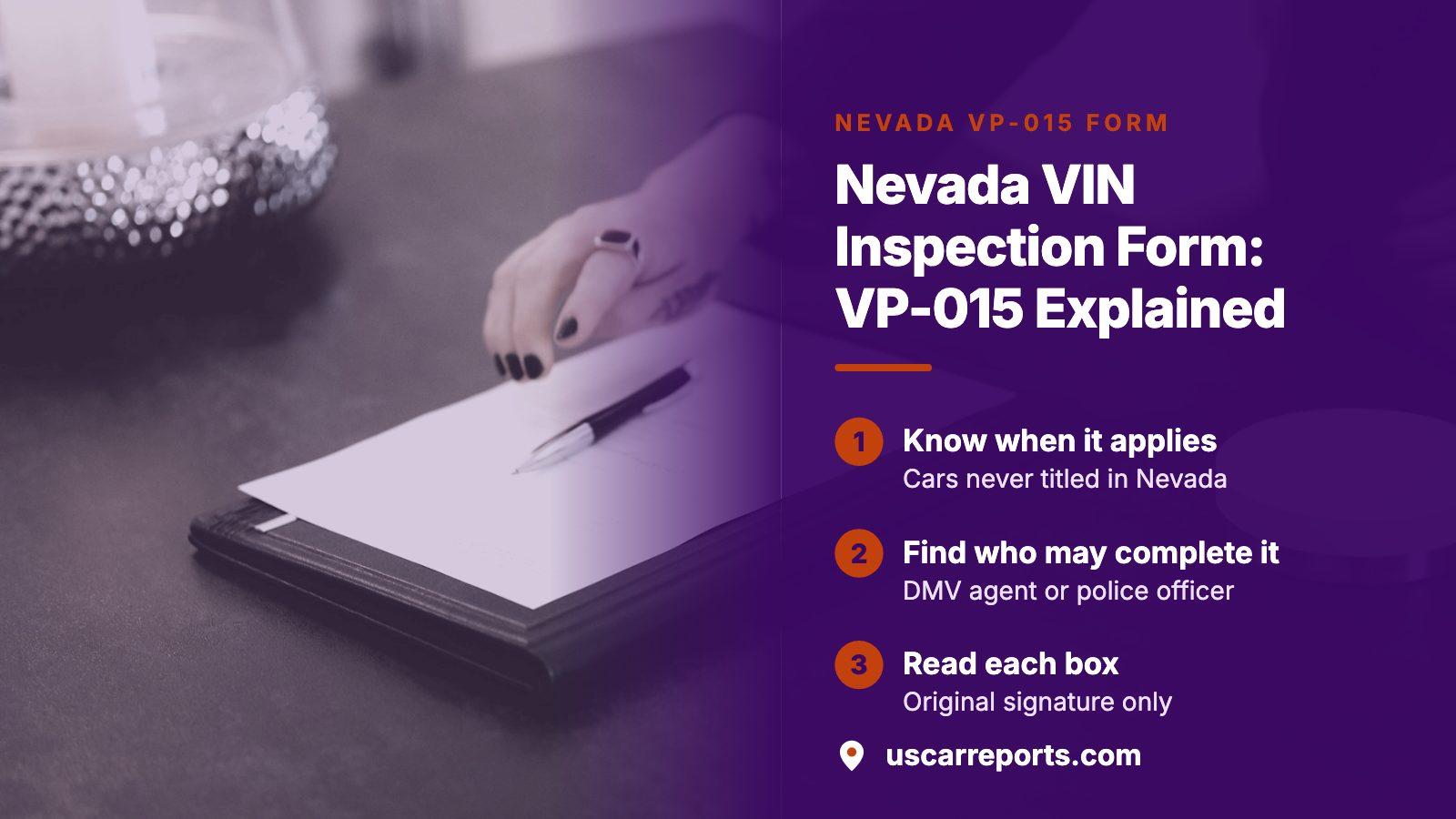
THE SHORT ANSWER
VP-015 is a one-page certificate that confirms an official physically examined the vehicle and recorded its VIN and mileage. Only a DMV agent with that authority or a peace officer may complete it, and the signature must be an original. You bring it when you register a car that has never carried a Nevada title or registration. It proves the car matches its papers. It does not reveal brands, liens or accidents.
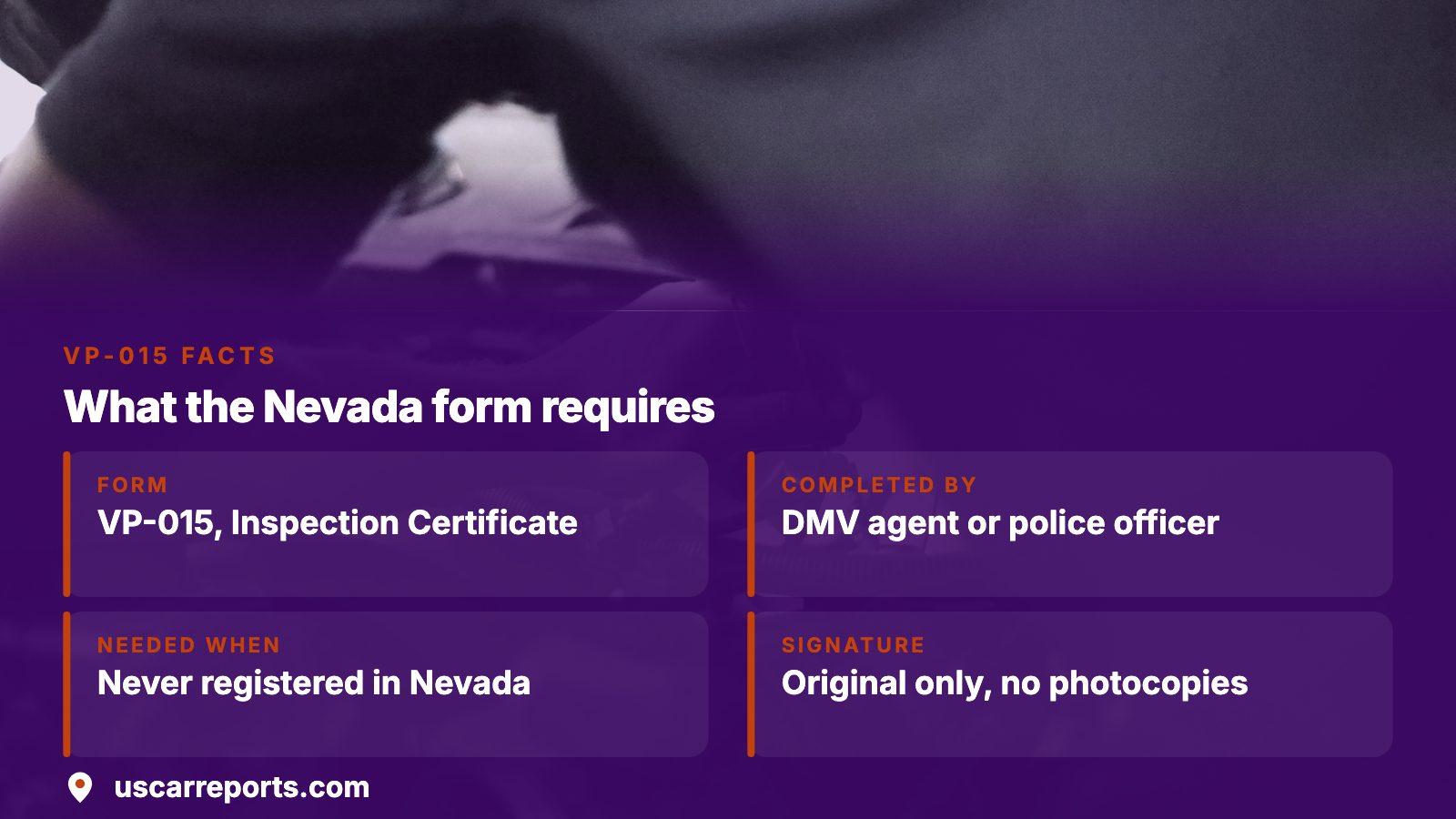
- Form
- VP-015, Vehicle Inspection Certificate
- Who completes it
- Authorized DMV agent or police officer
- Needed when
- Never registered or titled in Nevada
- Signature
- Original only, no photocopies
What VP-015 is, and the one thing it proves
Think of VP-015 as a witness statement about a physical object. Someone with authority stands at the car, reads the VIN off the vehicle itself, writes it in the boxes and certifies that they examined the vehicle. The DMV then compares that number with the one on your title or bill of sale.
USCarReports tracks the buying rules state by state, and Nevada's version of this step is short. The form answers a single question: is this the car the paperwork describes? A VIN swap, a cloned number or a title that belongs to a different vehicle shows up at this stage. What the form does not do is judge the car's past, which is a separate job covered further down.
When the DMV asks for it
On its registration page the DMV lists the certificate among the documents for a vehicle that was never registered or titled in Nevada. That covers a car bought from a private seller in another state, a purchase from an out-of-state dealer, and the vehicle a new resident drives in.
| Situation | VP-015 likely needed? |
|---|---|
| Used car titled in another state, now registering in Nevada | Yes |
| Out-of-state dealer sale registered in Nevada | Yes, per the DMV document list |
| Car already titled and registered in Nevada, private sale | Generally no |
| Moped | Different form, VP-30 |
The title page of the DMV site also lists a VIN inspection among title documents marked as applicable. Since requirements shift by situation, confirm with the DMV before you drive to an office.
Who is allowed to complete it
Not the seller, and not you. The page itself restricts the job to officials: a DMV agent with authorization, or a peace officer. If the exam happens somewhere other than a DMV inspection station, the inspector adds an address and ticks whether they act for an enforcement agency or a Nevada authorized agency.
- The inspector prints a name and a badge or ID number.
- The inspector signs and dates the certificate.
- Signatures must be originals, so a scan or photocopy will be refused.
- The DMV's own compliance division includes VIN inspectors on its staff.
Call the DMV office you plan to use and ask how they schedule inspections. Walk-in practice varies, and the website does not spell it out.
Reading the boxes on the form
The top of the page holds the year, make, model and body type, followed by a row of 17 squares for the VIN. Below that sits the odometer reading, six squares with no tenths. A five-digit odometer gets an X in the first square.
Three tick boxes sit under the mileage. One notes that the reading exceeds the odometer's mechanical limits. One says the reading is not the actual mileage and carries a printed warning about an odometer discrepancy. The third marks a model year over 20 years old as exempt. The rest of the page collects engine and weight details, fuel type, trailer or motorhome length and axle count, plus a remarks line.
Look at the odometer boxes
If the inspector ticks the not-the-actual-mileage box, that is an official finding on a government form. Pause the deal until the seller gives you a straight explanation.
Why the DMV pushes buyers toward an inspection station
The DMV warns that cash-only or limited-time offers on social media are often a way to sell vehicles that were stolen, had their VINs switched or had odometers tampered with. Its advice is to photograph the seller's ID, keep their contact details, deal only with the person you first contacted and meet at a DMV VIN inspection station.
That advice is a free fraud filter. A seller who refuses to meet where an official can read the number is telling you something. The DMV adds that buyers should use VIN history tools when an in-person inspection cannot happen, and that a seller who cannot show a title in their own name is a reason to walk away. A bill of sale alone does not prove ownership.
What the inspection cannot tell you
Nothing on VP-015 asks about title brands, loans, wrecks or theft. A car can pass the VIN check with a clean signature and still carry a salvage past. Nevada declares a vehicle salvage when repair costs exceed 65% of its fair market value or when it was submerged above the door sill, and an orange-titled salvage car is barred from sale or registration here until repairs and an inspection earn it a Rebuilt title.
- Brands from the state where the car was last titled
- Liens that the seller has not cleared
- Accident and auction history
- Theft records and open recalls
Owner details are not handed to buyers by the DMV, so history has to come from VIN-based services.
Run the history before you pay for the inspection trip
The cheapest order of operations is history first, inspection second. Take the VIN from the listing, ask the seller for a photo of the number on the car, and compare. Then run the free checks the DMV itself points to: the NICB stolen and salvage search, the NHTSA VIN decoder and the NHTSA recall lookup.
NMVTIS, which draws on title records from all states, is the federal layer for brands. The USCarReports preview of any VIN costs nothing. The report that follows is bought once, and it covers the title brands, damage and odometer entries that VP-015 never asks about. See the pricing page for the packs.
After the certificate is signed
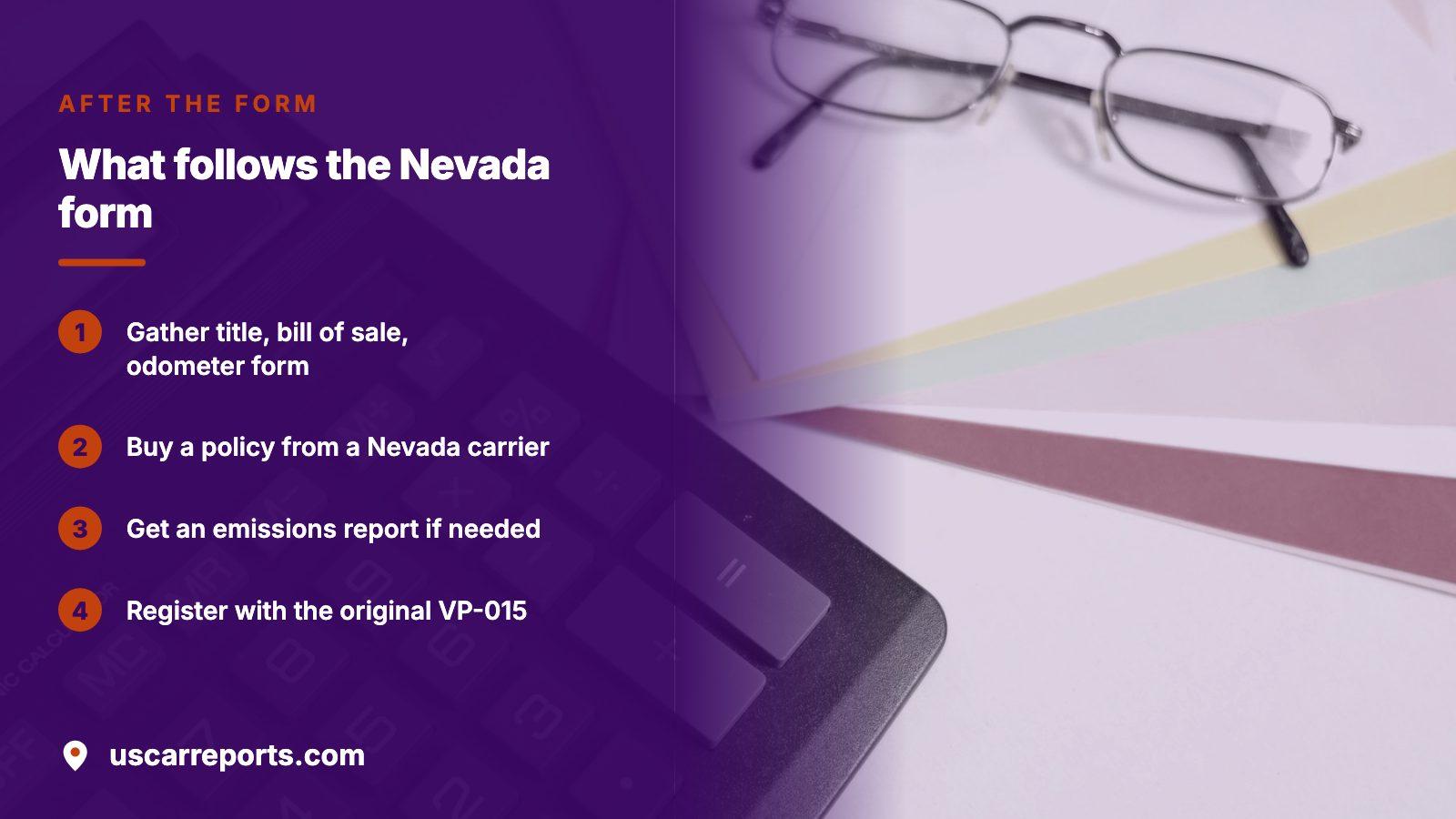
- Gather the title or certificate of origin, the bill of sale and an odometer statement if one applies.
- Buy a policy from a carrier licensed in Nevada, dated no later than the registration, in the exact names on the title.
- Get an emissions report if your county needs one.
- Bring VP-015 with the original signature.
- Register at a DMV office, or online through Rapid Registration where the DMV allows it. Motor homes, mopeds and trailers must register in person.
The DMV allows driving the car for up to three days after purchase with the signed title or bill of sale and an active Nevada policy. After that you need a movement permit.
Where this information comes from
- Nevada DMV: VP-015 Vehicle Inspection Certificate — fields on the form and who may complete it
- Nevada DMV: Register a vehicle — when the certificate is listed, scam advice, insurance and permit rules
- Nevada DMV: Vehicle title and ownership — VIN inspection as a title document and the salvage definition
- Nevada DMV: Compliance Enforcement Division — VIN inspectors on DMV staff
- VehicleHistory.gov: NMVTIS — federal title information system for buyers
Sources and photos: Facts checked against the sources above in November 2026. Photos by Annika Wischnewsky, Cht Gsml and Mustafa Sheikhmouss on Unsplash; diagrams by USCarReports.
Keep reading
- Nevada VIN Check: Title Brands, Liens and Registration RulesNevada's wider buying rules, emissions and title brands.
- Florida VIN verification form: who signs it and when you need itHow another state handles the same paperwork step.
- Registering a car in another state: deadlines, title and checksThe registration steps once a car crosses a state line.
- Bonded title: what it means for a buyer, state by stateThe fallback when a seller cannot produce a title.
Frequently asked questions
What is the Nevada VIN inspection form?
It is form VP-015, the Vehicle Inspection Certificate for VIN verification. A DMV agent with authorization, or a peace officer, examines the vehicle, records the VIN and mileage, and signs. The DMV lists it for vehicles that have never been registered or titled in Nevada, such as cars arriving from another state.
Can the seller or I sign VP-015?
No. The form is meant for a DMV agent with authorization or a peace officer, and the signature must be an original. Neither buyer nor seller qualifies, however honest both are, so plan to have the car in front of an official rather than sign it yourselves in a parking lot.
Does the form show if a car was wrecked or has a lien?
No. It records the VIN, odometer, and basic specifications, and the inspector can flag an odometer discrepancy. Brands, liens, accidents and theft entries come from VIN history sources, so run those separately before you commit to the sale.
Is a moped inspected on the same form?
The form states that moped inspections use VP-30 instead. For anything else, such as a car, truck, trailer or motorhome, VP-015 has fields for body type, weight, fuel, axles and length. Ask the DMV which certificate applies to a low-speed or unusual vehicle.
Can I check a Nevada car before paying for an inspection?
Yes, and it is the smarter order. Start with the VIN from the listing, run the free preview and the free federal lookups, then decide whether the car deserves a trip. The preview here costs nothing, and the report afterward is a single purchase with no subscription.
Now check the car itself
The guide explains what to look for. The report shows what this VIN has on record.