
THE SHORT ANSWER
In Tennessee the route is a surety bond application emailed to the Department of Revenue. It fits a Tennessee resident whose vehicle is worth more than $3,000 and was built less than 30 years ago. The bond is set at one and a half times market value. After approval you take the letter to your county clerk for the title. Older or cheaper vehicles use a different form.
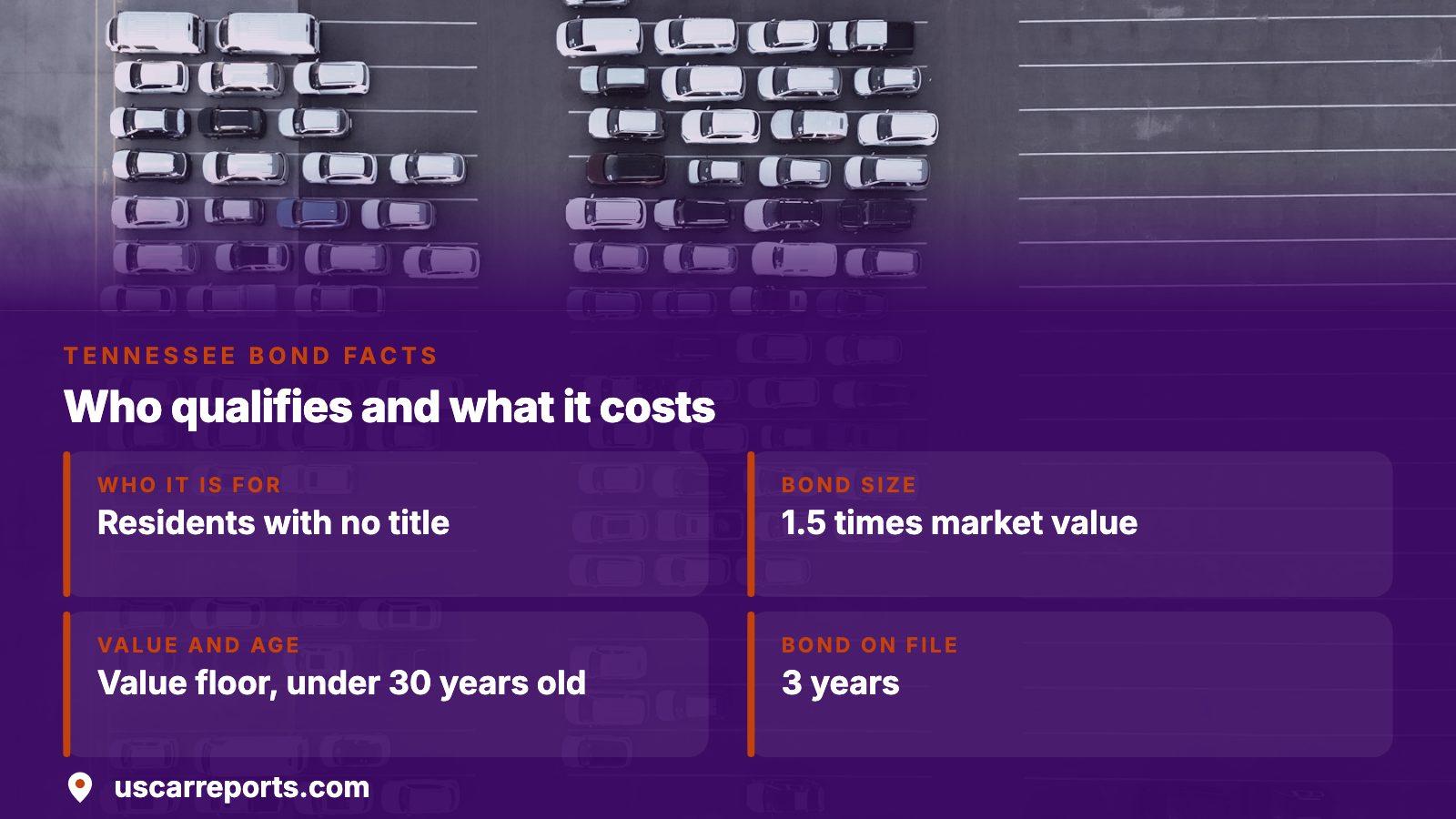
- Who it is for
- Tennessee residents with no title or proof of ownership
- Bond size
- 1.5 times fair market value
- Value and age window
- Over $3,000 and under 30 model years old
- Bond on file
- 3 years
What Tennessee calls a bonded title
Search results say bonded title, but the state's own pages say surety bond. The idea is the same in both phrasings. You show the state a bond, a financial promise that covers anyone who later proves they owned the car or held a lien on it, and in return the state lets you apply for a title without the signed-over original.
The department describes the process as meant for people with no title or no proper proof of ownership. It protects the state in issuing the title and protects earlier parties named on the old paperwork who may still have an interest.
Same thing, different label
If a clerk, a bond agent or a form says surety bond, you are in the right place. It is the process people usually mean when they search for a Tennessee bonded title.
Value and age decide which form you file
When ownership is unclear, no liens are known and nobody has reported the car stolen, the department can register it but ask for extra steps before a title issues. Which steps depends on two numbers: what the vehicle is worth and how old it is.
| Situation | Route |
|---|---|
| Worth more than $3,000 and under 30 model years old | Surety bond application |
| Worth $3,000 or less | Certification of Ownership |
| 30 model years old or more, any value | Certification of Ownership |
| Reported stolen | No bond can be written |
The bond route covers ordinary cars and trucks, and the state also lists off-road quads, golf carts, trailers and unattached mobile homes. A cheap truck from a neighbor and a decades-old project car therefore go down a different road than a late-model sedan.
You have to be a Tennessee resident
Only residents qualify, along with companies that keep an office or address inside the state. A buyer from elsewhere who collects a car here is turned away at this step.
There is one practical opening. Someone who lives in another state but keeps a second home with a valid Tennessee address can use that address on the application. The bond exists for people who plan to title the vehicle in Tennessee, so a car headed for another state's title office needs that state's process.
What goes in the application packet
You download the Surety Bond Application from the department and email it to the surety bond team. The packet needs proof of how the car came to you. Pick whichever of these you can get:
- A signed bill of sale out of the hands of whoever last had the car registered.
- A notarized letter from the seller saying why the car never got titled or registered under that name.
- With neither, a written appraisal of what the car is worth today, from a licensed local dealer or a valuation website.
A notarized bill of sale by itself does not count as proof of ownership. What it wants is the endorsed title itself, with every owner's signature in order, so the seller letter matters more than a stamp. Ask in your first application for any original documents to be sent back to you.
Sizing the bond and picking a type
The bond has to equal 1.5 times the car's fair market value. You work out the value yourself, from an online valuation guide or a dealer estimate. The multiplier means a bond always runs well above the car's sticker value.
| Type | How it works | Cost |
|---|---|---|
| Personal | Two Tennessee landowners sign alongside you; the three of you must live at different addresses, and the signers send property tax bills | Free, written by the state |
| Corporate | A bonding or insurance company backs it, signs, seals it and attaches a power of attorney | Whatever rate you agree with the company |
You cannot act as your own surety. For a corporate bond, ask the state for its Tennessee Corporate Surety Bond Form and hand it to your insurer or a third-party bond agency.
From approval letter to title in hand
Once the application is in, the department runs the VIN to confirm the vehicle has not been reported stolen. If everything is in order it mails an approval letter. Processing has no promised timetable: it depends on whether the file is complete, and applications are handled in the order received.
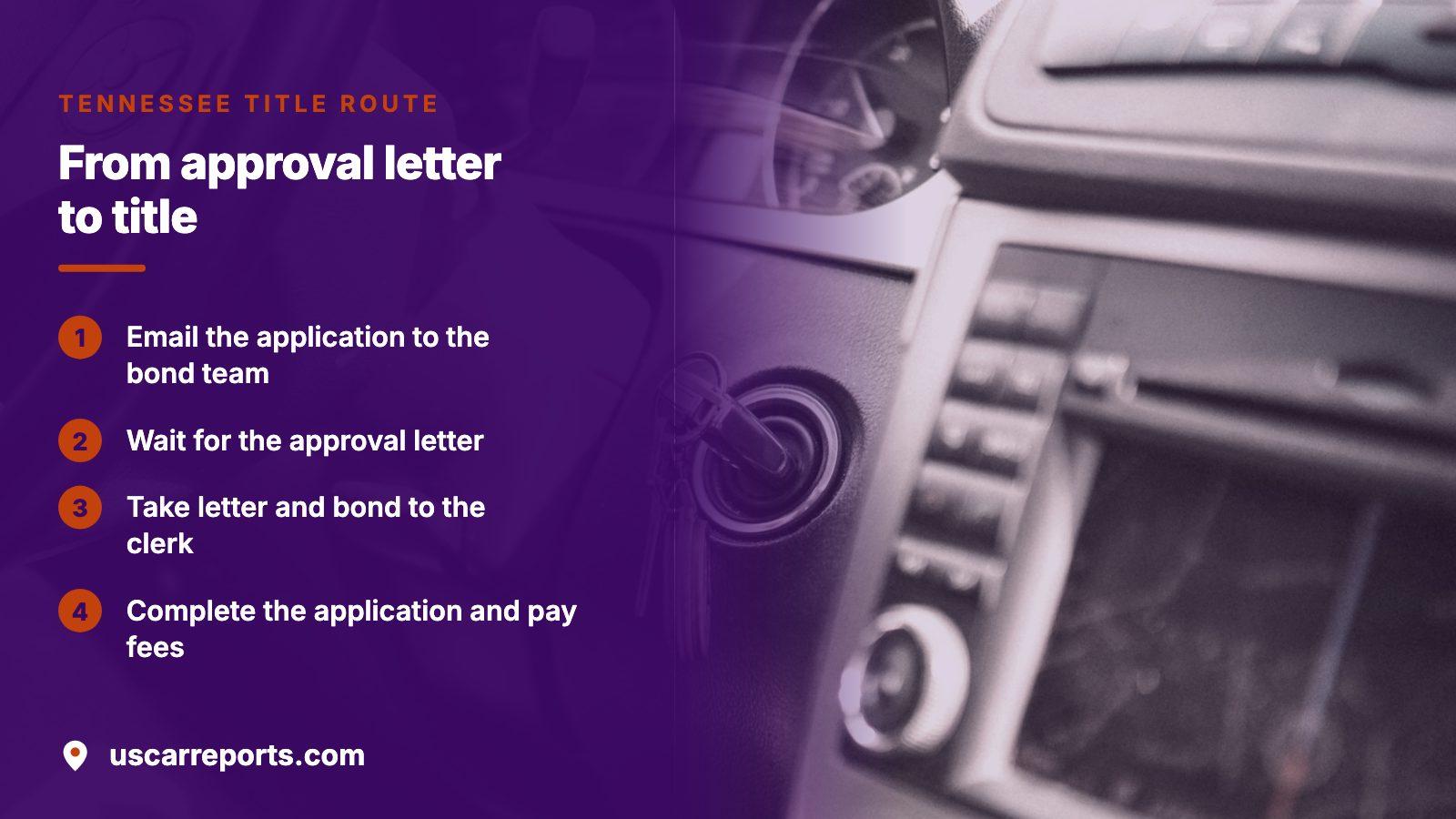
- Email the completed application and supporting papers to the surety bond team.
- Wait for the approval letter.
- Take the letter, the signed bond and your papers to your county clerk.
- Complete the Multi-purpose Application, then pay title and registration fees and any sales or use tax.
The clerk needs the approval letter to process the title. Fees and tax vary, so ask the clerk for the current total before you go.
The three-year window and what it means for resale
The state keeps the bond on file for 3 years and it protects earlier owners and lienholders during that time. The department does not issue a second bond for the same vehicle afterward, and once the period ends the title is not open to challenge.
For a later buyer, that means a title obtained this way is worth a closer look in its first years. If you plan to sell soon after titling, keep the approval letter and your seller statement together, since a careful buyer will ask how the title came about.
Check the VIN before you commit to a bond
A bond fixes a paperwork gap. It does not fix a car's past. The state rules out stolen vehicles, and a salvage history can lead to a salvage certificate instead of a normal title when salvage law applies. Learn both before paying anyone for a bond.
The federal NMVTIS system holds title brand history, the latest odometer reading, insurer total-loss declarations and reports of a transfer to a salvage yard. The Justice Department notes it has gaps, so a clean result can still miss something. A USCarReports preview costs nothing, and the full report adds accident, theft and odometer records for the VIN. Run it on the car in your driveway, not the seller's story.
Not sure of the status?
If you only suspect a title exists somewhere, a status inquiry through the state's call center, using the VIN, may be quicker than a bond. Call the Vehicle Services Division toll-free at (888) 871-3171.
Where this information comes from
- Tennessee Department of Revenue: The surety bond process (VT-12) — Value and age cutoffs, documents, submission and next steps.
- Tennessee Department of Revenue: Types of surety bonds (SB-4) — How personal and corporate bonds differ.
- Tennessee Department of Revenue: Limits on when a bond can be written (SB-9) — Stolen, low-value and 30-year-old cases.
- NMVTIS: Information for consumers — What federal title records show and where they fall short.
Sources and photos: Facts checked against the sources above in November 2026. Photos by Annika Wischnewsky, tim and Iain on Unsplash; diagrams by USCarReports.
Keep reading
- Bonded title: what it means for a buyer, state by stateHow bonded titles work across states.
- Tennessee VIN check: what to run, flood risk and county clerk titlingRunning a VIN check on a Tennessee vehicle.
- Abandoned vehicle title: what each state issues, and to whomAnother route when no owner can be found.
- Title status check: what the state lookup tells a car buyerFinding out what status a title already has.
Frequently asked questions
Is there a Tennessee bonded title application form?
Yes, though the state names it the Surety Bond Application. You download it from the Department of Revenue and email it to the surety bond team with your supporting papers. Cars worth $3,000 or less, or 30 model years old or more, use the Certification of Ownership form instead.
How much does a bonded title cost in Tennessee?
A personal bond written by the state carries no bond charge. A corporate bond costs whatever the bond company quotes. Title fees, registration and sales or use tax at the county clerk are separate, and the help pages give no total, so ask the clerk.
Can I get one if I live in another state?
Generally no. Tennessee writes bonds for residents and for businesses with a Tennessee address. A person who lives elsewhere but has a second residence with a valid Tennessee address can apply using that address, provided the car will be titled in Tennessee.
How long does approval take?
The department does not state a fixed time. It reviews applications in the order received, and speed depends mostly on whether your packet is complete. Missing seller statements or value proof are the usual reason a file sits, so gather everything before you send it.
Does a notarized bill of sale replace the title?
No. The department says a notarized bill of sale is not enough proof of ownership by itself. It wants a properly endorsed title showing every owner, which is why a bond application leans on a seller letter or a bill of sale from the previous registrant.
Now check the car itself
The guide explains what to look for. The report shows what this VIN has on record.