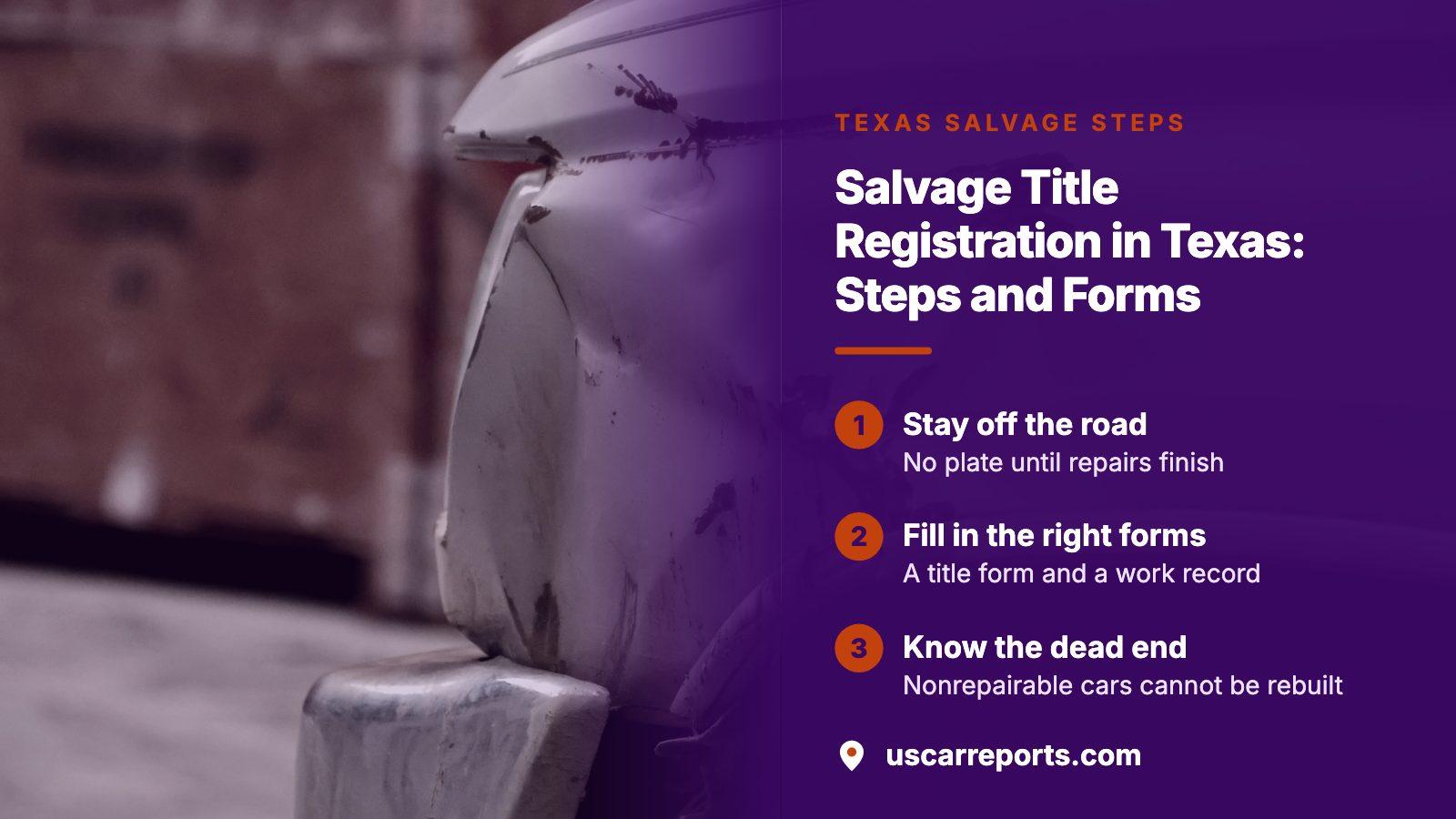
THE SHORT ANSWER
A Texas salvage vehicle stays off the road, and off the registration rolls, until repairs are finished and the state issues a title branded Rebuilt Salvage. The owner applies for the salvage title on a TxDMV form, repairs the car, documents the work and parts on a rebuilt vehicle statement, and then applies for title and registration through the county tax office. A car marked nonrepairable can never take this route.
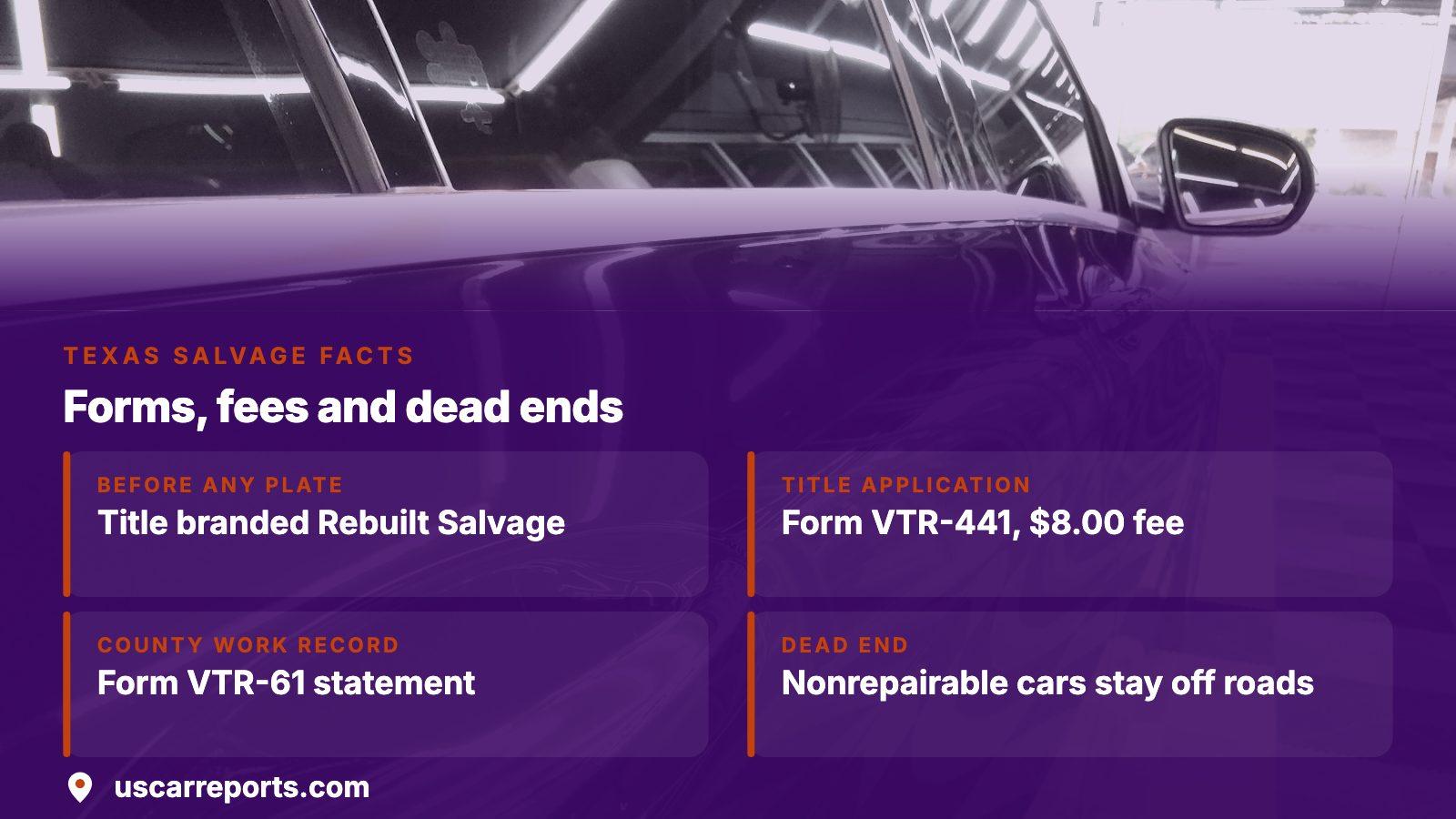
- Before any plate
- A title branded Rebuilt Salvage
- Salvage title application
- Form VTR-441, $8.00 fee
- Work record for the county
- Rebuilt Vehicle Statement, Form VTR-61
- Dead end
- Nonrepairable cars may not be rebuilt or made road-legal
A salvage title records the damage, it does not license the car
In Texas, salvage is a legal status with consequences. A branded car can be owned, sold, stripped for parts or repaired, but it cannot carry a plate or use a public highway. Until it is rebuilt and inspected, TxDMV limits it to three outcomes: a salvage title, a nonrepairable title, or permission to dispose of it.
That is why a seller's phrase like "it just needs a few things" deserves a hard look. If the paper in the seller's hand says salvage, no county office will put a plate on the car today. The buyer inherits a project with a deadline for paperwork and a title that will never be clean again.
What puts a Texas vehicle into salvage
The state's test is repair cost against pre-damage value. Parts and labor count toward the bill, but repainting and sales tax do not. When the total passes the car's actual cash value just before the damage, the car is salvage. Insurers usually make that call. A car that arrives in Texas on another state's salvage title is treated as salvage here too.
Some insurance payouts do not trigger it. Hail damage and theft claims are carved out, unless thieves wrecked the car badly enough before recovery to cross the repair-cost line. In a VIN check, these brands point to a salvage history:
- Fire damage
- Owner retained, where the insurer declared a total loss and the owner kept the car
- Salvage retention
- Salvage for damage, or with no reason specified
- Salvage for a reason other than damage, such as an abandoned car nobody claimed
- Salvage after a stolen car was paid out as a theft loss
Salvage and nonrepairable are different roads
Texas issues two kinds of branded title, and only one of them has a future on the road. The distinction matters most when the seller says a car was totaled but runs fine.
| Status | What it means | Road future |
|---|---|---|
| Salvage | Repair cost beat the pre-damage value | Can be repaired, then titled Rebuilt Salvage |
| Nonrepairable | Only worth parts or scrap metal | May not be repaired, rebuilt or made operable for public roads |
| Rebuilt Salvage | A once-salvage car after repairs, shown on the title for good | Can be titled and registered |
Liens follow the same split. A salvage title can carry a new lien or an existing one. A nonrepairable title can only carry forward a lien already on record.
The route from salvage title to registration
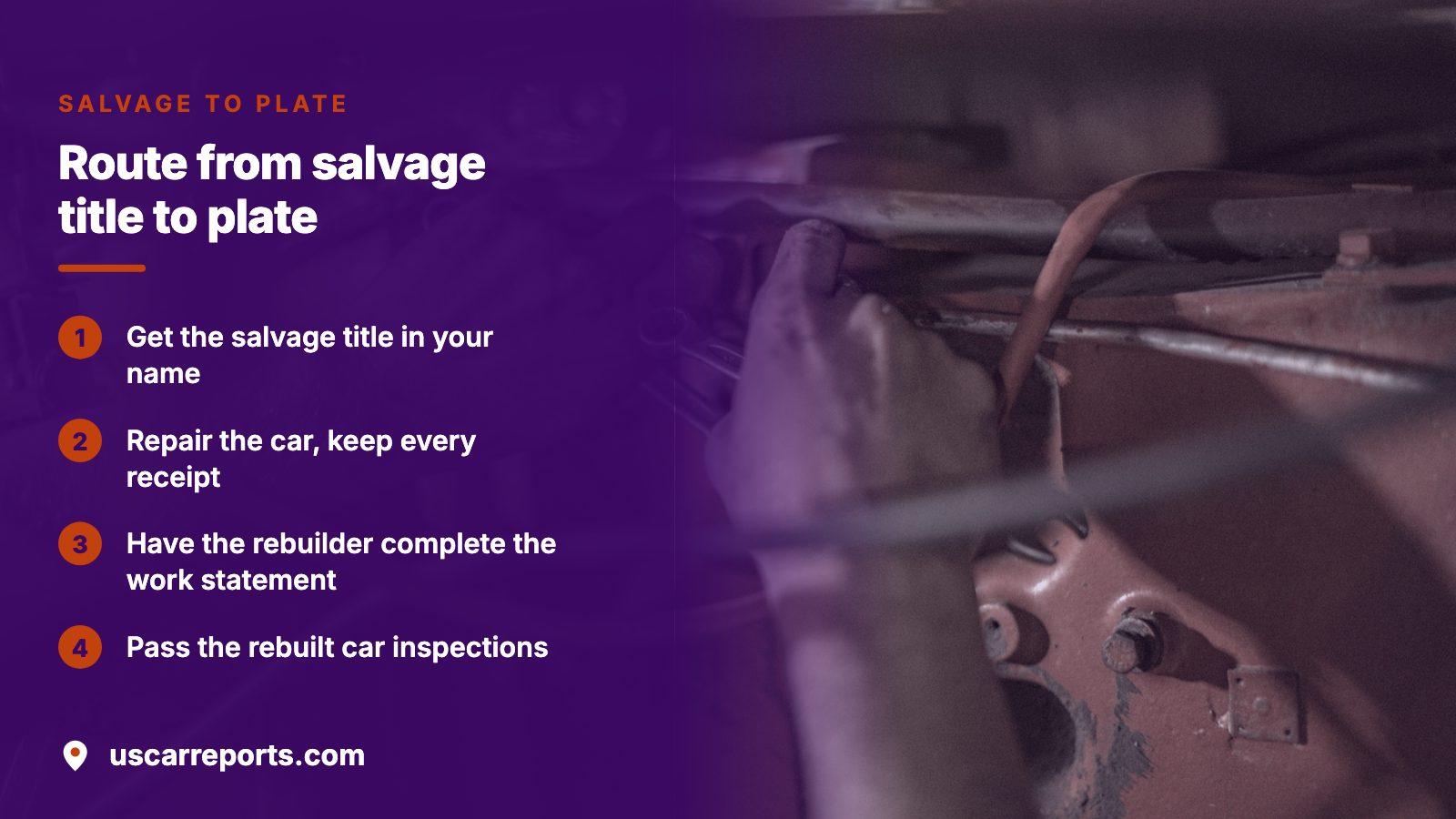
TxDMV's pages give the outline of the process, though the county tax office is the place to confirm the current inspection details for your car. In order, the steps look like this:
- Get the salvage title issued in the new owner's name, if it is not already.
- Repair the car and keep every bill of sale and receipt for parts, especially for an engine, a frame or a body.
- Have the rebuilder complete the statement of work and the parts list, with the location of each replaced part.
- Pass the safety and anti-theft inspections that apply to rebuilt cars.
- Take the title application, the statement, ownership evidence and insurance proof to the county tax assessor-collector.
If everything is accepted, the new Texas title carries the Rebuilt Salvage brand. Registration follows on the same visit or shortly after, depending on your county's process.
The forms, in plain terms
Form VTR-441 is the application for a salvage or nonrepairable title. It asks for the VIN, the odometer reading and whether the damage came from a collision, a flood or something else. The filing fee is $8.00. TxDMV takes a personal check, a cashier's check or a money order, not cash or cards, and the fee does not come back if you change your mind.
Form VTR-61 is the Rebuilt Vehicle Statement, handed to the county together with the standard title application, Form 130-U. The rebuilder describes the work and certifies that every part was obtained lawfully. The owner certifies that the VIN on the paper matches the car. One person may sign both roles.
False statements carry a felony label
Both certifications on the rebuilt statement warn that falsified information is a third degree felony. A seller who offers to fill in a blank parts list for you is handing you that risk. Keep the real receipts, and do not sign a statement about work you did not see.
A salvage car bought outside Texas
Auction listings in other states are where many Texas buyers meet salvage cars. For a car bought elsewhere, TxDMV sets two 30-day clocks: one from the sale date for putting the title in your name, and one from the car's arrival in Texas for registration. A salvage-branded out-of-state title does not skip the line, because Texas treats that car as salvage on arrival.
Out-of-state paperwork is also where terms get slippery. One state's rebuilt or prior-salvage notation can sit on a car that Texas still treats as a project, and a state may issue a brand that another state would never apply. Ask the county tax office how it will handle the specific title before money moves.
Where a VIN check earns its keep
The cheapest mistake to fix is the one you avoid before buying. A title check on the VIN shows any salvage, total-loss or junk-yard history on record. TxDMV points buyers to approved federal title-data providers for this, and the preview on USCarReports shows whether brands exist before you pay for a full report.
Read a clean result with some care. The Department of Justice says a federal search can miss a record, because not every reporting source feeds the system yet. It adds that the federal record is thinner than the title file the state itself keeps. For a car priced like a clean one, pair the VIN check with a look at the title itself, and see the pricing page for how the one-time report works.
Questions to settle before you buy a rebuilt one
A finished rebuild is a better starting point than a wreck, but TxDMV still warns buyers about it. Its guidance mentions repairers who cut and join sections or reuse damaged parts, and says a frame left out of line strains the drivetrain, wheels and brakes.
- Where was the car repaired, and can you see the repair receipts?
- Was the frame checked and aligned?
- Has an independent mechanic certified the work?
- Will your insurance agent write a policy on it?
Ask the insurer first
TxDMV notes that rebuilt cars are often denied insurance, and that they always sell for substantially less than clean ones. Get a written answer from your agent before you hand over a deposit.
Where this information comes from
- TxDMV: Salvage Vehicles — Supports the salvage definition, the list of salvage brands and the rule that a salvage car must be rebuilt and inspected.
- TxDMV: Rebuilt Vehicles — Supports the Rebuilt Salvage brand, the inspection requirement and the buying questions.
- TxDMV: Application for Salvage or Nonrepairable Vehicle Title (VTR-441) — Supports the fee, payment methods, lien rules, the nonrepairable limit and the hail and theft carve-outs.
- TxDMV: Rebuilt Vehicle Statement (VTR-61) — Supports the parts list, the two certifications and the felony warning.
- TxDMV: Out of State and Imported Vehicles — Supports the 30-day titling and registration windows for a car bought outside Texas.
- NMVTIS for consumers (U.S. Department of Justice) — Supports what a federal title search covers and why a clean result can still miss something.
Sources and photos: Facts checked against the sources above in November 2026. Photos by Everett Pachmann, Nina Mercado and Clarence Tioh on Unsplash; diagrams by USCarReports.
Keep reading
- Texas title check by VIN: brands, the 2003 cutoff and the 30-day clockHow to read Texas title brands before you buy.
- Texas VIN check: what to run, Texas title brands and buying rulesThe VIN check for a Texas purchase, with the state's buying rules.
- Certificate of destruction by state: what the paper allowsThe destroy-only paper, and how it differs from a rebuildable salvage title.
- Registering a car in another state: deadlines, title and checksRegistration steps for a car that arrives from outside the state.
Frequently asked questions
Can I register a salvage car in Texas?
Not as a salvage car. Texas bars registration and road use until the vehicle is repaired and a title branded Rebuilt Salvage is issued. After the repair, the county tax office handles the title and registration application. A car marked nonrepairable is excluded and can only serve as a source of parts or scrap.
How much is a Texas salvage title?
The application on Form VTR-441 lists an $8.00 fee for a salvage or nonrepairable title, plus $2.00 more when a lost Texas title needs a certified replacement. Payment must be a check or money order. Registration and county fees are separate, so confirm current amounts with your county tax office.
Does the Rebuilt Salvage brand ever come off?
TxDMV describes it as the brand on the title of a former salvage car that was rebuilt, and nothing on the pages we read offers a way to remove it. The only removal path described is for a brand applied by mistake from another state, and that needs an official written statement.
The seller calls it repaired, but the title still reads salvage. Now what?
Treat it as unregisterable. With no rebuilt title in existence, the car has no lawful path to a plate or the road. Ask for the rebuilt statement, the parts receipts and proof the required inspections were done, then check them against a VIN report before you pay.
Does a clean VIN report prove a car was never salvage?
No. The Department of Justice cautions that a federal search may show nothing negative even when a record exists, since some reporting sources have not joined yet. Use the report as one check, look at the actual title, and have a mechanic examine the frame and repairs.
Now check the car itself
The guide explains what to look for. The report shows what this VIN has on record.