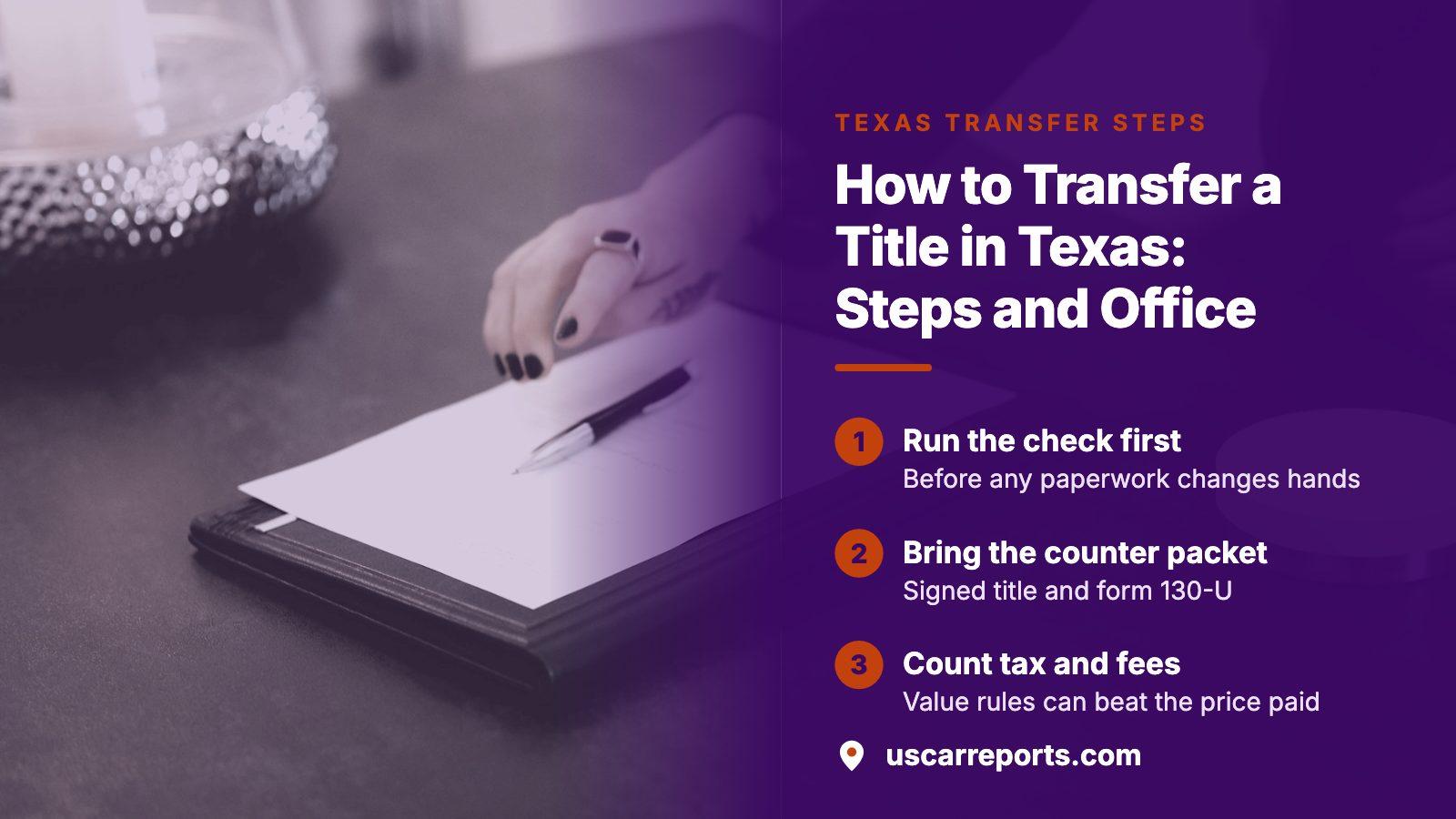
THE SHORT ANSWER
In a private sale, the buyer and seller visit the county tax office, ideally together. The buyer carries the title the seller has endorsed, showing the sale date and mileage, plus Form 130-U signed and stating the price. Add proof of liability insurance, an inspection report where required, and money for sales tax and fees. The title must be in the buyer's name within 30 days. A dealer files the application for you.
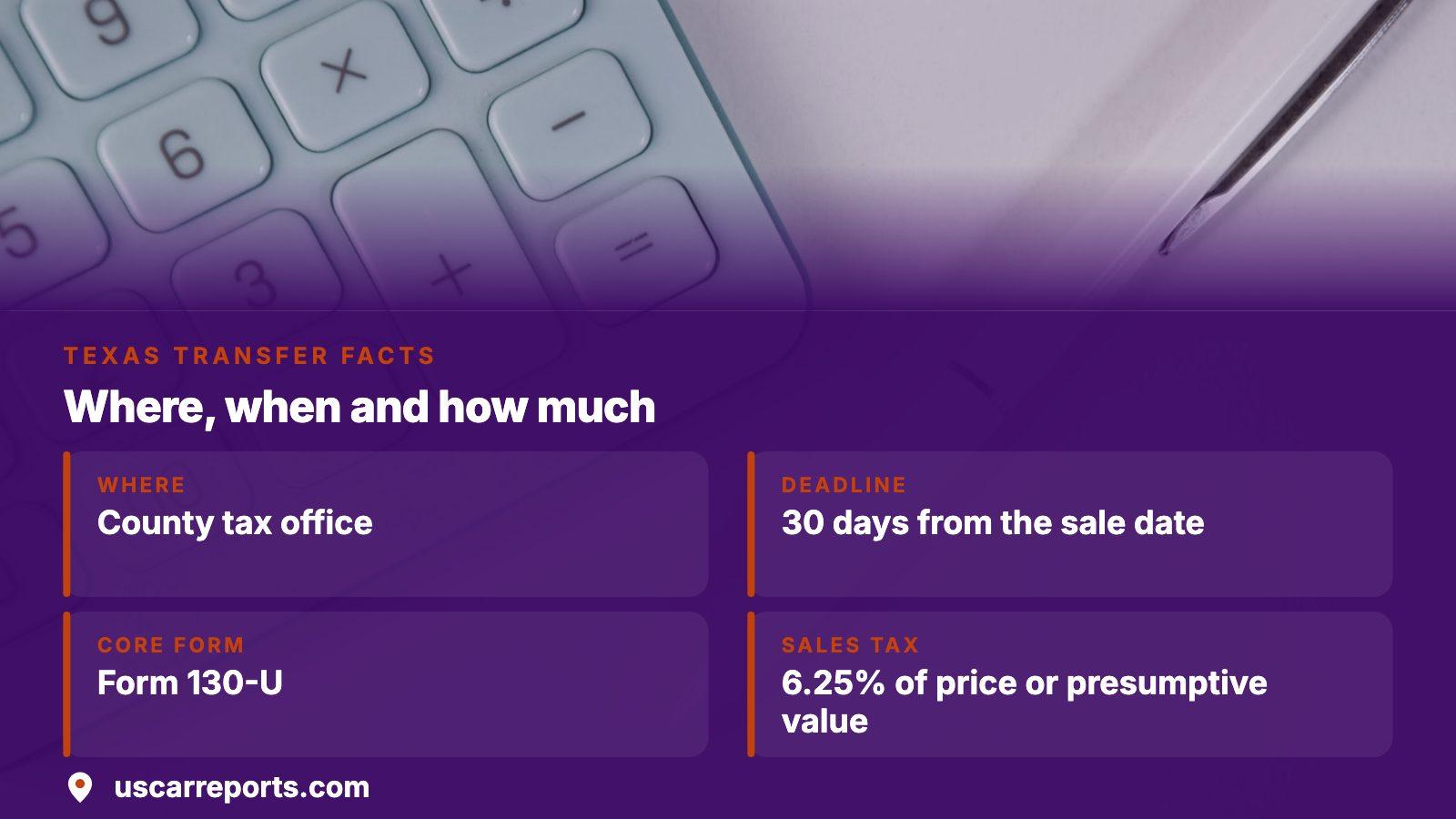
- Where
- County tax office
- Deadline
- 30 days from the sale date
- Core form
- Form 130-U
- Sales tax
- 6.25% of price or presumptive value, whichever is higher
Where a Texas title transfer happens
Texas does not run title transfers through a single state counter that you queue at. The work goes through your county tax office, the same place that handles registration stickers. For a private sale, TxDMV advises that buyer and seller walk in together, and there is a practical reason: a clerk can spot a signature in the wrong box or a name that differs from the one printed on the title while both people can still fix it.
If you bought from a dealer, the situation reverses. The dealer files the title application, so you do not need to go to the office. What you should ask for is a receipt that shows the car is being titled in your name, and then keep it until the title arrives.
The check that belongs before the paperwork
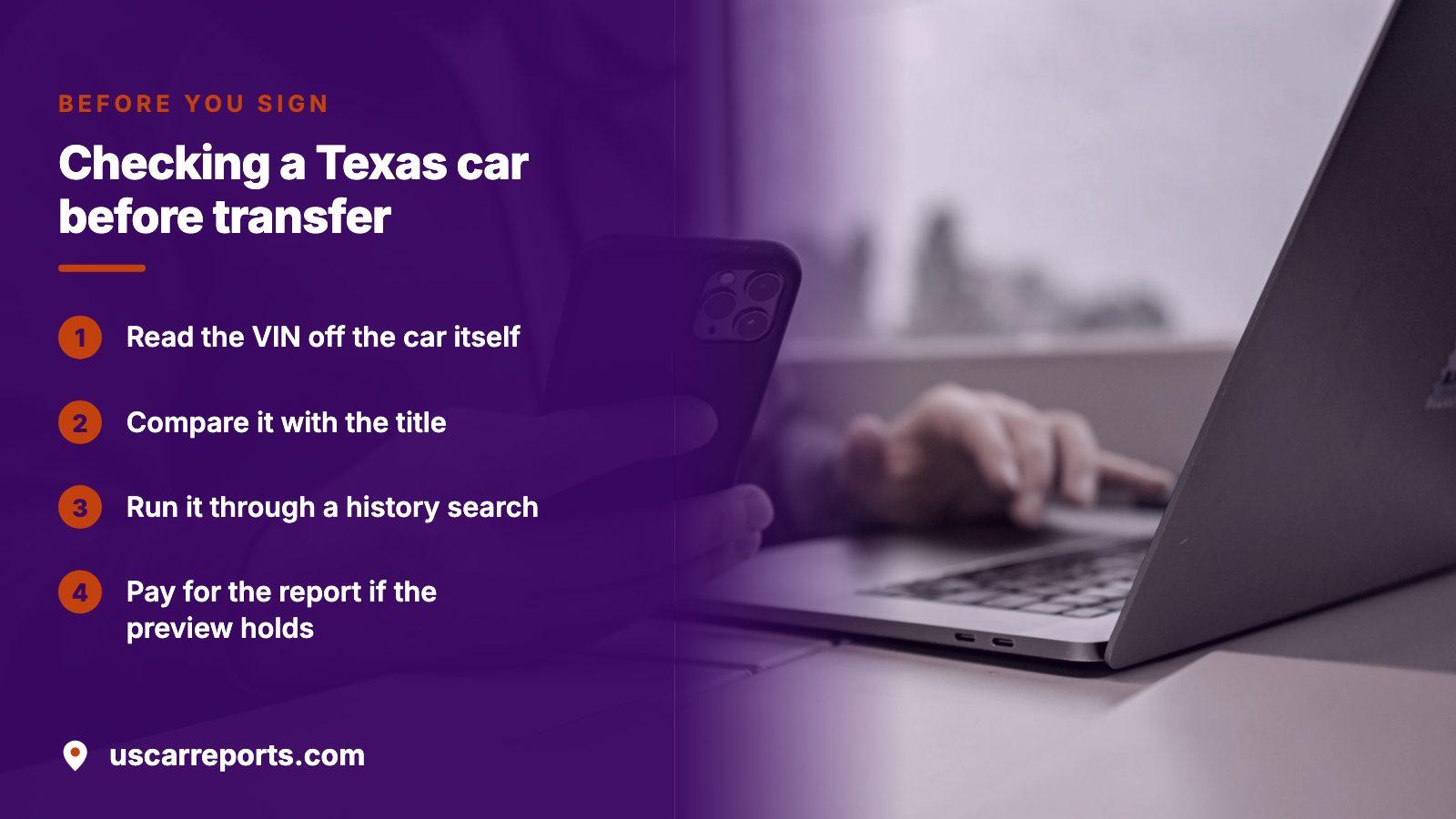
At USCarReports we cover title and VIN checks state by state, and Texas shows why the order matters. A transfer moves ownership of whatever the title describes, including its problems. Once your name is on it, a brand from another state, an unpaid lender or a rolled-back odometer belongs to you.
Start at the vehicle: copy the VIN from its dash or door plate, match it against the title, then run a history search. USCarReports opens every search with a preview at no charge, enough to show whether the record has anything worth a closer look. Pay for the full report only if the preview leaves the car in the running. The sections that matter for a transfer are title brands, odometer entries, liens and theft.
Why the national record matters here
The Justice Department set up NMVTIS so that buyers are protected from title fraud and stolen cars cannot be quietly resold. Consumers reach its data through approved providers, and Carfax, DMVDesk and Experian are listed there as serving dealerships only.
What the buyer brings to the counter
- The Texas title itself, endorsed by the seller, with the sale date and the mileage written in.
- Form 130-U, the state's combined title and registration application, signed and listing what you paid.
- Proof of liability insurance. Without it you can apply for title only and register later.
- A lien release or power of attorney if either applies to this car.
- A Vehicle Inspection Report when the state database holds no current inspection for the vehicle.
- Payment for sales tax, title, registration and local fees. Ask the office which payment types it takes, because counties differ.
Keep your own note of the seller's name, address, the day of sale and the VIN. It costs nothing, and it settles arguments later.
Tax, fees and the inspection question
The state charges motor vehicle sales tax at 6.25% of the sales price, or of the standard presumptive value if that figure is higher. So a car sold to you for a suspiciously low number is still taxed on the higher one. Title, registration and local fees come on top, and only the county tax office can give you the exact total for your case.
Inspection depends on where the car will live. Private passenger vehicles in 17 listed counties, among them Harris, Dallas, Tarrant, Travis and Williamson, must pass an emissions test; a safety inspection is not part of the transfer. Ask the seller for the most recent inspection report; if the database already holds one, you may not need a new one.
| Item | What to know |
|---|---|
| Sales tax | 6.25% of the higher of price or standard presumptive value |
| Other charges | Title, registration and local fees; the office quotes the total |
| Insurance | Liability proof needed, or apply for title only |
| Inspection | Report needed if none is on file; emissions test in listed counties |
The 30-day clock and what happens if it runs out
The clock starts on the day of sale, not the day you find time for the errand. Miss it and delinquent transfer penalties may apply. TxDMV's page does not print an amount, so ask the county office what the late charge would be rather than guessing.
After you file, expect a wait of 20 business days or more. If 30 business days pass with no title in your mailbox, contact TxDMV. A car with a lien is a special case: the lienholder receives the title, not you.
Weekend sale, no plates
If you buy on a Saturday or Sunday and the seller took the plates and sticker, you can get a Vehicle Transit Permit to cover the drive to the tax office. It lasts five calendar days and one is issued per sale.
What the seller must do to stay out of trouble
A seller who signs the title and walks away is still exposed. If the buyer never transfers it, tickets, tolls and worse can land on the seller as the owner of record. The protection is the online Vehicle Transfer Notification, and it only shields the seller from buyer parking tickets and toll violations when filed within 30 days of the sale.
- Write the sale date and mileage on the title when you sign it.
- Give the buyer Form 130-U, signed, with the price on it.
- File the transfer notification online and save the confirmation.
- Decide about the plates: carry them to a car in the same class, hold on to them, or deface them. The sticker does not travel.
If tickets keep arriving after a sale, Form VTR-275 lets the seller request the vehicle record and confirm the transfer date.
Gifts, inheritance and divorce
Not every transfer is a sale. A gift calls for the title, Form 130-U and the Form 14-317 affidavit, with both giver and receiver signing; either one may file, but in person. A $10 gift tax applies when the transfer is between close relatives, an estate or a qualifying charity, in place of sales tax.
When a spouse dies with no will, the surviving spouse files Form VTR-262, the Affidavit of Heirship. In a divorce, a certified copy of the decree is enough if the decree awards the car. If it does not, the ex-spouse must sign the title over properly. In each case, running the VIN first is wise, since a liens or brand surprise is just as costly inside a family.
Fixing a mistake after the visit
Errors turn up at the counter now and then. When the department or the county made the error, the correction is free. When the error came from what was written on the application, you file a new application with a fee at the county tax office.
Read the finished title the day it arrives: name, address, VIN, any lienholder and any brand wording. A branded record that you did not expect is a reason to contact the office quickly and to pull the full history report, which can show where the brand came from. Our Texas title check page explains the brand vocabulary and the line between salvage and nonrepairable paper.
Where this information comes from
- TxDMV: Buying or selling a vehicle — Source for the office visit, the documents, the deadline, tax, permit and seller notification.
- TxDMV: Title check, look before you buy — Backs the advice to look at the vehicle record before paying.
- U.S. Department of Justice: NMVTIS vehicle history — Explains how consumers reach national title data and which providers serve dealers only.
Sources and photos: Facts checked against the sources above in November 2026. Photos by Annika Wischnewsky, Anastasiia Nelen and Sasun Bughdaryan on Unsplash; diagrams by USCarReports.
Keep reading
- Texas title check by VIN: brands, the 2003 cutoff and the 30-day clockTexas brands, the salvage test and the rules for rebuilt cars.
- Texas VIN check: what to run, Texas title brands and buying rulesRunning a VIN on a Texas car before you pay.
- Transfer a car title to a family member: who counts as family, by stateThe family version of this process.
- Title office: which counter issues a car title in your stateWhat a title office does and what to ask there.
Frequently asked questions
How do I transfer a title in Texas after buying from a private seller?
Meet the seller at the county tax office with the endorsed title and Form 130-U. Bring insurance proof, an inspection report if needed, and payment for tax and fees. Apply within 30 days of the sale, and ask the clerk to look at the title for problems before filing.
Where do I go to title a car in Texas?
Your county tax office. It accepts the application, collects the tax and fees, and forwards the paperwork to the state. If a dealer sold you the car, the dealer files instead, so just keep the receipt that shows the car is being titled in your name.
Can I transfer a Texas title without the seller present?
TxDMV recommends that the seller go with the buyer, but the key requirement is paperwork: a properly signed title and a signed Form 130-U with the price. Anything missing, such as a lien release, can stall you at the counter, so check the title carefully before the seller leaves.
What if the seller lost the title?
Do not hand over money for a promise. A car with no title cannot be transferred the normal way, and the seller should obtain a replacement first. A VIN search before the sale can also show whether a lender still holds an interest in the car, which affects who gets the paper.
Does a title check cost anything?
The first look at a VIN here costs nothing, and it shows whether records exist worth reading. You pay once for the complete report, and the amount is shown on the pricing page. Neither is a subscription, and neither replaces the county office check at the counter.
Now check the car itself
The guide explains what to look for. The report shows what this VIN has on record.