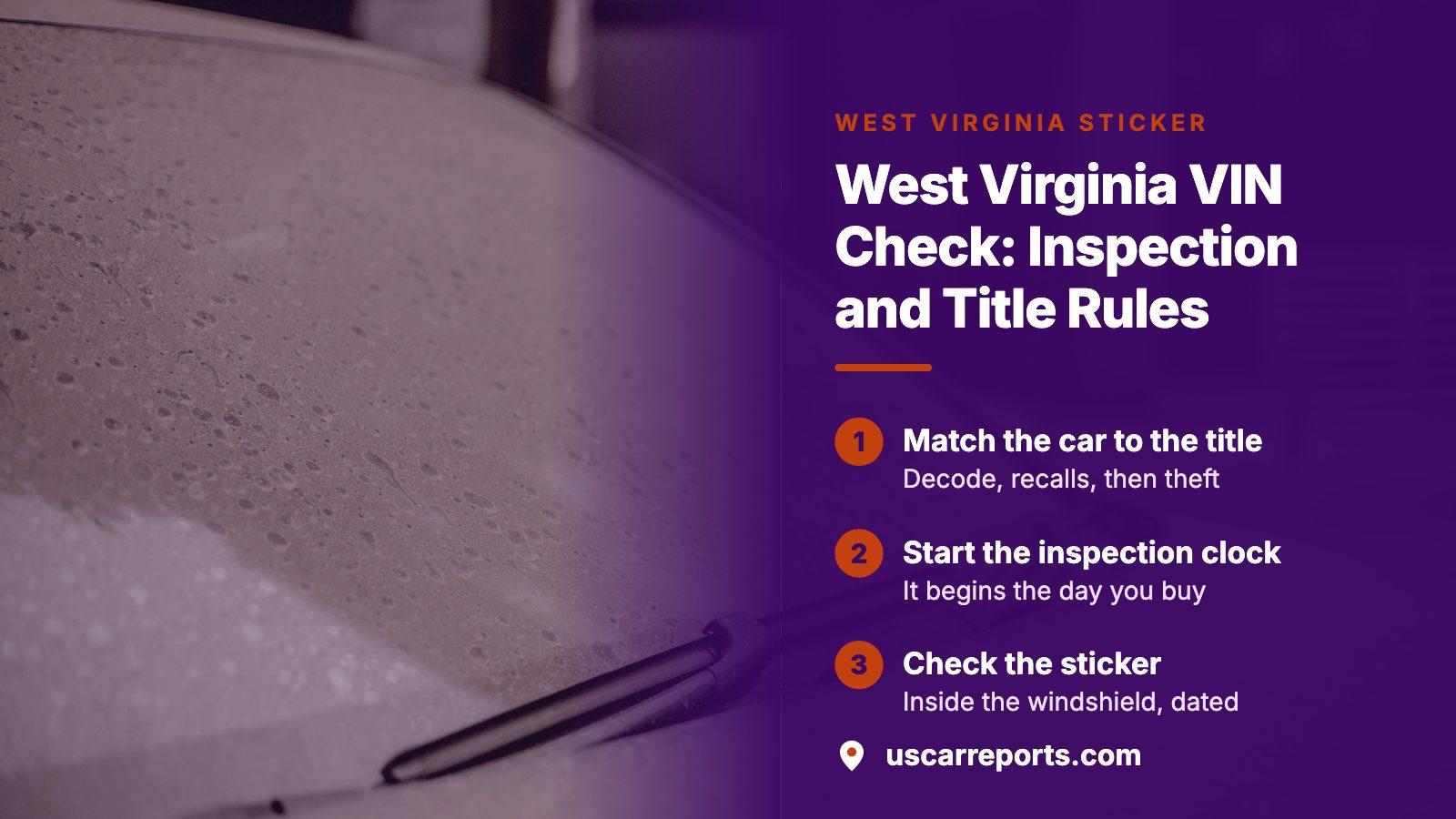
THE SHORT ANSWER
Match the number on the car to the title, then run a decode, NHTSA's open-recall search and NICB's theft and salvage lookup, all of which cost nothing. West Virginia's own paperwork covers West Virginia, so add a national title record for any car that has lived in Ohio, Pennsylvania, Maryland, Virginia or Kentucky. Before paying, check the inspection sticker: a missing one starts a three-day clock.
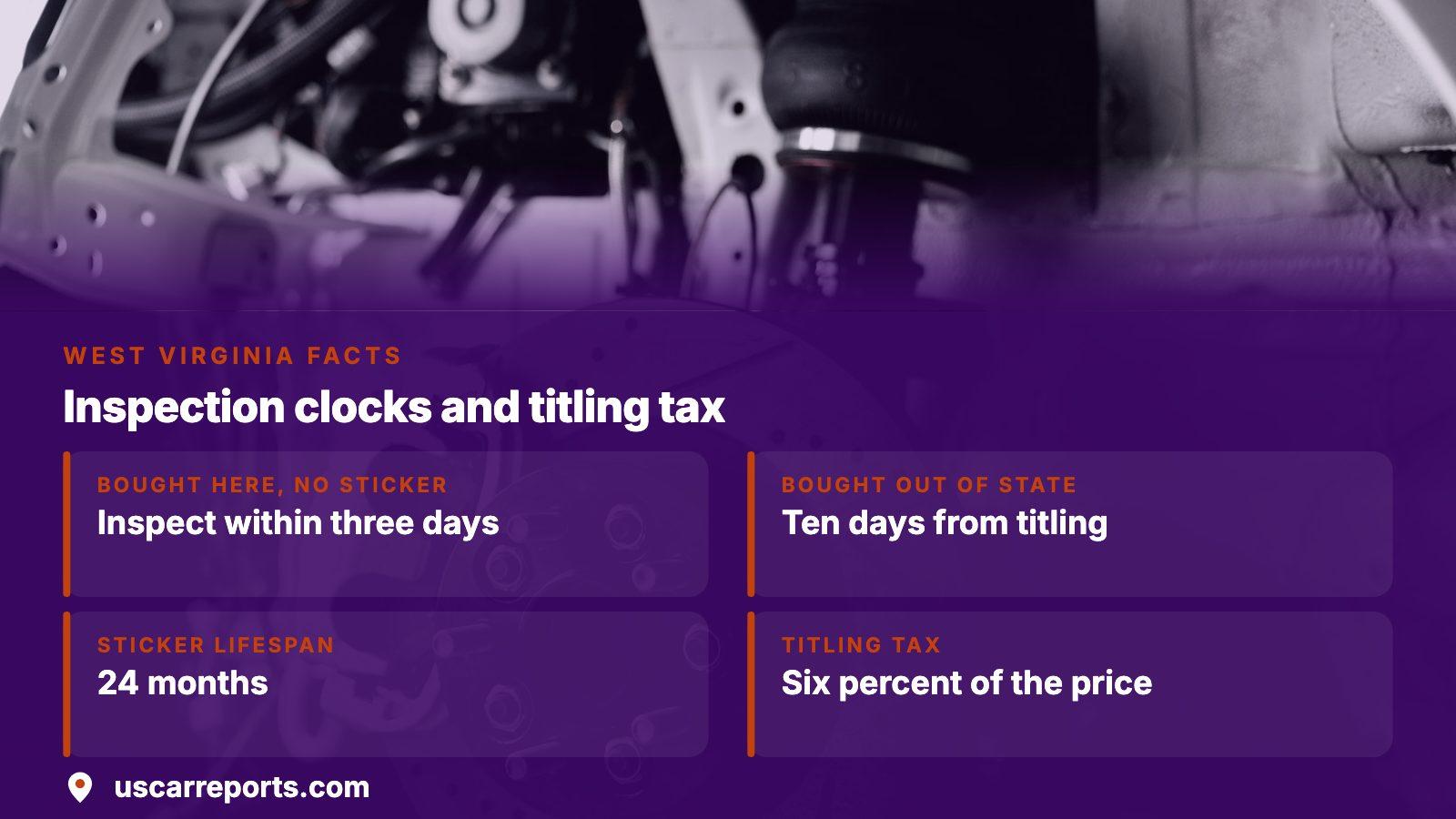
- Bought here, no valid sticker
- Inspect within three days
- Bought out of state
- Ten days from titling
- Sticker lifespan
- 24 months, inside the windshield
- Titling tax
- Six percent of the price
What a West Virginia VIN check finds, and what it can't
One number opens several different records, and none is complete alone. A decode shows what the factory built. Federal and insurer databases add recalls, theft reports and total-loss entries. The state adds rules on inspection, signatures and tax.
| What you want to know | Where to look |
|---|---|
| The car's factory build | A VIN decode |
| Any safety recall still unrepaired | NHTSA's recall search |
| A theft report or insurer write-off | NICB's VINCheck |
| Whether it may be driven this week | The windshield sticker and the DMV's rules |
| Title brands, odometer readings, auction photos | A full report from an approved data provider |
No lookup sees damage that never reached an insurer or the police. That gap is where a mechanic's inspection earns its fee.
Running a West Virginia VIN search, step by step
Start with the car, not the listing. Ads contain typos, and one wrong character returns the wrong record or none.
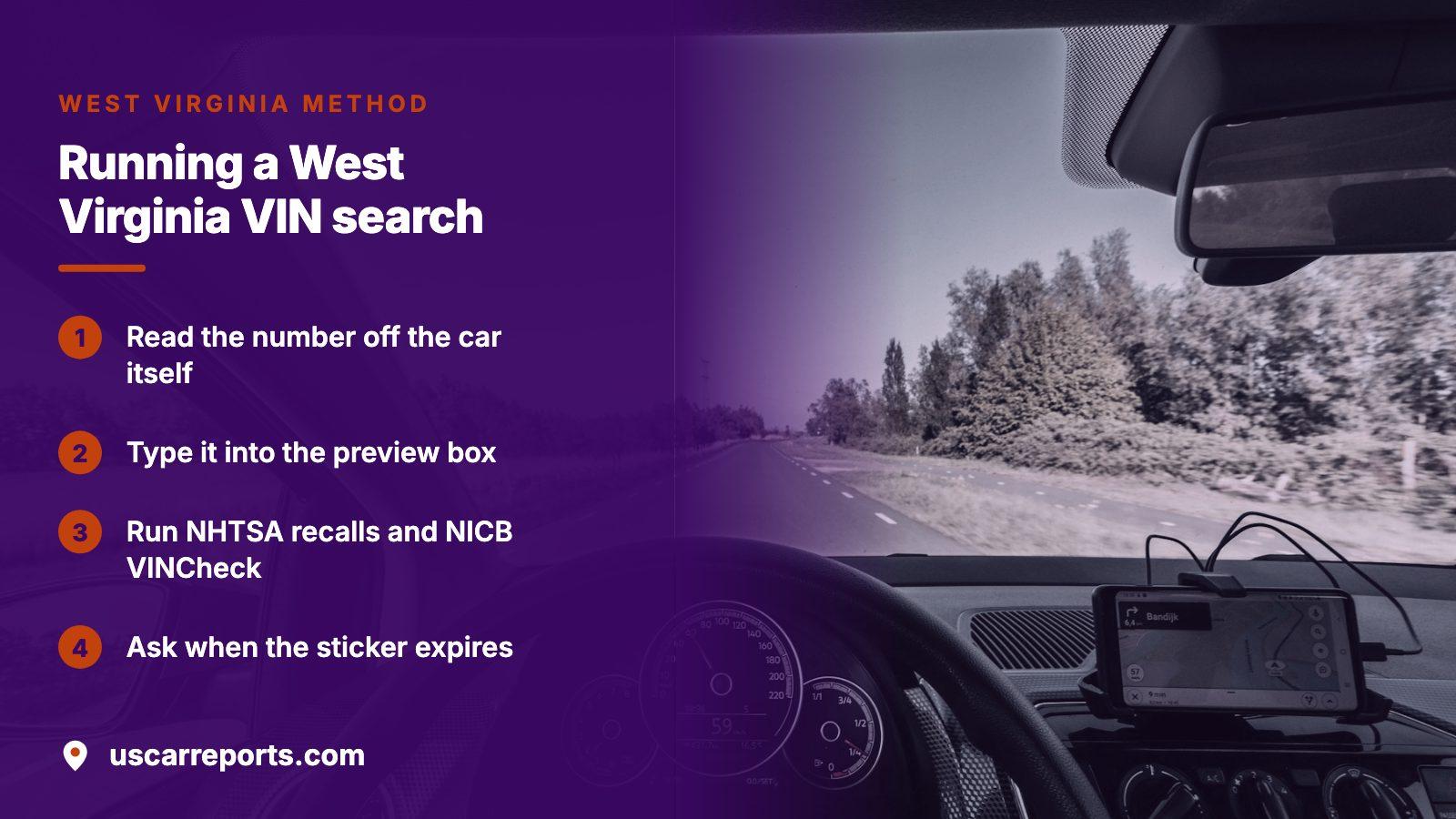
- Read the number off the car itself: one copy is stamped where the dashboard meets the glass, another sits on the doorway label. Compare both with the title.
- Type it into the preview box on this page. The preview costs nothing and shows whether records exist before you pay.
- Run NHTSA's recall search and NICB's VINCheck on the same number.
- Ask when the inspection sticker expires, then read the date yourself.
- Buy the full report before any deposit changes hands, and read it with the title beside you.
- Pay a mechanic to lift the car and check brakes and underbody, which mountain grades and winter treatment of the roads both punish.
The inspection clock that starts when you buy
West Virginia inspects registered vehicles every two years. A passing car earns a sticker good for 24 months, placed inside the windshield. The cycle was annual until HB 2310 changed it at the start of 2024.
The deadline after a purchase is the part that bites. The DMV's inspection page gives three days for a car acquired inside the state without a valid sticker, and ten days from titling for one bought elsewhere. Its registration page words the in-state rule as ten days, so ask the DMV or the station before leaning on the longer figure.
Put the sticker in the deal
A lapsed sticker leaves you with a deadline and no idea whether the car will pass. Ask the seller to get it inspected before you pay, or lower your offer by the cost of a failure. The sticker fee is capped at $19 for the full two years, so ask why a car is running without one.
Title paperwork: signatures, mileage, bill of sale and tax
The West Virginia DMV spells out what a clean private sale looks like. Each item below is something to check before cash moves.
- Seller and buyer both sign the back of a West Virginia title. Where owners are joined by AND, every one signs; with OR, a single signature can do.
- On a title from another state, the previous owner signs as seller and your name and address go on the face.
- The seller writes the exact mileage in the assignment area, and the odometer should not read lower than the title says.
- A private buyer who pays less than half the current NADA Clean Loan book value needs a notarized bill of sale, with copies of both parties' licenses.
- Titling tax is six percent. For a privately bought car two years old or newer, the DMV taxes book value whatever price was paid, and a notarized bill will not lower it.
Mileage deserves the closest read. A reading lower than an earlier one on the report is a question the seller should answer in writing.
Cars from over the state line
Five states touch West Virginia: Ohio, Pennsylvania, Maryland, Virginia and Kentucky. Buying across a border is routine here, so an out-of-state past is the normal case. The DMV accepts valid, unexpired stickers from nine other states only: Texas, Oklahoma, Utah, Wyoming, Missouri, Louisiana, Mississippi, New York and New Hampshire. None of the five neighbors is among them.
| Where the car came from | Its sticker | Inspection deadline |
|---|---|---|
| Bought inside West Virginia without a valid sticker | Nothing to honor | Three days |
| Bought in a state on the accepted list, sticker still valid | Accepted until it expires | At that expiry |
| Bought out of state, no accepted sticker | Not accepted | Ten days from titling |
Whatever happened to a car before it reached West Virginia was recorded somewhere else. For those years, the national title record matters more than any state lookup.
Total losses, flood cars and open liens
Insurers write off vehicles after floods, fires and collisions, and the entry stays with the number however good the paint looks. The DMV's title page treats a declared total loss as a special case: the vehicle has to pass the state's inspection process before it can receive a legal title again.
That process shows a procedure was followed, not that the repair was good. Ask for photos from before and after the work and the parts receipts, then have your own mechanic look at welds and airbag components.
A lender's letter is not a clear title
Once a loan is paid off, the owner applies for a clear title. Ask to see that title, or proof the application was filed, before you hand over money. A lien on the report that the seller calls settled needs paper behind it.
Reading the results: five entries and your next move
| Entry | What it may mean | Your next move |
|---|---|---|
| Salvage, rebuilt or flood brand | A total loss or major repair sits in the car's past | Ask for repair paperwork and photos, then pay for a structural check |
| Odometer reading below an earlier one | Rollback, a replaced cluster or a typo | Get the explanation in writing and walk away if it shifts |
| Title issued in a neighboring state | Part of the history was recorded outside West Virginia | Read every state's entries, not only the latest |
| Open lien | A lender still has a claim on the car | Settle through the lender and take a clear title |
| Theft entry | Reported stolen at some point, possibly recovered | Hold the deposit until police or the insurer explain it |
Order matters. A total loss followed quickly by a fresh title in another state deserves more suspicion than a total loss followed by a proper rebuilt brand.
Price, preview and the sensible order of events
The preview costs nothing and shows whether a record exists for the VIN. Paying for a report happens once and nothing renews, with packs of 3, 5 or 10 for shoppers comparing cars. See the /pricing page for amounts.
Run the no-cost lookups, read the preview, then buy the report before leaving a deposit. If the car still looks right, confirm the sticker date, book the mechanic and complete the title with both signatures and the mileage.
Where this information comes from
- West Virginia DMV: Vehicle Inspection — The two-year cycle, the sticker, the three-day and ten-day deadlines and the list of accepted out-of-state stickers.
- West Virginia DMV: Titles — Signature rules, the odometer statement, the notarized bill of sale threshold, titling tax and the total-loss process.
- West Virginia DMV: Registrations — What renewing a registration requires, and where its inspection wording differs from the inspection page.
- NMVTIS: National Motor Vehicle Title Information System — The federal title system behind the national records approved providers sell.
- NHTSA: Recalls — The no-cost search for open safety recalls by VIN.
- NICB: VINCheck — The no-cost theft and total-loss search fed by participating insurers.
Sources and photos: Facts checked against the sources above in November 2026. Photos by JavyGo, Sander Jeurissen and Erik Mclean on Unsplash; diagrams by USCarReports.
Keep reading
- Ohio VIN check: records to pull, title brands and Ohio buying rulesThe neighbor many West Virginia buyers shop in, with its own notary rule at sale.
- Virginia VIN check: salvage rules, title steps and inspectionAnother border state, and one whose stickers West Virginia does not accept.
- Kentucky VIN check: sheriff inspection, brands and buying rulesRules for a car that was titled across the Ohio River before it arrived.
- Sample reportSee how brands, odometer entries and auction photos are laid out before you buy.
Frequently asked questions
What is the inspection deadline after buying a used car in West Virginia?
The DMV's inspection page says three days for a vehicle acquired in the state without a valid sticker, and ten days from titling for one bought out of state. Its registration page words the in-state period as ten days, so confirm with the DMV. Plan around the shorter figure.
Is there a free West Virginia VIN lookup?
A decode, NHTSA's recall search and NICB's VINCheck cost nothing, and USCarReports shows a free preview for any VIN. None of those holds the national title record with brands and odometer entries from other states, which is sold as a one-time report.
Does a valid West Virginia sticker tell me anything about the car's past?
No. The inspection checks brakes and equipment at a single moment, and a sticker lasts 24 months, so a car can sit close to two years past its last examination and still be legal. A sticker says nothing about flood damage, theft or odometer rollback.
Do I need a notarized bill of sale in West Virginia?
The DMV ties it to one case: a private purchase below half the current NADA Clean Loan book value needs a notarized bill of sale signed by both parties, with copies of both driver's licenses. Above that level, tax is figured on the price you declare.
Can I look up a West Virginia license plate to find the owner?
Not as a private buyer. A federal privacy law restricts access to personal details in state motor vehicle files, and curiosity is not a permitted reason, so a plate cannot lawfully give you an owner's name. Use the VIN on the car and ask the seller to match it to the title.
Now check the car itself
The guide explains what to look for. The report shows what this VIN has on record.