THE SHORT ANSWER
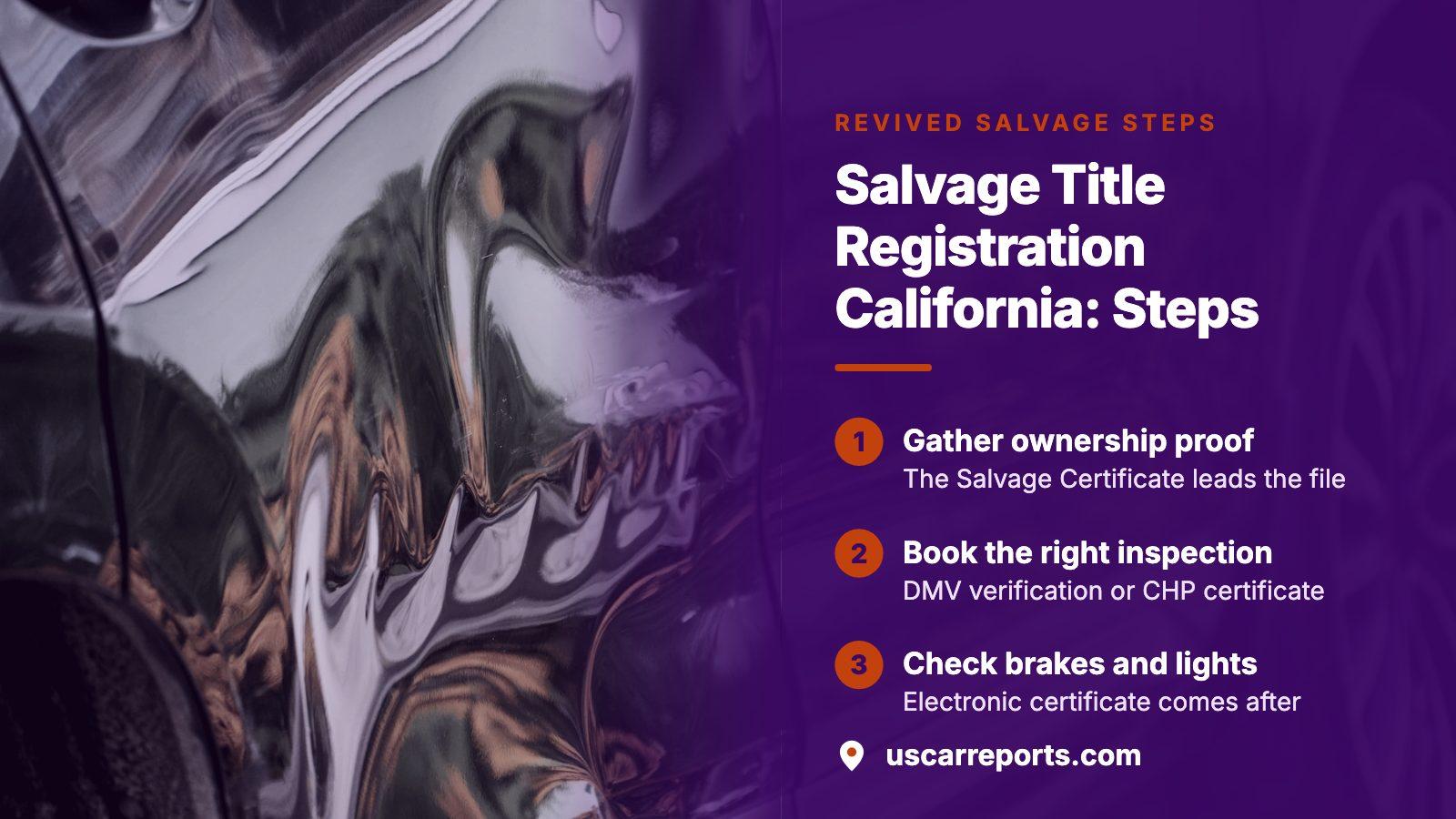
To register a salvage car in California, you file an application (REG 343) with proof of ownership such as the Salvage Certificate, pass a DMV or CHP inspection, hold a passing electronic safety systems certificate from the Bureau of Automotive Repair, add smog if it applies, and pay the fees. A car issued a non-repairable certificate can never be registered.
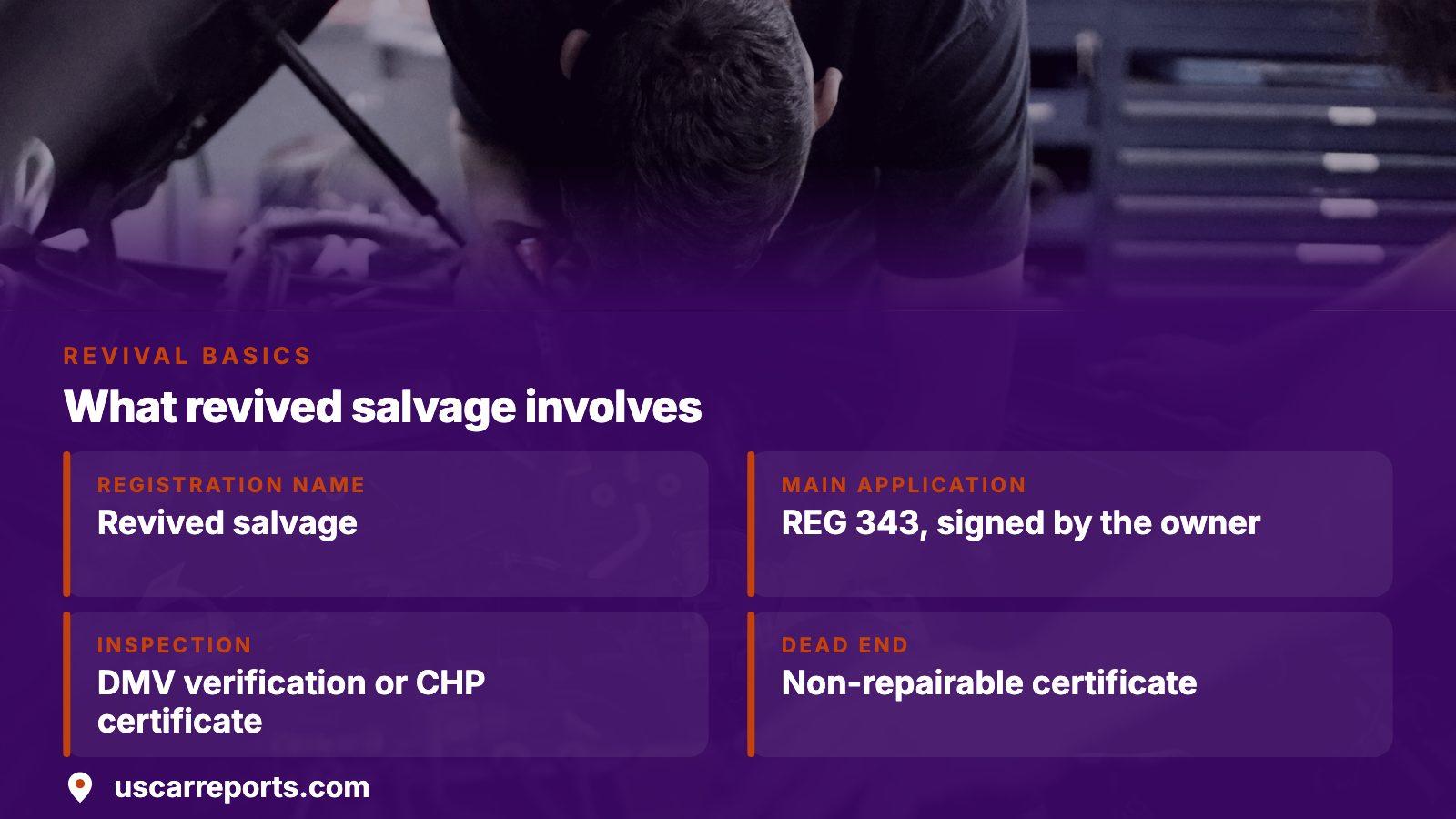
- Registration name
- Revived salvage
- Main application
- REG 343, signed by the owner
- Inspection
- DMV verification or CHP certificate
- Dead end
- Non-repairable certificate
Revived salvage is the name for a rebuilt car
California DMV uses the term revived salvage for a car that an owner or insurer once reported as a total loss and that has since been repaired to running condition. Once that has happened, the car has to be registered again, and DMV can then issue a branded title with the registration.
A second group exists beside it. A revived junk vehicle is one that was reported as dismantled and then brought back. It follows a similar path but needs the junk receipt DMV issued, so a seller who cannot produce that paper is a warning sign rather than a minor gap.
The paperwork DMV asks for
Everything hangs on form REG 343, which every current owner signs. Behind it sits proof of ownership. For a car bought from a licensed dismantler, that means a bill of sale or a transfer and reassignment form carrying the dismantler's vehicle acquisition number.
- Form REG 343, the title and registration request, with every owner's signature.
- Ownership evidence: the California Salvage Certificate, or a California title filed alongside REG 488C.
- Proof the car was physically examined: DMV's REG 31 verification, or CHP's 97C certificate.
- A passing electronic safety systems record.
- Smog paperwork, plus a certified weighmaster's slip for pickups and trucks, when either applies.
- The fees for your case.
DMV's manual adds a detail that surprises do-it-yourself rebuilders: the cost of the car must include labor, even when the applicant did the labor personally.
Who inspects the car, and what they look for
For a car salvaged inside California, a DMV staff member with the right authority may examine it, or the file is sent to the California Highway Patrol. A car salvaged elsewhere always goes to CHP. Both routes end in a signed document that travels with the application.
Air bags are checked by eye
If a car was built with air bags and the verifier sees a hole in the steering column, the passenger glove box area or the door panels, DMV treats that as a sign they fired or were removed. The car then has to be inspected at a CHP Salvage Inspection Station, so a cheap rebuild with missing air bags will not get through quietly.
The manual says the inspection fee must be paid before the inspection or verification takes place. It lists that fee as $50, but fees change, so confirm the current figure with DMV before you book.
Brakes, lights and the electronic certificate
Revived cars need a Vehicle Safety Systems Inspection certificate. A single electronic pass from the Bureau of Automotive Repair replaces what used to be two paper slips, one for brakes and one for lamps. Paper versions dated September 28, 2024 or later are refused, and a repair shop's own letter saying the brakes and lights work no longer counts.
You can look up a result by VIN on the BAR inspection history page. A VIN search is better than a plate search because plates change. Results do not appear there on the day of the inspection, although the clerk can confirm them electronically. A certificate older than 90 days can still be used when your first DMV transaction fell within 90 days of its issue date.
Bringing a salvage car in from another state
A vehicle that has never carried California plates, and was branded salvage somewhere else, can still be registered here. The ownership paper is a California Salvage Certificate, an out-of-state salvage certificate or an out-of-state title, filed with a salvage certificate application. CHP verifies the car if it is referred, and a New York Salvage Certificate always triggers that referral.
| Situation | Ownership paper | Inspection route |
|---|---|---|
| Salvaged in California | California Salvage Certificate or title with REG 488C | DMV employee or CHP |
| Salvaged in another state | Out-of-state salvage certificate or title with REG 488C | CHP referral |
| Paper from New York | New York Salvage Certificate | CHP checks the confidential number |
Fees on such a car include a prior history fee, and the clock for paying them runs 20 days from the first time the car is driven, after which penalties apply. A smog certificate is required when it is appropriate for the car, and DMV's fee calculators cover nonresident vehicles.
Where the process stops for good
A non-repairable vehicle certificate closes the door. It goes on cars an owner declared only as a source of parts or scrap, cars fully stripped, and burned shells with nothing usable. DMV states that such a car cannot be titled or registered again as junk or revived salvage.
Ownership problems end deals too. Someone without a California title must file a notarized replacement application, and someone without the other state's title has to get a replacement from that state. When ownership cannot be shown and the car is valued at $5,000 or more, DMV asks for a surety bond or a title deposit agreement.
Run the VIN before you hand over cash
Sellers must disclose salvage history, yet DMV admits the rule is hard to enforce, particularly for cars that arrive from another state. Reading the VIN's title record tells you if a salvage or junk brand exists, whether anyone reported a total loss and what the odometer last said. Do that before paying for a rebuild that might never be registered.
Start with the preview here at USCarReports. If it points to a brand, one purchase shows the rest of the record, with no plan to cancel later, and the pricing page has the options. Pull it for any branded California car, then compare the brand against the paper the seller hands you. A mismatch means walk away or ask DMV.
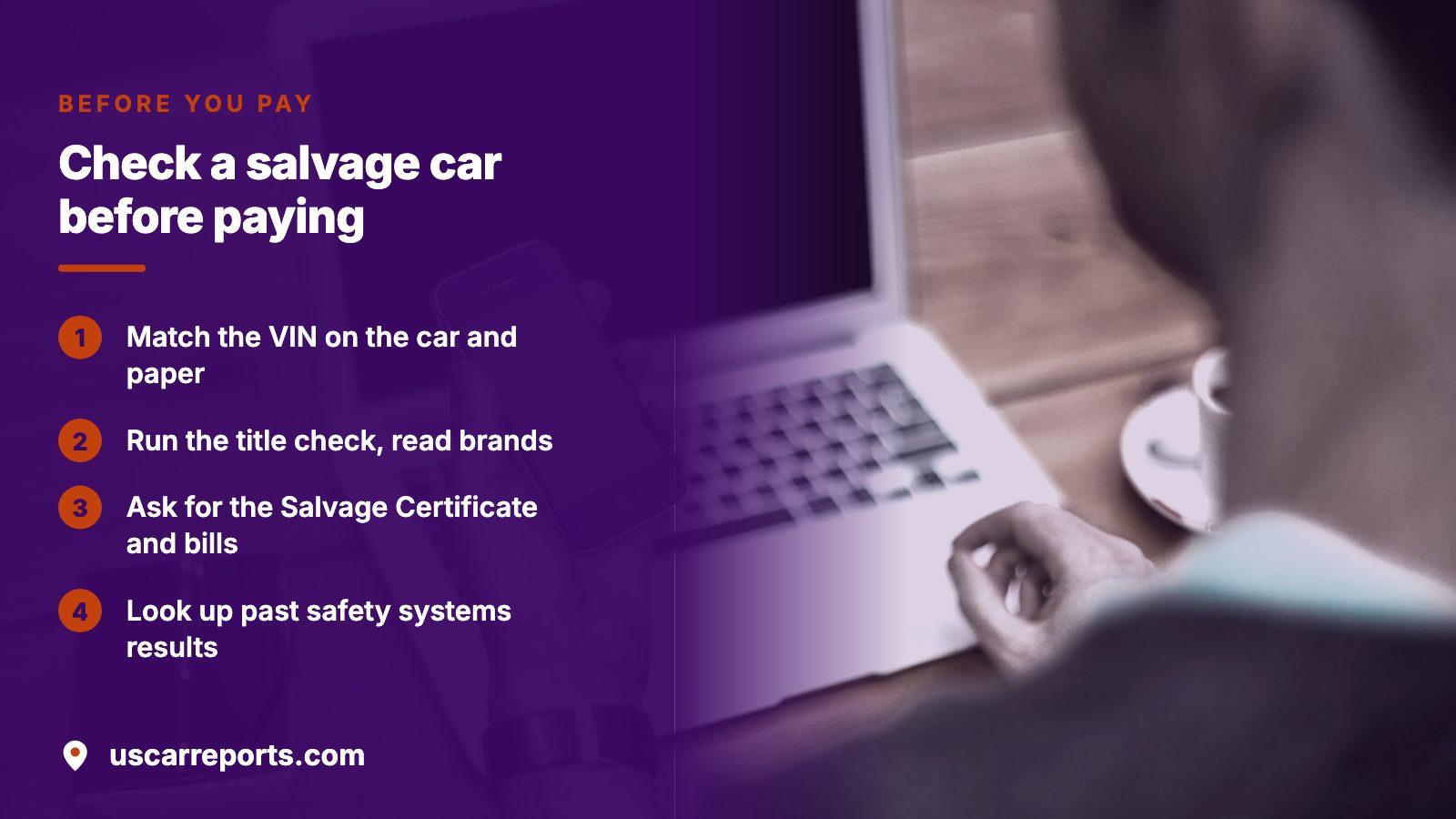
- Get the VIN from the car and from the seller's paper, and confirm they agree.
- Run the title check and read the brand history.
- Ask for the Salvage Certificate and every bill of sale.
- Look up any past safety systems result by VIN on the BAR page.
Where this information comes from
- California DMV: junk and revived salvage vehicles — the required forms and inspection step for re-registering
- California DMV: total loss salvage and non-repairable vehicles — who applies for certificates and the non-repairable dead end
- California DMV manual: revived salvage, California record — ownership papers, air bag rule, inspection routes and inspection fee
- California DMV manual: revived salvage, new or nonresident — cars first registered in California after a salvage loss elsewhere
- California DMV manual: Vehicle Safety System Inspection program — electronic certificate and BAR lookup by VIN
- California DMV: branded titles — seller disclosure and revived salvage cautions
Sources and photos: Facts checked against the sources above in November 2026. Photos by Maxim Tolchinskiy, Alejandro Escamilla and Mustafa Sheikhmouss on Unsplash; diagrams by USCarReports.
Keep reading
- California title check by VIN: brands, salvage rules and the 10-day clockRead California's title brands before you decide on a branded car.
- California VIN Check: Run the Report, Then Hold the Seller to SmogThe state-level VIN check with California's buying rules.
- Certificate of destruction by state: what the paper allowsA related paper that marks a car as not meant for the road.
- Bonded title: what it means for a buyer, state by stateThe route when ownership cannot be proven on a high-value car.
Frequently asked questions
Can you register a salvage title car in California?
Yes, in most cases. The car must be repaired, inspected, and re-registered as revived salvage with a signed application, ownership proof and a passing safety systems certificate. The exception is a car carrying a non-repairable certificate, which DMV says cannot be titled or registered again.
Does a revived salvage car need a smog check?
DMV's manual says smog certification is required when appropriate, and the DMV page lists it among items you may need. Whether it applies depends on the car and its situation, so ask DMV or a smog station about your VIN before you book the inspection.
Who inspects a salvage car for registration?
Either a DMV staff member with the right authority or the California Highway Patrol, depending on where the car was salvaged. Out-of-state cases go to CHP. The outcome is a verification form or a CHP certificate that is filed with the application.
What if my out-of-state salvage car has no title?
DMV asks for proof of ownership. Without an out-of-state title you obtain a replacement from the state that issued it. If you still cannot prove ownership and the car is worth $5,000 or more, DMV asks for a surety bond or a title deposit agreement.
How do I check a car for salvage history before buying?
Run the VIN through a title check and compare the brand with the paper the seller shows. DMV also lists physical clues such as inner fender repairs, rust or mud under the trunk carpet and missing federal labels. A history check plus a mechanic's inspection covers both sides.
Now check the car itself
The guide explains what to look for. The report shows what this VIN has on record.