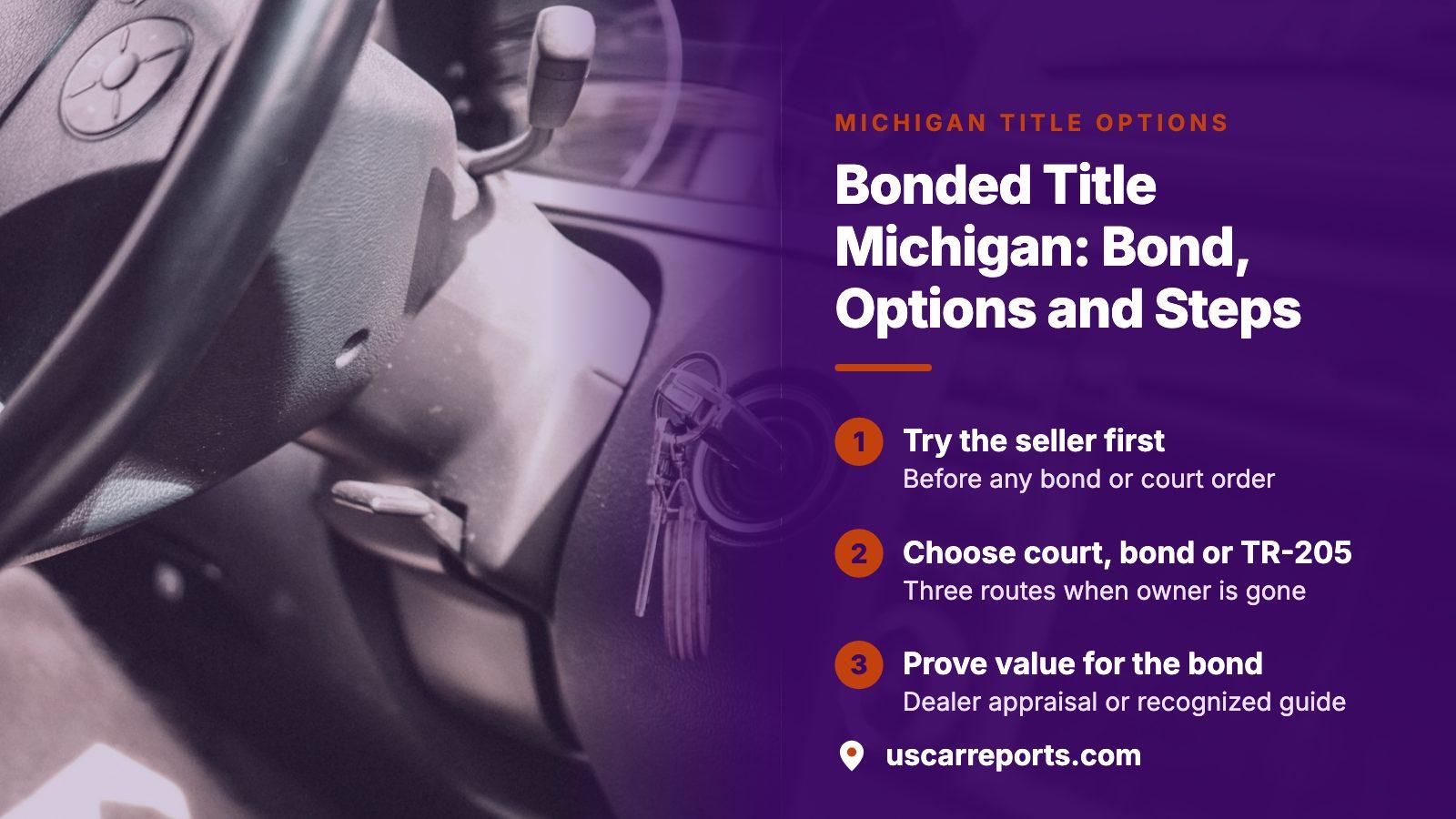
THE SHORT ANSWER
If you cannot reach the previous owner, Michigan lists three ways to get a title: a court order naming the car by year, make and VIN, a surety bond when no court order is possible, or a TR-205 self-certification for a cheap, older Michigan-titled vehicle. The bond must equal twice the car's fair market value, shown by a dealer appraisal or a recognized guide.
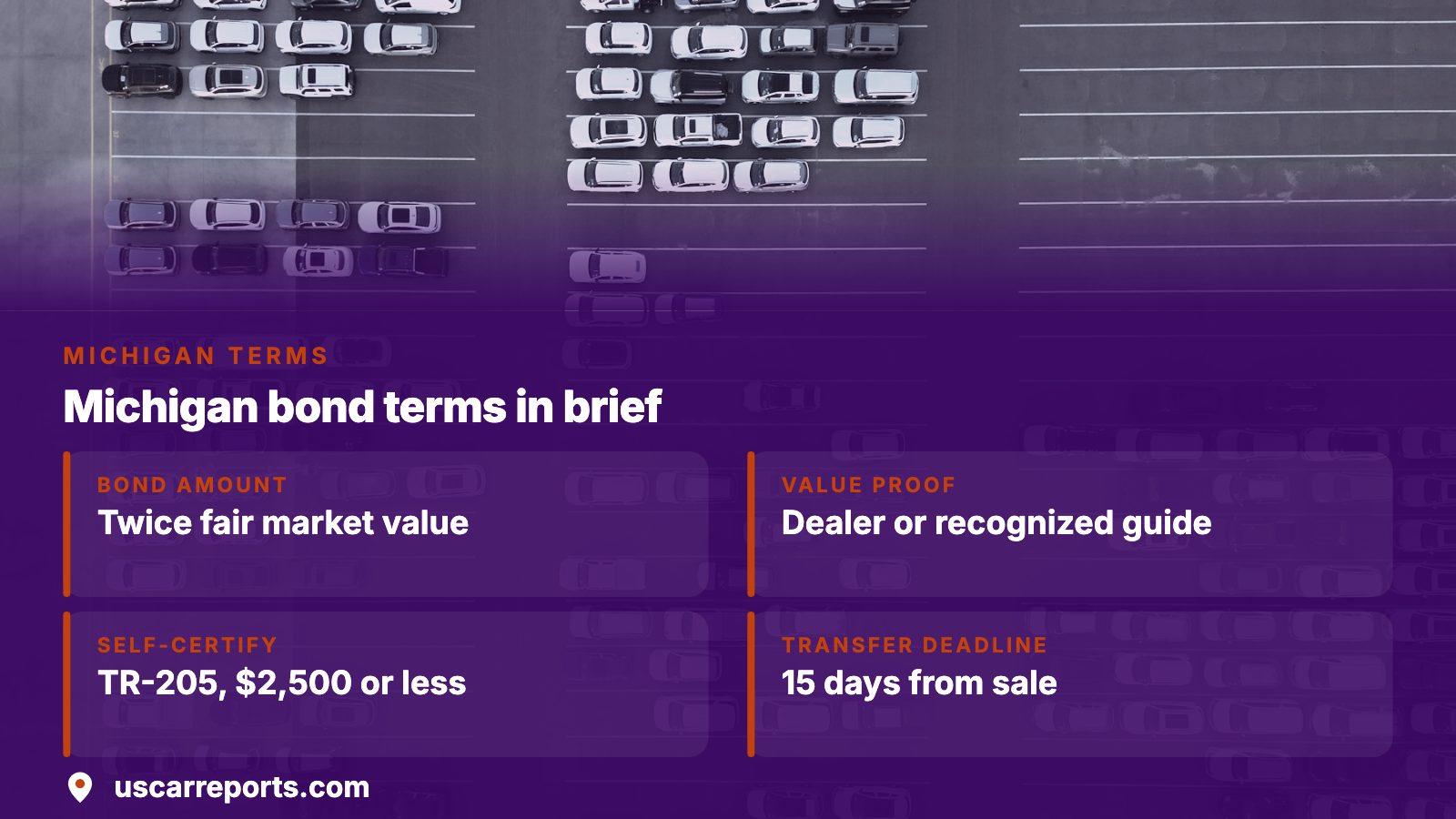
- Bond amount
- Twice the fair market value
- Value proof
- Dealer appraisal or recognized appraisal guide
- Self-certify option
- TR-205, value $2,500 or less, Michigan-titled
- Transfer deadline
- 15 days from the sale
What Michigan means by a bond for a title
Search results talk about bonded titles as if every state runs one program. In Michigan the Secretary of State's own wording is plainer. Its title FAQ addresses a buyer who lost the title before it was put in their name, and it offers a surety bond as one of the fixes.
The state compares the bond to an insurance policy that you buy from an insurance company or a bonding agency. It exists to cover anyone who later proves they owned the car. You are the one who answers for a claim, so treat the bond as a cost of doing business on a car with a gap in its paperwork, not as a shortcut.
One more point of vocabulary: Michigan pages do not promise a title with a special bonded label. Ask the branch what the finished title will say before you commit money.
Start with the seller, not the bond
The state's first instruction is simple. Try to reach the seller. A seller who still has the vehicle on record can apply for a duplicate title and sign it over to you again. A duplicate costs $15 when ordered through the seller's online Secretary of State account, and if a lienholder exists the title goes to that lender instead.
That makes a short, documented effort worthwhile: a text, a letter, a call. If the seller answers, you save the bond premium and the appraisal. If they do not, you now have a record of effort that helps with the next step.
Do this before paying anyone
Log each try at reaching the previous owner, with the date. A judge or a branch clerk may ask what you did, and a log costs nothing.
The three ways Michigan accepts when the owner cannot be reached
When the previous owner is out of reach, the state's FAQ gives you a short menu. Which one fits depends on the car and on how much time you have.
| Route | What the state asks for |
|---|---|
| Court order | An order awarding you ownership, listing the year, make and VIN |
| Surety bond | Offered when a court order is not possible; set at twice fair market value |
| TR-205 self-certification | In Michigan's records, at least a decade old, with a value no higher than the $2,500 cap |
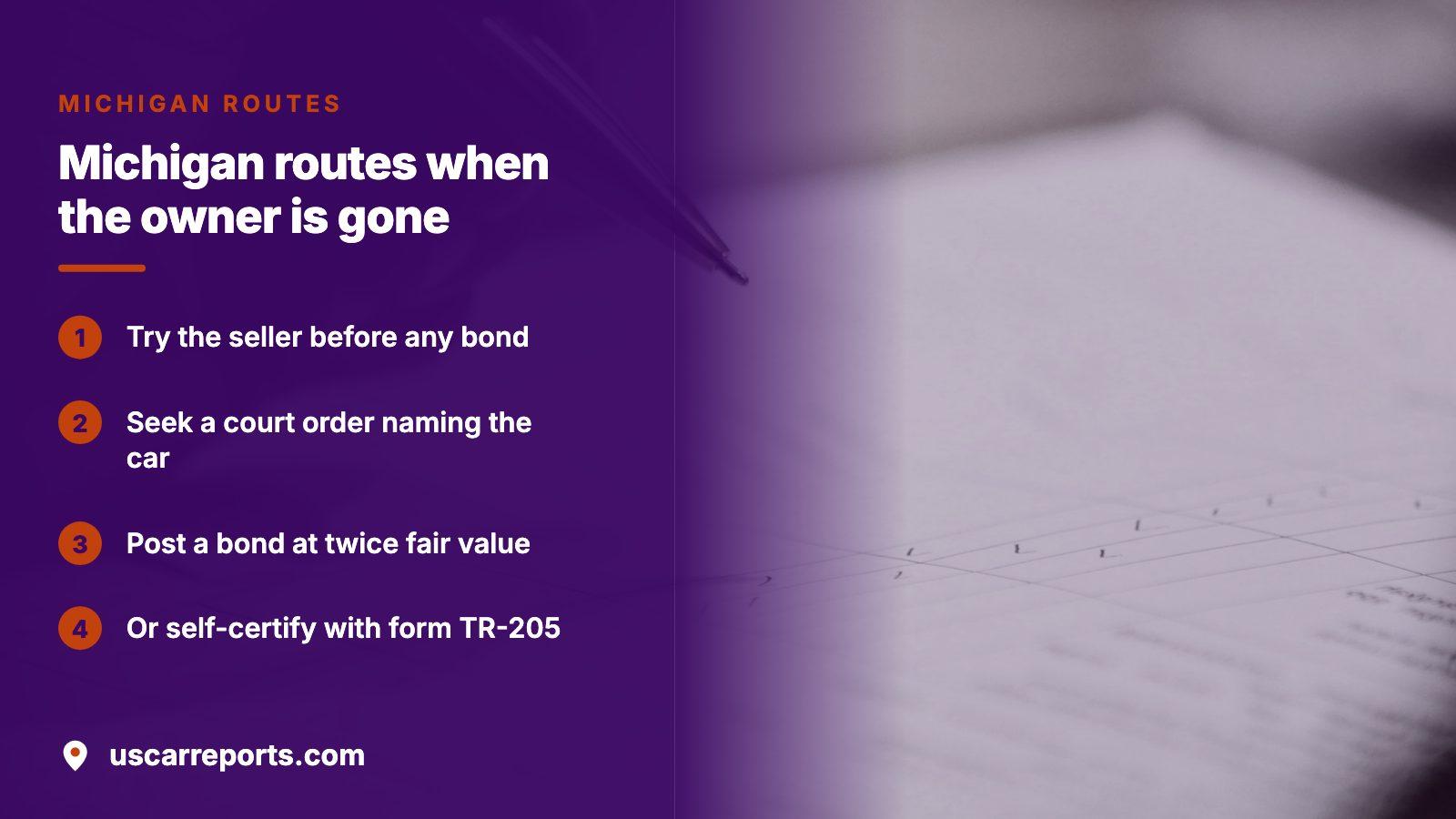
The bond is the fallback for people who cannot get a judge's order, which is why it suits cars worth more than the self-certification ceiling. A court order is the cleaner route if you have the time, since it settles the question of ownership directly rather than insuring against it.
How the bond amount is set
Michigan's rule is that the bond equals twice the car's fair market value, so a car valued at a given figure needs a bond of double that figure. The bond is the face amount of the cover, not what you pay: the cost of the premium is set by the surety company, and I could not confirm any premium figure from an official page, so ask for a written quote.
The state says the value can be established by a dealer appraisal or by a recognized vehicle appraisal guide. Use a figure you can print and hand to the clerk, and keep the VIN on the printout.
Because the amount depends on value, a car with hidden damage can look cheaper to bond than it is worth. A salvage history lowers value, and a seller who skipped the paperwork may have had reasons.
When the TR-205 self-certification is the better path
A cheap older car may skip the bond entirely. Form TR-205 lets you certify ownership yourself, but only if every condition below is met.
- The car already carries a Michigan title.
- Its age is a decade or more, and its appraised worth is at or under the $2,500 cap.
- The form is not available for another state's title or for a nonresident.
- You attach a valuation from a dealership in the state or from an online appraisal tool.
The form is available online and at every Secretary of State office. If your car is worth a bit more than the ceiling, or comes from another state, the self-certification is closed to you and the bond or a court order takes its place.
Run the VIN before you bond the car
A bond answers one question: who owns this car. It does not tell you whether the car was totaled, whether the odometer was rolled back or whether a lender still holds a lien. Those are the questions that decide whether the car is worth the paperwork.
Michigan itself tells buyers to pull a history report built on NMVTIS data, the federal system that holds title, brand and latest odometer information and that insurers and salvage yards must report to. Start with the free preview on USCarReports, then buy the full report once if the car still looks right. Look at brand history, the last odometer reading and any open lien before you hire a surety.
A lien changes the whole plan
A lender with a recorded lien on the VIN is a claim a bond does not erase. Resolve the lien, or walk away, before you apply.
Liens, signatures and the office visit
Each person who will be listed on the new title must appear at the Secretary of State branch. If someone cannot attend, an Appointment of Agent form lets another person act for them. Bring the paperwork that proves how you got to this point: the court order, the bond, or the TR-205 and appraisal.
If a loan ever existed on the car, the office wants a lien termination. The state accepts a termination statement on the title, a dated paid stamp, a separate signed statement that includes the VIN, or a letter from the lender on its letterhead that names the VIN. A finance contract stamped paid and signed by the lender also works.
To confirm who holds a lien, the state sells a record lookup for $15 per record, or $16 if certified, prepaid, online or by mail.
Deadlines and the late fee
Michigan gives you 15 days from the sale to transfer a title. After that a $15 late fee is added. When paperwork is missing the clock is awkward, since the bond or court order may take longer than that, so start the paper trail on the day you buy.
Online transfer is not an option for this situation. Online transfers cover only a single person selling to a single person, with a Michigan paper title in hand. A car whose ownership chain has a hole belongs at a branch counter.
A signed seller section on the title, collected before you hand over cash, is the cheapest protection there is.
What to do next
- Run the VIN preview and read brands, odometer and lien entries.
- Contact the seller and ask for a duplicate title.
- If that fails, check eligibility for TR-205, then a court order, then the bond.
- Get a written appraisal and a written bond quote before you pay either.
- Book a Secretary of State visit and bring every document.
Run the VIN first. A history report is a one-time purchase and the preview costs nothing, a far smaller bet than a bond on a car that turns out to have been totaled.
Where this information comes from
- Michigan Department of State: Titles FAQs — the three routes when the owner cannot be reached, the bond rule and the TR-205 conditions
- Michigan Secretary of State: transfer and registration page — lien termination options, the 15-day deadline and NMVTIS advice
- Michigan Department of State: Titles — duplicate title cost and where it is sent
- VehicleHistory.gov: NMVTIS — federal title history system run by the Department of Justice
Sources and photos: Facts checked against the sources above in November 2026. Photos by tim, Masjid MABA and Iain on Unsplash; diagrams by USCarReports.
Keep reading
- Bonded title: what it means for a buyer, state by stateHow bonded titles differ from state to state.
- Michigan Title Check by VIN: Salvage, Scrap and Seller DutiesWhat a Michigan title check shows about salvage and scrap brands.
- Michigan VIN check: salt, the Secretary of State and what a report can missRun the VIN with Michigan's buying rules in mind.
- Abandoned vehicle title: what each state issues, and to whomAnother route to a title when the owner is gone.
Frequently asked questions
Does Michigan issue a bonded title?
Michigan's Secretary of State lists a surety bond as one way to get a title when you cannot reach the previous owner and cannot get a court order. The state's pages do not describe a separate bonded title product, so ask the branch what the finished title will show.
How much is a Michigan title bond?
The bond must equal twice the car's fair market value, shown by a dealer appraisal or a recognized guide. What you pay the surety for it is a separate premium, which the state does not publish. Get a written quote from a bonding agency.
Can I skip the bond with a self-certification?
Only when the car has a Michigan title, is at least a decade old and is worth no more than $2,500. File TR-205 with an appraisal. Out-of-state titles and nonresident owners are excluded.
Should I check the VIN before applying?
Yes. A bond handles ownership claims and nothing else. A VIN report can show salvage brands, odometer readings and liens, any of which can make the car a poor buy. The preview is free, and the full report is a single payment.
Who has to go to the Secretary of State office?
Anyone whose name will appear on the title. If an owner cannot attend, an Appointment of Agent form lets someone else act for them. Bring the bond, court order or TR-205, plus any lien termination.
Now check the car itself
The guide explains what to look for. The report shows what this VIN has on record.