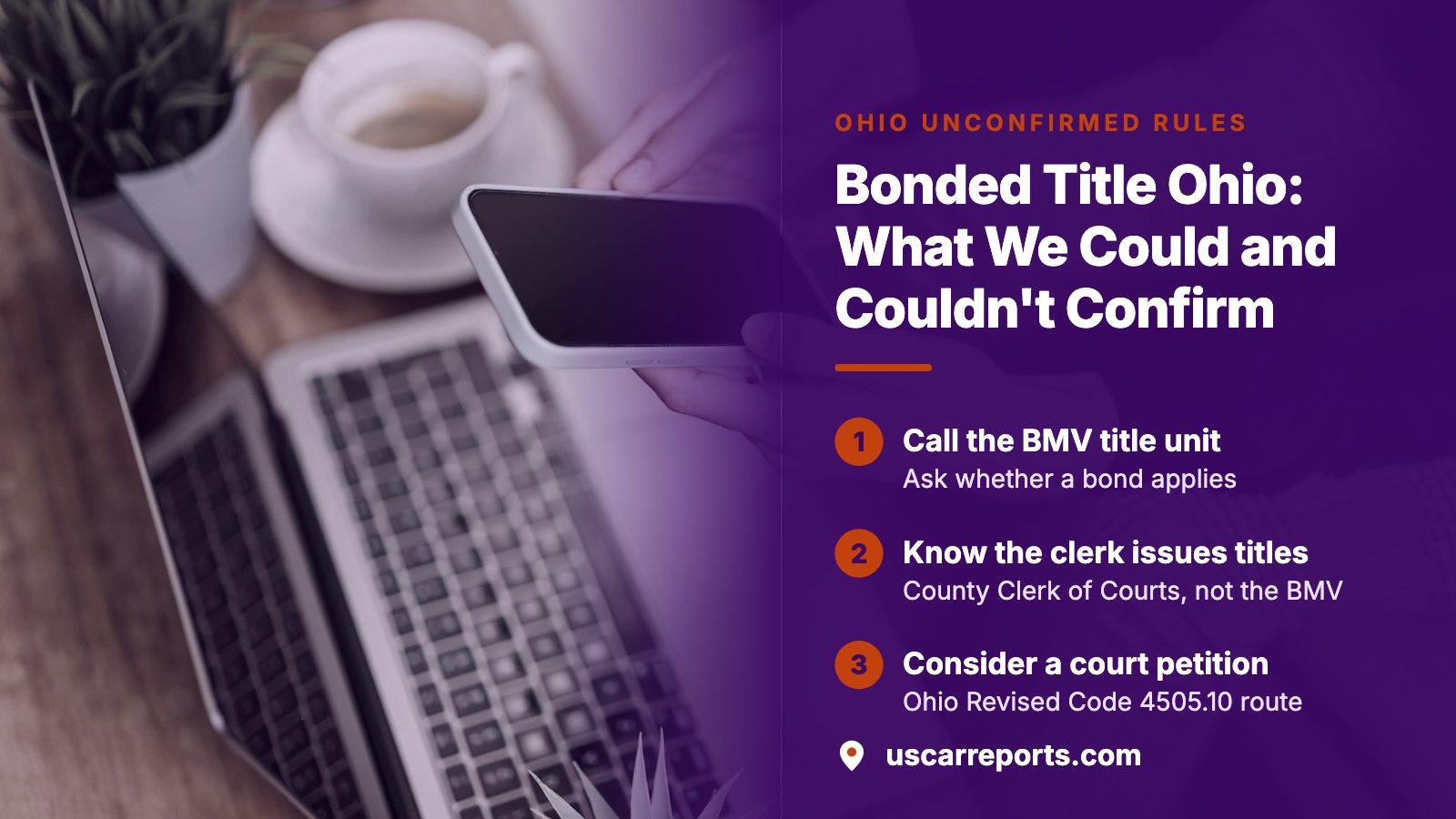
THE SHORT ANSWER
We found no Ohio bond requirement or bond form on the official pages we could open. A county clerk tells buyers without a seller's title to call the BMV title unit at 614-752-7671, and publishes a petition asking the Common Pleas Court to order a title under Ohio Revised Code 4505.10. Ask the BMV directly whether a bond applies to your car.
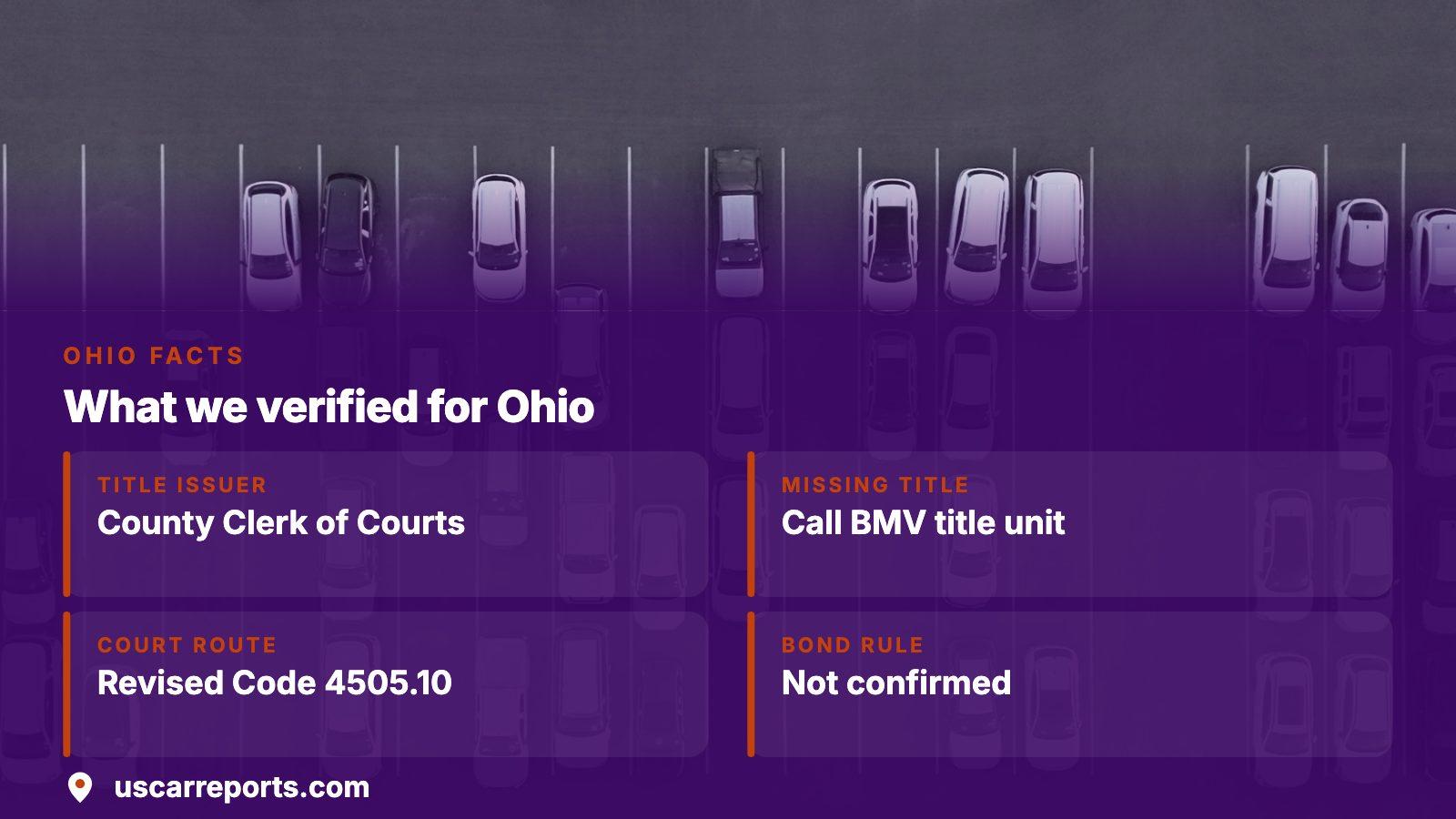
- Who issues titles
- County Clerk of Courts, not the BMV
- Missing seller title
- Call the BMV title unit, 614-752-7671
- Court route
- Petition under Ohio Revised Code 4505.10
- Bond rule confirmed
- No, BMV pages were blocked to us
Ohio bond rules: what we verified and what we did not
Our approach on every state page here is to print only what we read on an official page. For Ohio, the Bureau of Motor Vehicles website answered every request with a rejection notice, and the state's code server did not respond. That means the bond amount, the length of a bond, the form name and any value cutoff are all unknown to us. Other sites will quote a multiple of the car's value as if it were Ohio law. We would rather say we did not verify it.
What we did read was a county Clerk of Courts site, and it is useful because Ohio hands titles to its clerks. None of its pages that we opened mention a bonded title, which is itself a clue about where to start asking.
Treat any bond price you see with suspicion
If a page quotes an Ohio bond amount without naming the statute or an agency page, you cannot tell whether it describes Ohio or a different state. Confirm with the BMV before paying a surety anything.
Why the county clerk matters in an Ohio title problem
Ohio divides the counter work in two. According to a county clerk's FAQ, license plates and driver licenses belong to the Deputy Registrar, and the Clerk of Courts holds the legal duty over titles: keeping them, moving them to new owners and processing the applications. Different managers run each office, though they often sit near each other.
For a buyer, this means the person who can look at your paperwork and the person who can fix your plates are different people. Bring the vehicle documents to the title office, and take the plate questions to the registrar. It also means a title problem can start at the county where the last title was issued.
The seller never gave you a title
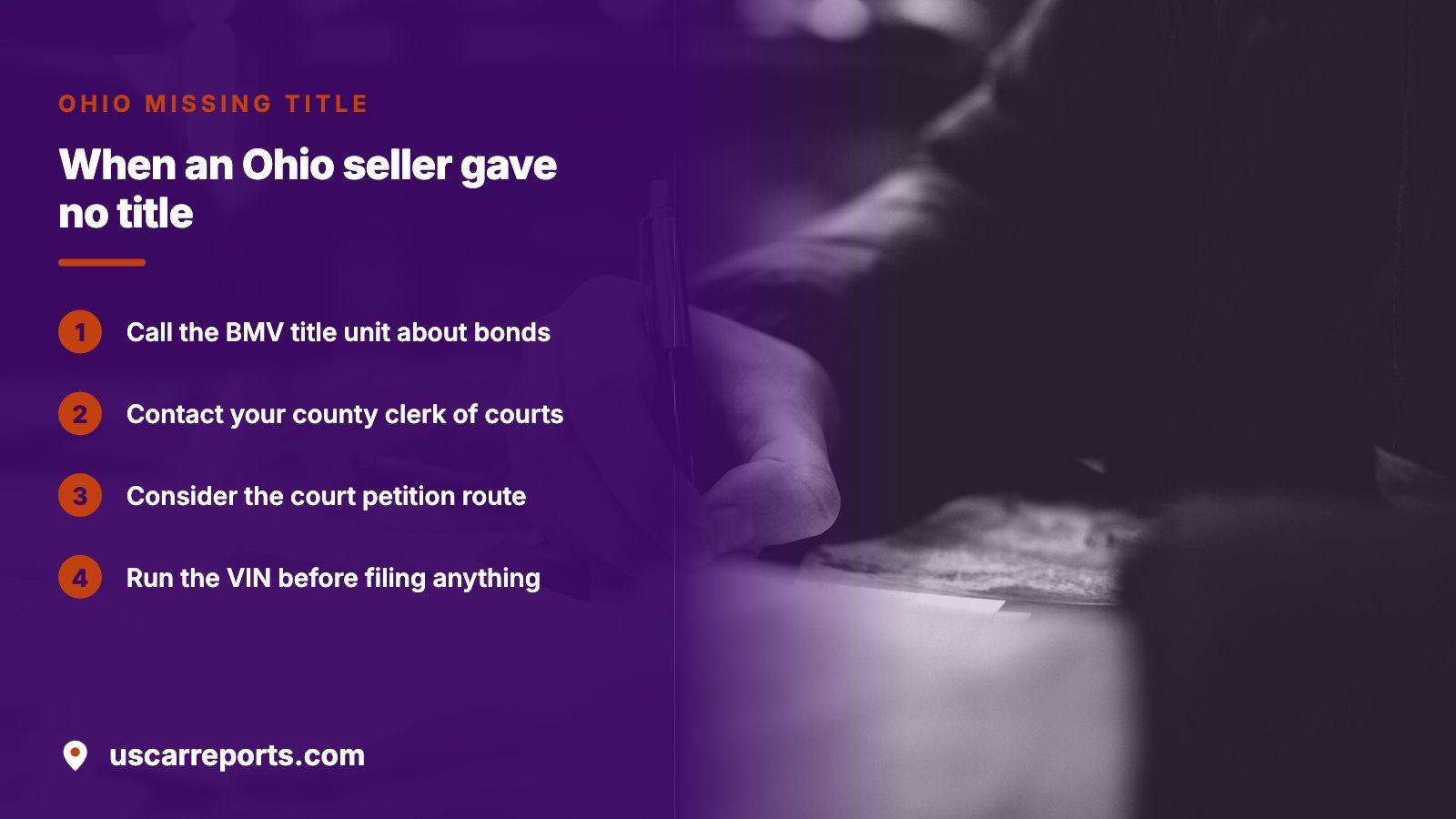
The clerk's FAQ has an entry for exactly this situation, whether you bought in Ohio or out of state. The answer is short: ring the state's title support unit at 614-752-7671. That is the first call to make, before you spend money on anything else.
Have these ready when you call, so the agent can tell you which route fits:
- The VIN, read from the car itself and matched to any paperwork you hold
- A bill of sale showing the seller's name, the date and the price
- The seller's last known address, if you have it
- Whether the car came with a lien, a loan or a lender's name attached
- Photos of the car and of its VIN plate
Do not assume a bond is the answer. Ask the unit whether one applies to your car, and write down what you are told.
The court-ordered title packet one clerk publishes
Hamilton County's clerk posts a packet headed Court Order Title. In the petition, you ask a county judge, in the court's general division, to order the clerk to put a certificate of title in your name as the rightful owner, and the form cites Ohio Revised Code 4505.10. The form asks for the year, make, model, VIN, color, when and where you got the car, and where you live.
| Piece of the packet | What it is for |
|---|---|
| Title information form | A records request that checks the title for liens, with a $5 search charge |
| Blank entry form | Drafting your affidavit, with year, make, model and VIN included |
| Petition | Asking the court to order the title in your name |
| Written request form | Used if the search says no records found; lists the seller's last known address |
Attached to the petition you would include your purchase receipt, one picture of the whole car, one of the VIN, and the completed records request. The packet mentions no surety bond. It comes from one county, and other counties may run things differently, so call your own clerk.
If the car was abandoned on your land
A different question in the same FAQ covers a vehicle left on your property. Start with local law enforcement, since each area handles it differently. If they will not remove it, the clerk says to contact the BMV, and that you may need a court order to get the car titled to you.
Notice what is absent: nothing there promises that paying a bond will substitute for a court order. If you are in this position, our abandoned vehicle title page walks through how states treat it, and the rules vary a lot from one to the next.
Run the VIN before you file anything
A court order or a bond gets a title issued. Neither tells you what happened to the car before you owned it. A car with no title trail is exactly where a hidden salvage brand, a theft record or a lien can sit unnoticed.
On the Justice Department's consumer page, a state's junk, salvage or flood designation for a car is called a brand, and a brand that has been recorded stays on file in the federal system. The same page warns that a paper title can lose its brand if the car is retitled somewhere that never checks the earlier states. Filing for a title on a car with a concealed brand could leave you owning someone else's problem.
On this site you start with a preview at no charge. Going further means paying once for a report, nothing recurring, and the pricing page spells out the packs. When it arrives, read the title brand and lien sections before anything else.
Where a VIN check has gaps
No database is complete. By the Justice Department's count, 87 percent of vehicles appear in its title system, yet only a bit over half the states send it data. A search may therefore say there is no junk or salvage history when there is one. Clones are a separate gap: stolen cars wearing a VIN lifted from a matching car, with about 250 of them recovered in one multistate investigation.
- Compare the VIN on the dash, the door and any paperwork
- Read the odometer history for jumps or drops
- Look for a lien or a theft entry
- Pay for a mechanic's inspection regardless of what the report says
Once you hold a title in your name
The clerk's FAQ lists a few routine fees worth knowing. A duplicate title is $18.00 at a county title office, with notarizing an extra $1.00. A buyer who waits past thirty days after the title is assigned pays a $5 late fee, and sales and use tax is collected when the title is issued at a rate that differs by county.
Keep a copy of every paper you signed or filed, and keep the court order or the BMV's written instructions with the car's records. When you sell, you will want to show the next buyer how the title came to be in your name.
Where this information comes from
- Hamilton County Clerk of Courts: auto title FAQ — Who handles titles, the no-seller-title answer, abandoned vehicles and the routine fees.
- Hamilton County Clerk of Courts: Court Order Title packet — The petition, its Ohio Revised Code 4505.10 basis and the documents it asks you to attach.
- Hamilton County Clerk of Courts: auto title forms — Shows the petition for a court ordered title listed among the clerk's forms.
- NMVTIS for consumers, US Department of Justice — Explains brands, brand washing, cloning and the gaps in coverage.
Sources and photos: Facts checked against the sources above in November 2026. Photos by Jakub Żerdzicki, Owen Michael Grech and Iain on Unsplash; diagrams by USCarReports.
Keep reading
- Bonded title: what it means for a buyer, state by stateHow bonded titles work across states, for comparison.
- Ohio title check: what the state search shows and what it leaves outChecking the Ohio record on a car before you buy it.
- Ohio VIN check: records to pull, title brands and Ohio buying rulesThe Ohio buying rules and what a VIN check adds.
- Abandoned vehicle title: what each state issues, and to whomTitling a car someone left behind.
Frequently asked questions
Does Ohio issue a bonded title?
We could not confirm it. The BMV's pages refused our requests, and the county clerk pages we read never mention a bond. They describe calling the BMV title unit and petitioning a court instead. Ask the BMV at 614-752-7671 whether a bond is an option for your vehicle before you pay for one.
What is the Ohio bonded title application?
We found no form by that name on any official page we could open, so we will not name one. The forms we did see were a petition for a court ordered certificate of title and a records request that checks for liens. A bond seller's own form is not an Ohio agency document.
Who do I call if I bought a car without a title?
One county clerk's FAQ points buyers to the state title support unit, 614-752-7671, for an in-state or out-of-state purchase. Tell them what you have: a bill of sale, the VIN, the seller's details and photos of the car.
Can a VIN check replace the title paperwork?
No. A VIN check shows history such as brands, liens and odometer readings, but only a title in your name proves ownership. Run the check first so you know what you are about to own, then follow the clerk or BMV on the paperwork.
What does the court ordered title packet ask me to attach?
Hamilton County's petition names four attachments: the receipt for the purchase, a picture of the car, a picture of the VIN, and the finished lien-search request. Another county may ask for more or different items, so confirm with your own clerk of courts.
Now check the car itself
The guide explains what to look for. The report shows what this VIN has on record.