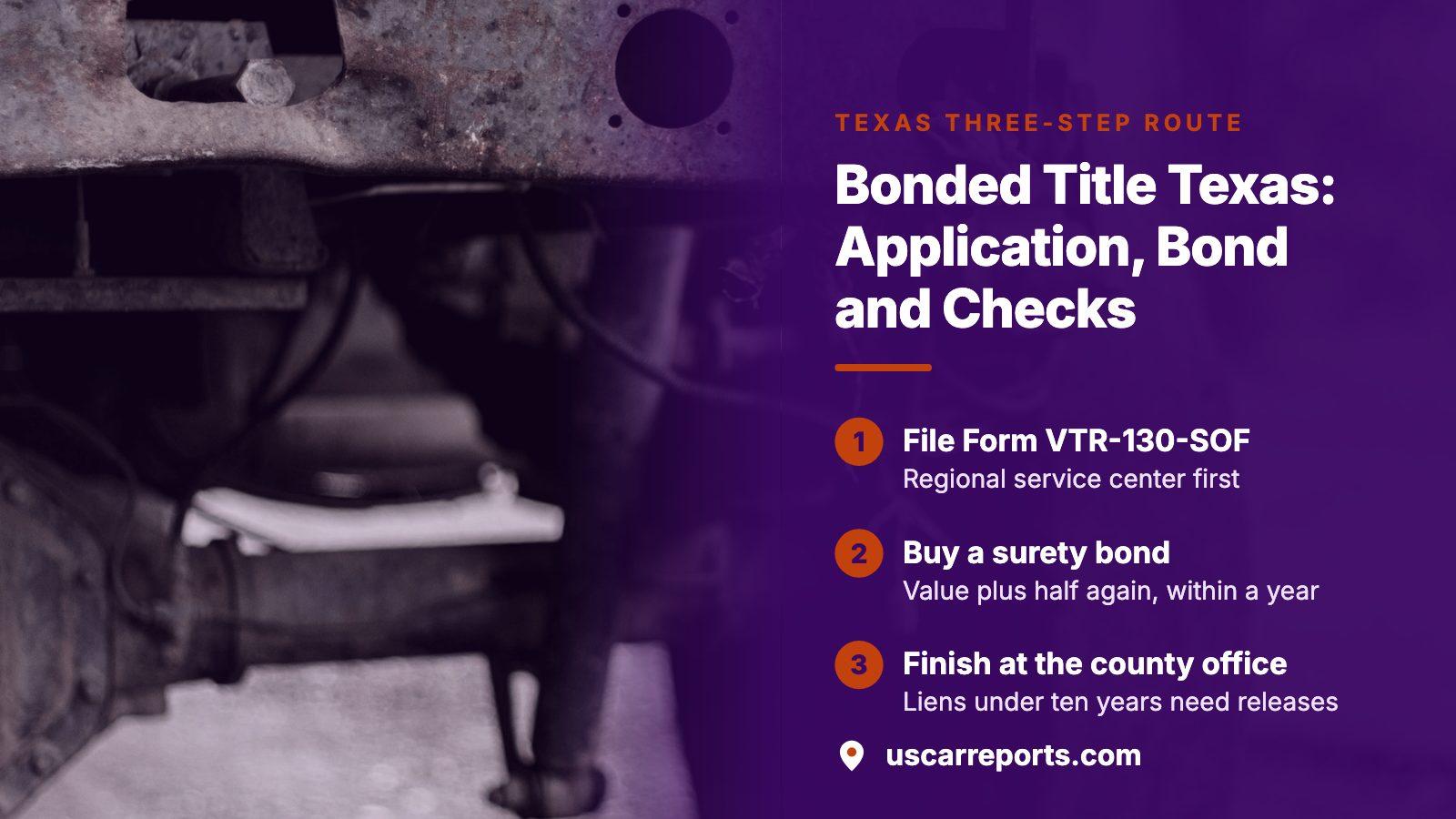
THE SHORT ANSWER
TxDMV lets a Texas resident, or military member stationed in Texas, apply for a bonded title when ownership papers are missing or wrong and the seller cannot fix them. You file Form VTR-130-SOF with a regional service center, buy a surety bond priced at the car's assessed value plus half again, then finish at your county tax office. Any lien under ten years old needs a release first.
- Bond size
- One and a half times the vehicle's value
- State fee at step one
- $15.00 administrative fee
- Lien rule
- Releases needed for liens under 10 years old
- Window to buy the bond
- One year from the notice date
Who can ask for a bonded title in Texas
TxDMV describes the procedure for a person who received incomplete or incorrect proof of ownership, or lost it, and has no way to get the seller to supply the right papers. Think of a handshake sale where the title was never signed over, or a title that names someone who has since vanished.
Two conditions come first. The applicant lives in Texas, or serves in the military and is posted here. And the car has to be physically with you. Running is optional, but the vehicle must be whole, meaning a frame, a body and an engine, while a motorcycle needs only its frame and engine.
Vehicles the state turns away
TxDMV says a car considered junked or nonrepairable, or otherwise ineligible for a title, cannot go through this route. A bond fixes missing paperwork. It does not fix a car's history.
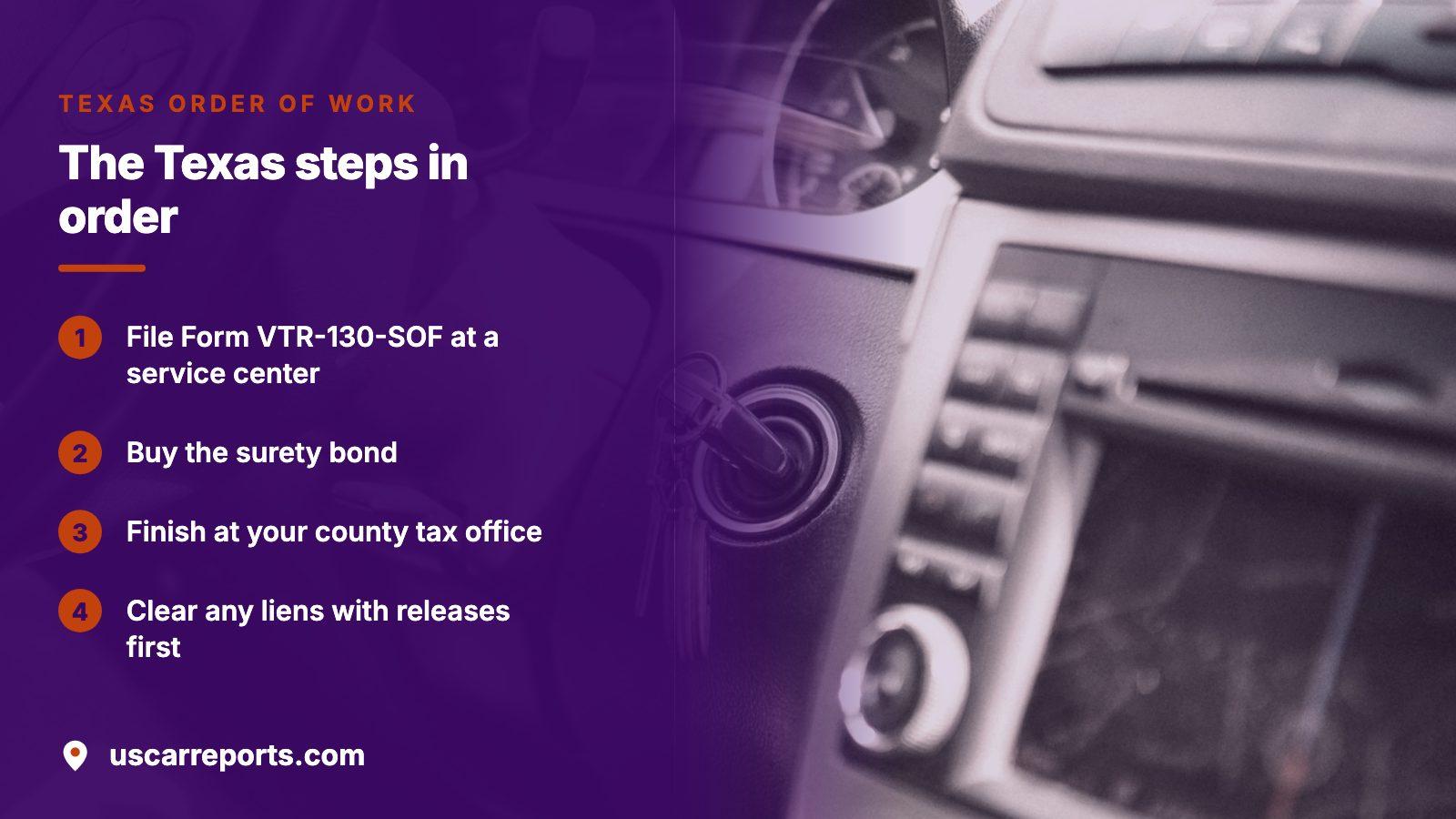
The three steps in order
TxDMV lays the process out as three stages, and the order matters because each stage has its own deadline.
- Check eligibility and file with the regional service center that covers your county, with the administrative fee and your papers.
- Take the notice the center issues to a licensed surety agency and buy the bond for the stated amount.
- Once the bond is bought, deliver the bond paperwork and title application to the county tax office inside a 30-day limit.
Appointments at the regional service centers can be booked online for the same day or the next day, which saves a wasted trip. You may also mail the first packet.
What goes in the first packet
The packet goes to the regional service center, not the county office. TxDMV accepts checks and money orders for the $15.00 administrative fee, and cash only when you file in person.
- The application itself, Form VTR-130-SOF.
- Proof of purchase, for example a receipt, a bill of sale or a cancelled check.
- If a lien under ten years old is on record, the original release or a letter of no interest.
- Acceptable photo ID.
Keep copies of everything. The more your paper trail shows who sold the car, when and for how much, the easier the file is to follow.
How the bond amount gets set
When the file is approved, the center gives you a notice, Form VTR-130-ND, whose long title also mentions a tax assessor-collector hearing. Its key line is the bond you must buy: the vehicle's value plus half of that value again.
| Order | Where the value comes from |
|---|---|
| First | Standard Presumptive Value from the TxDMV site |
| Second | The NADA reference guide, if no SPV exists |
| Third | A written appraisal from a licensed dealer or an insurance adjuster, using Form VTR-125 and filed within 30 days of its date |
Older cars get a special rule. For a vehicle 25 years old or older, the owner may choose an appraisal instead of a guide value, and any appraisal under $4,000 is raised to $4,000. For trailers, the department's own values apply: $4,000 under 20 feet and $7,000 at 20 feet or longer.
Buying the bond and finishing at the tax office
Take the notice and your papers to an insurance agent or any firm holding a Texas license to sell surety bonds. The state page names no premium, so ask what they charge for the amount on your notice. The notice stays good for one year; wait longer and you start over with a fresh notice and bond.
Once the bond is in hand, you have 30 days to reach your county tax office with the original notice, the first packet's papers and a completed Form 130-U, the Application for Texas Title and/or Registration. A commercial vehicle or truck also needs a weight certificate.
Cars with no Texas record
A car with no earlier Texas title or registration adds another hurdle: an auto theft investigator must inspect the VIN and sign Form VTR-68-A. The department itself does not do this work. Ask local police, a grantee of the state's Motor Vehicle Crime Prevention Authority, or a regional service center to find an authorized inspector.
Why this inspection matters to buyers
The investigator matches the VIN stamped on the car to the one on your documents. A mismatch there is a bigger problem than a missing signature, and it is better to learn it before you pay for a bond.
Liens can block the whole plan
A bond answers a question about who owns the car. It does not wipe out someone's claim as a lender. TxDMV says you are not eligible if records show a recorded lienholder of ten years or less and you cannot obtain a release or a letter of no interest from it.
The page points those applicants to a lawyer and a court order awarding the vehicle free and clear, and it asks that TxDMV not be named in such a lawsuit. Learning about a lien at the start costs a lookup. Learning about it after paying for a bond costs the bond.
Run the VIN check before you commit
TxDMV's own advice to used-car buyers is to run the VIN through NMVTIS, which holds title information from states across the country. It shows whether a car sat in a junk or salvage yard or was declared a total loss by an insurer. Those brands can make a car ineligible, and they cut its value whatever the bond says.
USCarReports lets you start with a free preview by VIN, then buy a single report if the car still looks worth saving. Look at the title brands, any lien or impound entry, theft records and the odometer readings. Pricing sits on the pricing page.
What a bonded title means for resale
The bond protects the state and later claimants, and the person on the hook is you. A buyer down the road will see how the title was obtained, so expect questions and keep your original paper trail: the bill of sale, notices and bond documents.
Sales tax is a separate cost. Anyone buying from a non-dealer owes 6.25 percent on the higher of price or SPV, with the exact amount calculated when you file at the county. TxDMV exempts several categories, among them vehicles 25 years or older and abandoned vehicles. When we opened the SPV calculator it displayed a not-working notice, so confirm values with the county.
Where this information comes from
- TxDMV: Bought a Vehicle Without a Title? — Eligibility, forms, fee, bond sizing and the two deadlines.
- TxDMV: Standard Presumptive Values — What SPV is and how it relates to sales tax.
- TxDMV: Title Check, Look Before You Buy — Why the agency recommends an NMVTIS check.
- TxDMV: Form VTR-130-SOF — The bonded title application form.
Sources and photos: Facts checked against the sources above in November 2026. Photos by Zoshua Colah, tim and Scott Graham on Unsplash; diagrams by USCarReports.
Keep reading
- Bonded title: what it means for a buyer, state by stateHow bonded titles compare from state to state.
- How to transfer a title in Texas: where to go, what to bring, what to check firstThe ordinary route when the seller can sign over the title.
- Texas title check by VIN: brands, the 2003 cutoff and the 30-day clockReading Texas title brands before you buy.
- Salvage title registration in Texas: what has to happen before a plateWhat happens when the car is branded instead of merely undocumented.
Frequently asked questions
How much does a bonded title cost in Texas?
TxDMV charges a $15.00 administrative fee at the first step. The bond amount is the value plus half again, but what you pay a surety for it is not published on the state's page. Ask a licensed agency for a quote against your notice, and add normal title and tax office charges.
Can I get a Texas bonded title if the car has a lien?
Only if any recorded lien is older than ten years, or the lienholder gives you a signed original release or a no-interest letter. TxDMV says you are not eligible without one for a lien of ten years or less, and suggests a court order instead.
Does the car have to run?
No. TxDMV says the car need not be operational, but it must be complete with frame, body and motor. A motorcycle needs a frame and motor. Junked or nonrepairable vehicles cannot use this process.
How long do I have to buy the bond?
One year from the date on the Notice of Determination. If that year passes, TxDMV requires a new notice and a new bond. After buying, you then have 30 days to take your papers to the county tax office.
Is a bonded title the same as a clean title?
TxDMV's page does not say. A bond is the state's tool for ownership gaps, and it says nothing about accidents, flood damage or odometer rollback. Run a VIN check for brands and history regardless of how the title was obtained.
Now check the car itself
The guide explains what to look for. The report shows what this VIN has on record.